
KAI and BRIN Strengthen Automatic Train Protection Research with Roadmap Through the Second Quarter of 2027
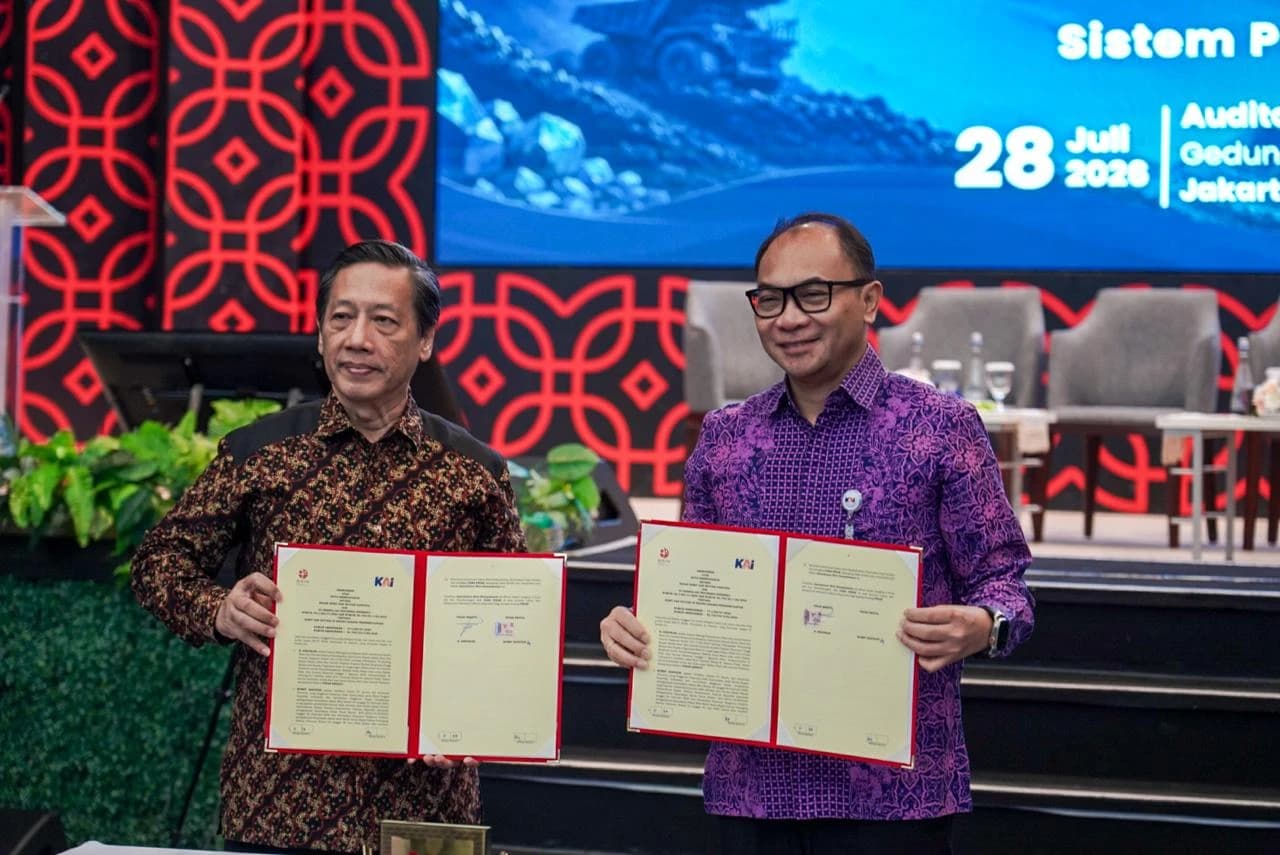
PT Kereta Api Indonesia (Persero) signed a Memorandum of Understanding (MoU) with the National Research and Innovation Agency (BRIN) during the BRIN Goes to Industry 5 event held at the Soemitro Djojohadikusumo Auditorium in Jakarta on Tuesday (July 28). The collaboration is aimed at strengthening research, exploration, and the adoption of railway technologies, including the development of an Automatic Train Protection (ATP) system.
In his opening remarks, Indonesia's Vice Minister of Energy and Mineral Resources, Ir. Yuliot Tanjung, M.M., stated that Indonesia's industrial transformation requires stronger synergy among the government, research institutions, universities, and the business sector.
According to Yuliot, strengthening research and innovation is essential to supporting industrialization, enhancing national competitiveness, accelerating downstream industrial development, and producing technologies that meet industry needs. The government also plays a vital role in building an ecosystem that supports technological advancement and the development of the national industrial structure.
As Indonesia enters the Industry 5.0 era, the utilization of digital technologies and artificial intelligence must go hand in hand with human capital development and attention to social aspects. Research and industry collaboration is expected to support economic transformation while addressing energy needs, sustainability, and the advancement of national industries.
The MoU on behalf of KAI was signed by I Gede Darmayusa, Director of Portfolio Management and Information Technology of KAI. The signing forms part of BRIN's broader collaboration with various industry players to accelerate the application of research outcomes in operational activities and technological development.
In his report, Dr. R. Hendrian, M.Sc., Deputy for Research and Innovation Utilization at BRIN, explained that BRIN Goes to Industry 5 was designed to strengthen the collaboration framework between research institutions and industry. The event featured technical discussions, business matching sessions, research showcases, and direct meetings between researchers and business representatives, involving approximately 135 industrial participants.
In his remarks, Prof. Dr. Arif Satria, S.P., M.Si., Head of BRIN, emphasized the importance of ensuring that research outcomes are effectively utilized by industry and generate economic, social, and environmental impacts.
Collaboration among researchers, the government, and industry is expected to accelerate the development of practical innovations, improve productivity, create business opportunities, and support emissions reduction and environmental management.
I Gede Darmayusa, Director of Portfolio Management and Information Technology of KAI, stated that the development of an ATP system requires structured studies, testing, and evaluation, as it must be tailored to Indonesia's railway operational environment.
"Safety remains the primary consideration in every stage of technology adoption at KAI. Our collaboration with BRIN provides the opportunity to evaluate various research-based technology alternatives, ensuring that implementation decisions are supported by strong technical, operational, and safety foundations," said I Gede.
ATP is a train protection system with three primary functions: preventing trains from passing signals at danger (Signal Passed at Danger/SPAD), monitoring train speed, and delivering operational information to train drivers.
The system requires integration between trackside infrastructure equipment and onboard equipment installed on locomotives or self-propelled trainsets.
The development of this technology refers to Minister of Transportation Regulation No. 52 of 2014, which mandates the implementation of Automatic Train Control Systems. Under the regulation, the infrastructure manager determines the system installed along the railway network, while rolling stock operators are responsible for equipping trains with onboard systems compatible with the selected technology.
KAI and BRIN will adopt a Proof of Product approach as the validation stage before determining the ATP technology to be implemented. This approach is intended to validate the technology's functionality, integration, and performance under conditions that represent KAI's operational environment, while identifying gaps, mapping risks, and defining the necessary adjustments and mitigation measures.
Such validation is essential due to the complexity of KAI's operational environment, which includes diverse train traffic, varying rolling stock characteristics, different operational patterns, complex infrastructure, interoperability requirements, and the use of technologies from multiple suppliers.
The process will also take into account data readiness, regulatory frameworks, human resources, and maintenance systems.
"Proof of Product enables technology to be evaluated under relevant operational conditions. It allows KAI to understand from the outset the technology's functionality, interfaces, integration requirements, potential risks, and maintenance capabilities before it is implemented on a broader scale," I Gede explained.
The ATP development roadmap has been structured into three phases. The first phase will commence in the third quarter of 2026 with the establishment of an ATP Working Group involving KAI and the Directorate General of Railways. Alongside the working group, KAI will collaborate with BRIN to conduct studies on local operational conditions for ATP, including standardization, weather conditions, lightning protection, and long-term maintenance sustainability.
The team will develop the ATP adoption concept, define functional requirements, prepare the implementation roadmap, establish the consultant framework, assess the diversity of rolling stock and infrastructure, conduct gap analyses, and formulate technology recommendations.
The second phase is scheduled for the fourth quarter of 2026 and will focus on Proof of Product planning, the development of design criteria, technical, operational, and safety requirements, as well as market sounding with technology providers.
The third phase will begin in the fourth quarter of 2026 and continue no later than the second quarter of 2027. This phase will include ATP technology validation through field testing, assessment and evaluation, and safety assessments covering both operational aspects and ATP products for rolling stock and infrastructure.
The studies will cover ATP technologies based on onboard equipment, trackside balises or transponders, and integration with signaling systems.
KAI is also exploring satellite-based and wireless communication technologies, which still require further regulatory assessment and the readiness of dedicated railway communication networks to support safety-critical functions.
The scope of the collaboration also includes research and technology exploration, studies on ATP integration readiness for rolling stock, preparation of technical documentation, renewal of the KAI–BRIN cooperation framework, and the formulation of implementation recommendations in collaboration with regulators, research institutions, consultants, rolling stock manufacturers, and technology providers.
"For KAI, the success of this collaboration will be measured by our ability to generate well-founded technology decisions through research, ensure integration with Indonesia's national railway system, meet safety requirements, and establish sustainable long-term management," said I Gede.
"Ultimately, our goal is to build a more independent, adaptive, and innovative railway ecosystem in Indonesia that supports the long-term safety and reliability of railway operations," I Gede concluded.
VP Corporate Communication KAI