
KAI Prepares to Develop Affordable Housing in Central Jakarta; Manggarai to Kickstart TOD Development
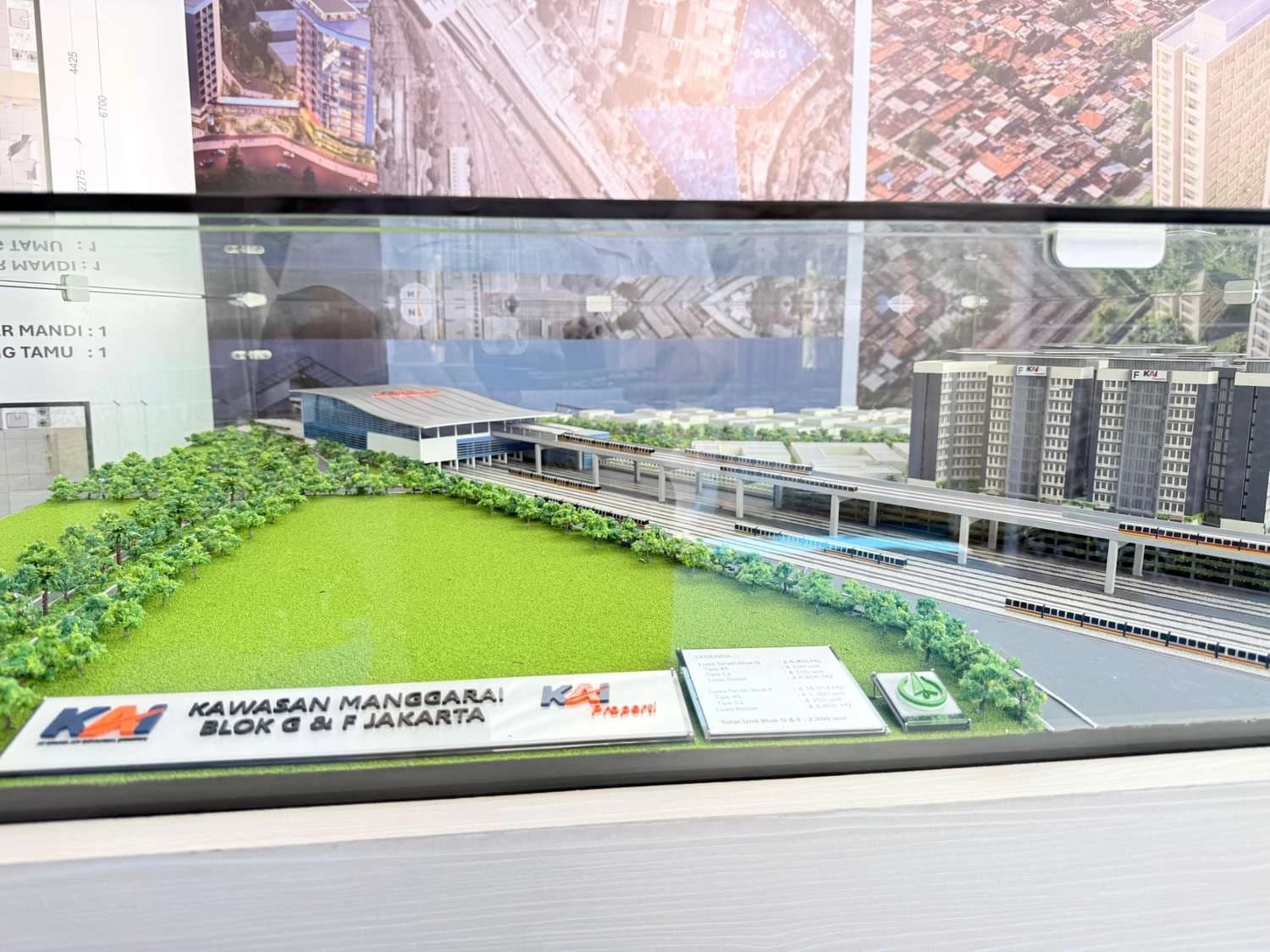
PT Kereta Api Indonesia (Persero) is preparing to develop affordable housing in central Jakarta through the development of the Manggarai Transit-Oriented Development (TOD) area. The initial phase will focus on Blocks F and G, covering a total area of approximately 2.19 hectares, which is planned to include 3,740 housing units and 150 retail units. Of this total, 1,232 units are designed for the Low-Income Community (MBR) and Middle-Income Community (MBM) segments.
The groundbreaking for the initial phase of the development is scheduled to take place on August 21, 2026, with Chairman of the Housing Task Force Hashim Djojohadikusumo scheduled to attend. The development of Manggarai is aimed at bringing housing closer to public transportation, workplaces, and various urban activities that are part of the daily lives of people in Jakarta and the surrounding agglomeration area.
KAI President Director Bobby Rasyidin said that the development of Manggarai is part of KAI’s efforts to expand the role of public transportation in shaping urban areas. According to him, cities with high mobility require planning that can bring people closer to housing, workplaces, public services, and transportation networks.
“A city will function better when people can live closer to public transportation and activity centers. Manggarai provides KAI with the opportunity to develop an area using that approach. We want people’s journeys to become more efficient, mobility costs to become more affordable, and access to the city to become more open,” Bobby said.
Manggarai has a strong mobility base to support the development. Manggarai Station currently serves around 162 thousand customer movements every day, with approximately 700–750 train services operating daily. KAI data shows that the number of Commuter Line customers entering through the gates at Manggarai Station reached 5,142,739 customers in 2023, increasing to 5,575,711 customers in 2024, and reaching 5,456,309 customers in 2025. From January to June 2026, the number had reached 2,716,932 customers. This mobility capacity serves as one of the foundations for the development of a more integrated area.
Bobby added that the development of Manggarai is also part of KAI’s efforts to build increasingly competitive TOD development capabilities. Various cities around the world have demonstrated how areas surrounding stations can develop into productive living spaces when transportation, housing, public spaces, economic activities, and pedestrian connectivity are designed as an integrated whole.
“KAI aims to build TOD development capabilities to increasingly higher standards. We learn from the best practices of various cities around the world, but the needs of Indonesian society remain our starting point. The success of Manggarai will ultimately be measured by how comfortable the area is for living, working, transferring between modes of transportation, and carrying out daily activities,” Bobby said.
KAI Vice President of Corporate Communication Anne Purba explained on the same occasion that Block G covers an area of approximately 6,925 square meters, while Block F covers approximately 15,014 square meters. The two areas are planned to accommodate the development of 308 MBR housing units, 924 MBM housing units, and 2,508 commercial housing units, as well as 150 retail units. The housing units are designed in several types, ranging from 28-square-meter studios and Type 36 units with two bedrooms to Type 45 units with two bedrooms and a larger family room.
“The housing composition in Blocks F and G is designed to allow different groups of society to live within one area that is close to public transportation. A total of 1,232 units are allocated to the MBR and MBM segments. This is an important part of the Manggarai plan as an area where housing, transportation, public spaces, and economic activities are interconnected,” Anne said.
Overall, the Manggarai TOD development plan covers an area of approximately 129 hectares, of which around 64 hectares are KAI-owned land. The development will be carried out in stages and will include improved pedestrian connectivity, an elevated pedestrian deck, transportation integration facilities, public spaces, green areas, vertical housing, and commercial functions. KAI is also preparing to connect the area with the KRL Commuter Line, Airport Commuter Line, TransJakarta, Manggarai Terminal, and the planned Jakarta LRT.
Anne added that KAI is currently coordinating the preparation of the Master Plan and Urban Design Guidelines (PRK) as part of the development process for the Manggarai Transit-Oriented Development Area. These stages include the preparation of planning documents, submission to the Jakarta Provincial Government, and the designation process in accordance with applicable spatial planning regulations.
“Blocks F and G serve as the starting point because of their proximity to Manggarai Station and their location on KAI-owned land. Once the initial phase is underway, the development of the area will continue gradually. The direction is to make Manggarai increasingly accessible, comfortable for pedestrians, well-connected between transportation modes, and equipped with housing options that are close to people’s daily journeys,” Anne concluded.
VP Corporate Communication KAI