
World Energy Day, KAI Promotes Energy Efficiency through Solar Power Plants and Digitalization
Energy savings in railway companies are achieved through various operational decisions. Solar panels help provide electricity for company assets, digital technology reduces the need for paper, while water refill facilities provide an alternative for customers to reduce the use of single-use plastic bottles. These measures demonstrate how efficiency can be implemented from the workplace to customers’ travel experiences.
Commemorating World Energy Day on October 22, PT Kereta Api Indonesia (Persero) (KAI) is developing energy and resource management through the use of renewable energy, improved operational efficiency, and the provision of facilities that support more environmentally friendly habits.
Based on KAI’s 2025 Sustainability Report, the company’s energy consumption decreased from 11,945,467 gigajoules (GJ) in 2024 to 10,107,302 GJ in 2025. Energy use decreased by 1,838,165 GJ, or 15.39 percent. During the same period, energy intensity per customer decreased by approximately 22.05%, from 0.0263 GJ to 0.0205 GJ per customer.
KAI Vice President of Corporate Communication Anne Purba said that energy management needs to go hand in hand with service development. Consumption monitoring, the use of technology, and the development of alternative energy sources are part of the company’s efforts to use resources more efficiently.
“Efficiency needs to be translated into measurable operational decisions. We see opportunities for energy management in company facilities, the use of technology, and the ways customers access services. Each initiative has different benefits, but all of them need to be directed toward increasingly responsible resource use,” said Anne.
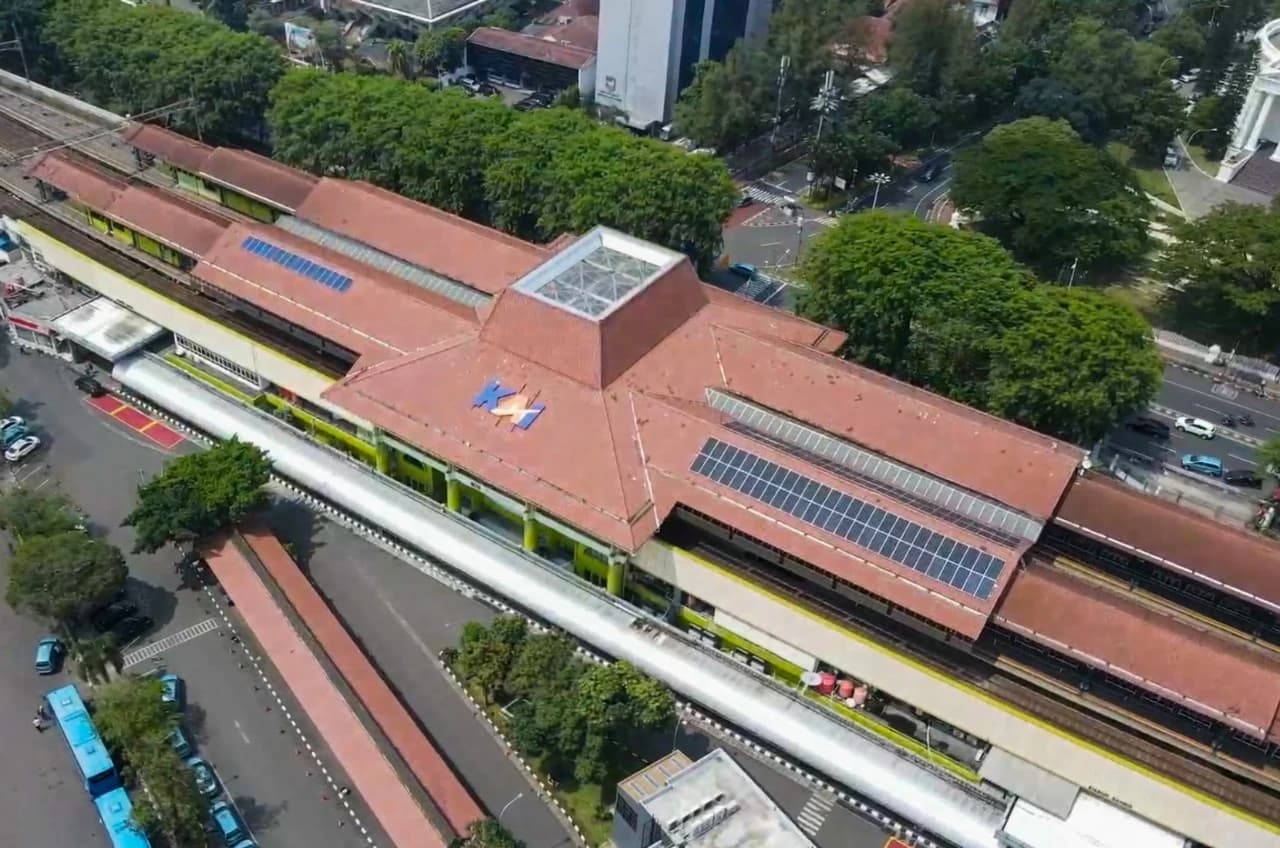
One of these efforts is the operation of 113 Solar Power Plant (PLTS) units at 92 locations, with a total installed capacity of 4,430.65 kilowatt-peak (kWp), equivalent to approximately 4.43 megawatt-peak (MWp). These facilities are spread across stations, railway workshops, offices, operational facilities, depots, and record centers to support electricity needs within KAI’s operational environment.
Efficiency is also achieved through service digitalization. During the first half of 2026, a total of 5,555,034 Long-Distance Train customers used the Face Recognition Boarding Gate facility. The use of this technology is estimated to reduce the consumption of 13,888 rolls of boarding pass paper, with cost savings of approximately Rp203.80 million. Reducing paper use is a direct benefit of digitalization, although its energy-saving impact needs to be calculated separately.
In customer service areas, KAI had provided 124 Water Station units at 58 stations, covering 70 service areas, as of June 2026. These free drinking water refill facilities allow customers to use tumblers or reusable bottles. Based on a conservative estimate, if 10% of Long-Distance and Local Train customers during the first half of 2026 refilled their bottles once, the potential reduction in single-use plastic bottle consumption would reach approximately 2.99 million bottles. This figure represents an estimated potential, not actual usage.
Anne explained that energy and resource management requires clear indicators so that the results of each program can be evaluated according to its benefits. Reduced energy consumption, solar energy capacity, reduced paper use, and the potential reduction in plastic use are different indicators that complement one another in assessing the company’s sustainability efforts.
“Changes toward more efficient operations take place through consistent steps. We continue to evaluate the use of energy and resources while also encouraging customers to participate through simple habits, such as using digital facilities and bringing reusable drinking bottles,” Anne concluded.
VP Corporate Communication KAI