
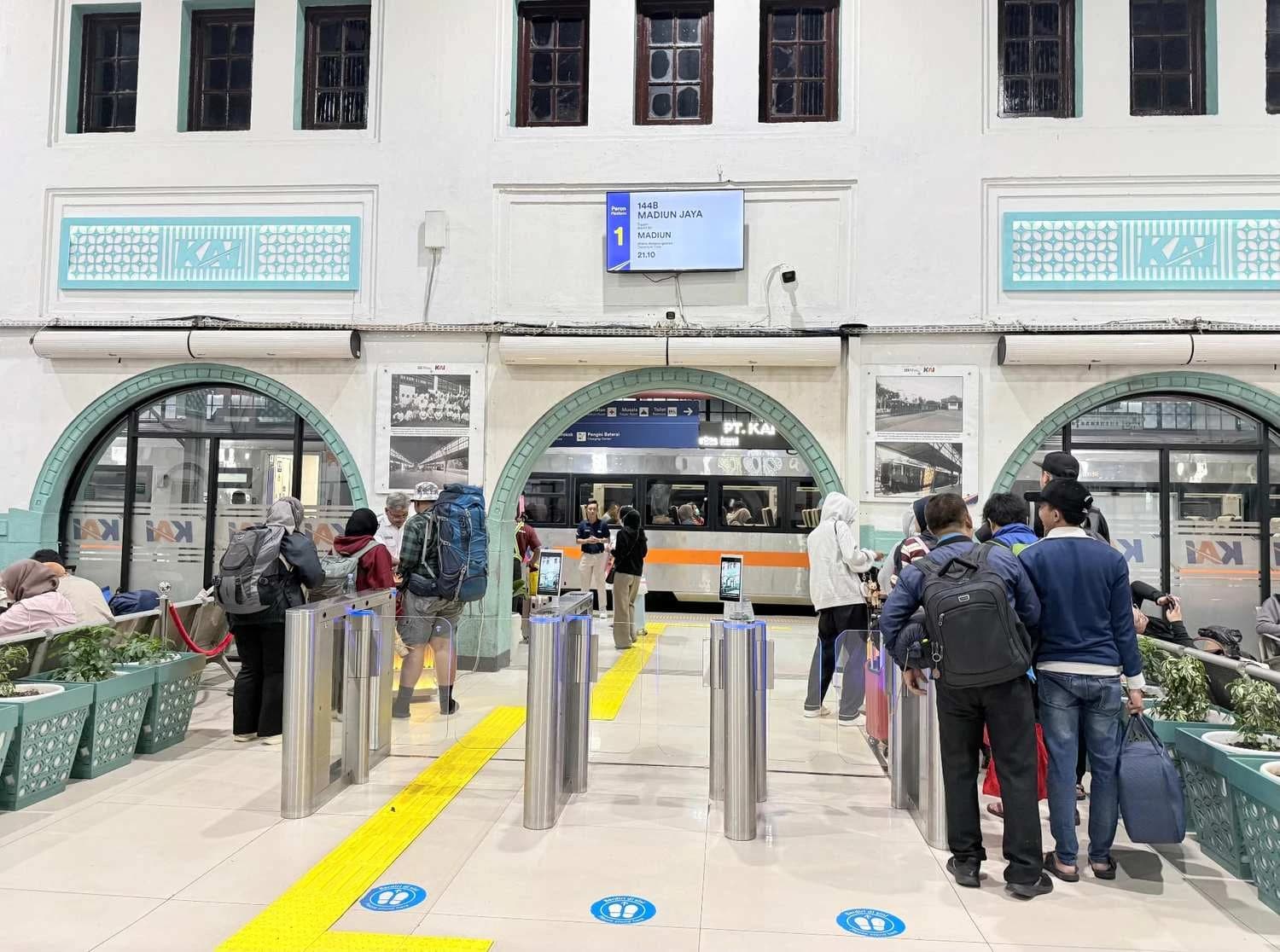
Gambir to Be Further Integrated, KAI Enhances Connectivity for Long-Distance Trains, Commuter Rail, and the Monas Area
PT Kereta Api Indonesia (Persero) is preparing the development of Gambir Station with a stronger focus on connectivity to meet customer needs and support urban life. Following the previously announced vision of transforming Gambir into a hospitality and leisure hub, the next phase of development will emphasize integration, making Gambir easier to access, more comfortable to use, and better connected to various modes of transportation in central Jakarta.
Gambir has long been recognized as the gateway for Long-Distance Train (KA Jarak Jauh) travel from central Jakarta. The station is also located close to the city's main activities, surrounded by the National Monument (Monas), government offices, business districts, hotels, public spaces, and connecting transportation networks. Therefore, the development of Gambir is considered important to create a more seamless customer journey, from arriving at the station, waiting for departure, transferring between transport modes, to continuing activities in the city center.
Vice President Corporate Communication KAI Anne Purba said that stations located in city centers now play an increasingly broader role. Stations have evolved into spaces where travel, public services, economic activities, culinary experiences, retail, culture, and urban life come together. The development of Gambir is based on this vision while maintaining its primary function as a Long-Distance Train station.
"We are preparing Gambir as a more complete travel hub. Customers come to board a train, but at the same time they also need easy access, clear passenger flows, comfortable waiting areas, food and beverage options, travel services, and connectivity to surrounding destinations. The development of Gambir is designed to bring all of these needs together into a better travel experience," said Anne.
Currently, Gambir Station serves 34 regular Long-Distance Train services daily, with approximately 78 train stops for passenger boarding and alighting. Meanwhile, the elevated railway line at Gambir is traversed by 326 Bogor Line Commuter Line services every day on the Jakarta Kota–Bogor and Jakarta Kota–Nambo round-trip routes.
Anne explained that, at this stage, Commuter Line trains passing through Gambir do not yet accommodate passenger boarding and alighting at the station. Therefore, discussions regarding Commuter Line integration at Gambir are being carried out gradually, requiring infrastructure readiness, operational arrangements, safety considerations, line capacity, and coordination with the regulator.
"Today, Gambir serves Long-Distance Trains and is traversed by the Commuter Line. What we are preparing is how this integration can operate better once all technical aspects are fully ready. The principle is to provide easier access for customers while maintaining safety and operational reliability as the top priorities," Anne said.
The need for integration has become increasingly relevant given the growth in Commuter Line passenger movements across Greater Jakarta. Commuter Line passenger volume increased from 217,964,892 trips in 2022 to 344,621,825 trips in 2025, representing an increase of 126,656,933 trips, or 58.11%, within three years.
Bogor Line remains the busiest Commuter Line route. It served 102,054,022 passengers in 2022, increasing to 133,040,885 passengers in 2023, 145,920,264 passengers in 2024, and 155,009,997 passengers in 2025. During January–June 2026, Bogor Line served 78,077,679 passengers.
According to Anne, these figures demonstrate that travel from Bogor, Depok, Cibinong, Nambo, and surrounding areas to Jakarta has become an essential part of daily mobility. Once Gambir is technically ready to accommodate Commuter Line passengers, the public will have easier access to Monas, government offices, hotels, public spaces, activity centers, and Long-Distance Train services.
"For Bogor Line passengers, Gambir will provide easier access to central Jakarta. For Long-Distance Train passengers, this integration will offer wider onward travel options after arriving at Gambir. From there, journeys will become shorter, easier to navigate, and closer to passengers' final destinations," Anne said.
The development of Gambir is also progressing alongside the enhancement of Manggarai Station. Both stations play different but complementary roles within the Greater Jakarta railway ecosystem. Manggarai remains the central station and the primary interchange hub, while Gambir is being strengthened as the main gateway for Long-Distance Trains in the city center, an access point to the Monas area, a customer service hub, and a potential future integration point for the Commuter Line.
"Manggarai and Gambir complement each other. Manggarai manages large-scale transfers between railway lines, while Gambir strengthens access to the city center, Long-Distance Train services, the Monas area, and the overall customer experience. This division of roles will create a more organized public transportation system across Greater Jakarta," Anne said.
According to the Gambir Station Business Optimization and Visioning Study, Gambir is envisioned as a Modern Station & Lifestyle Hub built upon three pillars: mobility, culture, and lifestyle. The concept places mobility at the core of the development while integrating cultural spaces, customer services, commercial facilities, and public areas connected with the Medan Merdeka district.
This vision positions Gambir as an urban space that connects various activities. Customers will be able to transfer between transport modes, enjoy culinary offerings, meet travel needs, access services, wait comfortably, and connect easily with the Monas area and other activity centers in Jakarta.
The study also includes plans for future connectivity with TransJakarta, the MRT, pedestrian areas, Monas public spaces, retail outlets, restaurants, lounges, hotels, rooftop parks, meeting facilities, and additional public spaces. The design concept also includes Commuter Line platforms, a commuter concourse, a lower-ground intermodal hub, and improved arrival and departure flows for Long-Distance Train passengers.
Anne said the development of Gambir is intended to improve the overall customer journey within the station. Pedestrian circulation will become more open, departure and arrival areas easier to navigate, vehicles will be directed to the lower-ground area, and the ground floor will become a more pedestrian-friendly public space.
"Integration is achieved when customers no longer have to wonder where to go, can easily find connecting transportation, enjoy comfortable waiting areas, and remain close to the services they need. Therefore, Gambir is being prepared as a station that is more organized, more people-oriented, and better suited to the rhythm of the city center," Anne said.
Today, Gambir's commercial ecosystem is already well established. According to the 2026 Gambir Station tenant data, there are 132 leased commercial areas, consisting of 67 indoor spaces and 65 open spaces. The tenants include restaurants, coffee shops, convenience stores, retail outlets, souvenir shops, bookstores, lounges, lockers, transit hotels, sleeping pods, ATMs, vending machines, parking facilities, outdoor media, and various travel support services.
The presence of these tenants reflects Gambir's role as an activity hub for customers before and after their journeys. As intermodal connectivity, pedestrian pathways, waiting areas, and commercial functions continue to improve, the benefits will be felt not only by passengers but also by business owners, workers, suppliers, cleaning services, security personnel, parking operators, tenant logistics providers, and supporting businesses in the surrounding area.
Based on the development study, the new retail facilities will provide approximately 15,479 square meters of leasable commercial space, while hotels and meeting facilities will occupy around 3,756 square meters. If the development proceeds according to the plan, the new retail area could accommodate approximately 220–310 small and medium-sized enterprises, with an estimated unit size of 50–70 square meters per tenant.
Assuming each business employs two to three workers, the development could generate approximately 440–930 direct jobs. Beyond tenant employment, the hospitality and leisure area will also require supporting personnel, including cleaning staff, security officers, building technicians, parking operators, customer service staff, park and rooftop management teams, loading crews, logistics personnel, and waste management workers. As a result, once fully operational, the Gambir development has the potential to create approximately 500–1,000 direct and supporting employment opportunities, depending on the final design, tenant composition, construction phases, and operational model.
Anne added that Gambir is being prepared as a station capable of responding to changing travel patterns. While it will continue serving as a major gateway for Long-Distance Trains, its location along the Commuter Line corridor and close to Jakarta's main activity centers makes future integration an important priority.
"KAI wants Gambir to become a station that is easier to access, more comfortable to use, and closer to customers' needs. Through gradual development, Gambir is being prepared to connect intercity travel, daily mobility, connecting transportation, culinary experiences, retail, culture, and activities in central Jakarta within a more integrated environment," Anne concluded.
VP Corporate Communication KAI