
KAI President Director: Gambir to Be Gradually Prepared, Strengthening Access for Long-Distance Trains, Commuter Rail, and the Monas Area
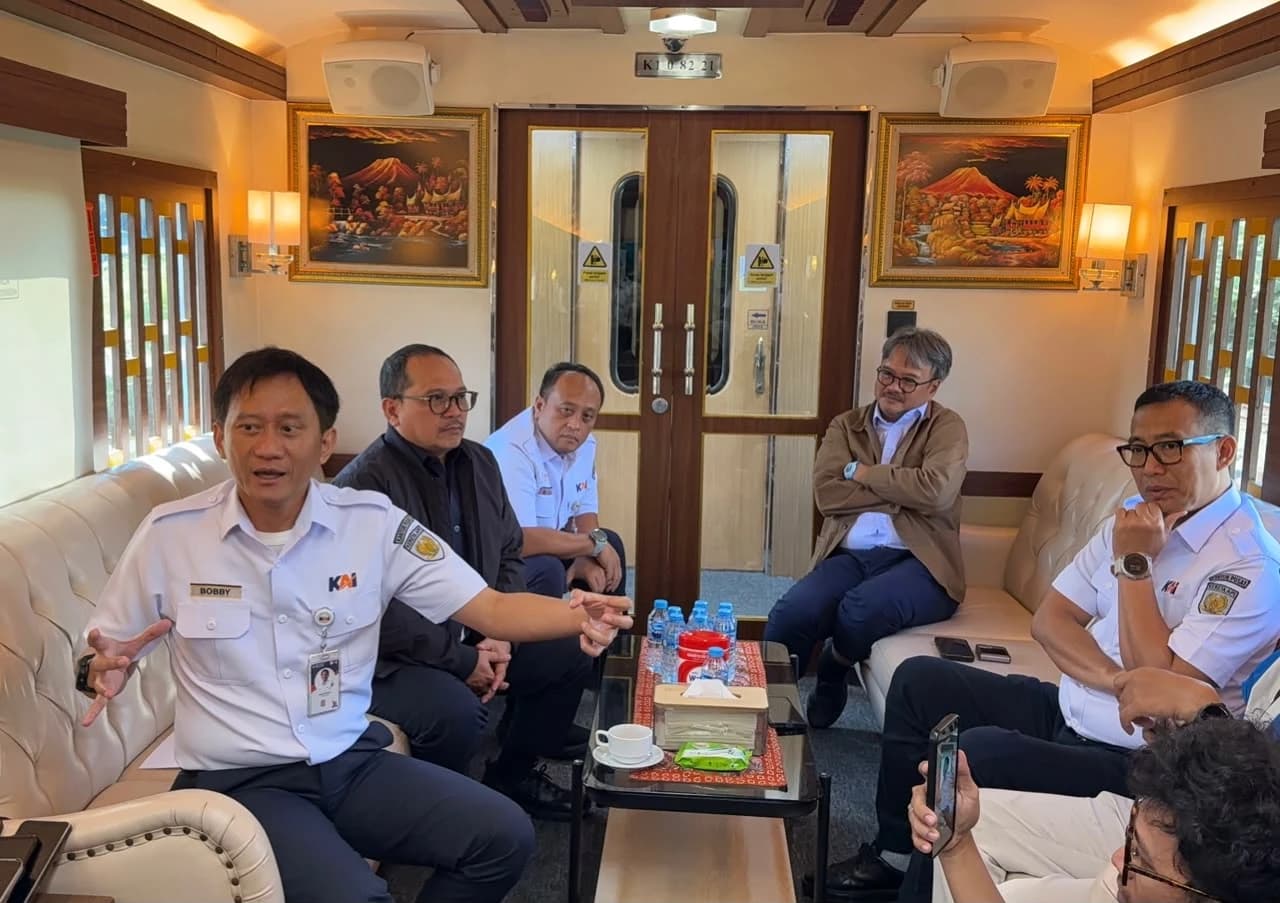
PT Kereta Api Indonesia (Persero) emphasized that the development of Gambir Station is being prepared in stages as part of the structuring of public transportation services in central Jakarta. This was conveyed by KAI President Director Bobby Rasyidin along with the Board of Directors, including KAI Director of Finance and General Affairs Indarto Pamoengkas, during a special train journey from Yogyakarta to Gambir on Wednesday (8/7/2026).
Bobby explained that there is a perception that needs to be clarified regarding the development of Gambir. According to him, Gambir is not being positioned in competition with Manggarai. Both have different functions within a single Jabodetabek public transportation system.
“There has been a perception that needs to be clarified regarding Gambir. We are not placing Gambir in opposition to Manggarai. Manggarai remains the main interchange hub, while Gambir is being prepared as a long-distance train gateway in the city center, access to the Monas area, and part of Jakarta’s public transportation integration,” Bobby said.
Bobby stated that Gambir holds a strategic position as it is located in the heart of Jakarta, close to Monas, government areas, offices, hotels, public spaces, and connecting transportation networks. With this position, the development of Gambir is directed to provide customers with a more seamless travel experience, from arriving at the station, waiting for departure, transferring between modes, to continuing activities in the city center.
Currently, Gambir Station serves 34 regular trains per day or approximately 78 stops for boarding and alighting long-distance train passengers. Meanwhile, the elevated tracks at Gambir are traversed by 326 Bogor Line commuter train trips daily on the Jakarta Kota–Bogor and Jakarta Kota–Nambo routes.
KAI emphasized that at this stage, the Commuter Line passing through Gambir does not yet serve boarding and alighting passengers at the station. Discussions regarding the potential service of commuter trains at Gambir are positioned as a gradual process that requires readiness of infrastructure, line capacity, electrification, signaling, safety, operational patterns, and coordination with regulators.
“Integration requires stages. Customers must receive easier access, but safety and operational reliability remain the top priorities. Therefore, platform readiness, passenger flow, electricity, signaling, line capacity, and connections to other transport modes must be carefully calculated,” Bobby said.
According to Bobby, access to central Jakarta needs to be increasingly supported by public transportation. Residents from Bogor, Depok, Cibinong, Nambo, and surrounding buffer areas require easier options to reach Monas, government areas, public spaces, hotels, offices, and long-distance train services.
“We want people in Jabodetabek to have easier access to the city center. Residents from Depok, Bogor, Cibinong, Nambo, and other areas must have better public transportation options to reach the Monas and Gambir areas. Access to the city center should not rely solely on private vehicles,” Bobby stated.
This need for integration is becoming increasingly relevant as the volume of commuter trains in Jabodetabek continues to grow. The volume increased from 217,964,892 trips in 2022 to 344,621,825 trips in 2025, representing an increase of 126,656,933 trips or 58.11% over three years.
The Bogor Line recorded the highest number of passengers. In 2022, it served 102,054,022 passengers, increasing to 133,040,885 in 2023, 145,920,264 in 2024, and reaching 155,009,997 in 2025. In January–June 2026, the Bogor Line served 78,077,679 passengers.
Bobby explained that increasing commuter train capacity must be carried out comprehensively. Adding train sets must be accompanied by readiness of platforms, electrification, signaling, operational patterns, and passenger flow. Therefore, KAI is also preparing the development of platforms 6, 7, and 8 at Bogor Station to support the operation of SF12 train sets on the Bogor Line. This program is targeted for full completion on 15 July 2026.
“Adding train sets cannot stand alone. Platforms must be ready, electricity must be ready, signaling must be ready, and operational patterns must also be prepared. When everything is well arranged, congestion can be better managed and customers will receive more comfortable services,” Bobby said.
On the other hand, Bobby emphasized that KAI is fundamentally an operations-based company. Therefore, strengthening operations, safety, and service remains the main focus. Changes in the organizational structure of the Board of Directors are also directed at strengthening operations, infrastructure, safety, and rolling stock management.
“KAI’s foundation is operations. Therefore, operations must be strong. Safety is non-negotiable, while hospitality must be maintained and improved. These two aspects go hand in hand: journeys must be safe, and customers must experience better service,” Bobby said.
Bobby added that the development of Gambir is also related to KAI’s direction in strengthening its revenue structure. Currently, around 96% of KAI’s revenue still comes from railway operations, particularly passenger and freight services, while non-farebox revenue remains around 4%.
According to Bobby, this composition needs to be strengthened to provide KAI with more diverse revenue streams. In many global public transport operators, non-farebox revenue has become a significant source through area utilization, property, hospitality, retail, and supporting services.
“Currently, around 96% of KAI’s revenue comes from railway operations, while non-farebox revenue is only about 4%. Going forward, this needs to be strengthened. Operations will remain the core, but station assets must also be managed more productively so that their benefits return to services and the public,” Bobby stated.
Bobby said that many of KAI’s assets are still under-leveraged or not yet optimally utilized. Therefore, asset utilization is one of KAI’s key agendas. Government direction regarding return on assets is also a concern, with KAI currently at around 2–2.1%, which needs to be gradually improved to a healthier level.
“KAI’s assets are substantial, but some are still under-leveraged. These assets need to be activated. There are programs for Manggarai, Gambir, Bandung, and other areas. The goal is for assets not to remain passive spaces, but to provide added value for services, customers, and regional economies,” Bobby said.
Gambir is one example of a strategic asset with significant development potential. Its location in central Jakarta, close to Monas, government areas, offices, hotels, public spaces, and connecting transport networks makes it suitable for optimization to strengthen travel services while unlocking added value from culinary, retail, hospitality, public spaces, and area activities.
In the Business Optimization and Visioning Study of Gambir Station, its development is positioned as a Modern Station & Lifestyle Hub with three directions: mobility, culture, and lifestyle. This concept places mobility as the foundation, strengthened by cultural spaces, customer services, commercial areas, and public spaces integrated with the Medan Merdeka area.
The study also includes plans for connections with TransJakarta, MRT, pedestrian areas, Monas public spaces, retail, culinary, lounges, hotels, rooftop parks, meeting spaces, and public areas. The design concept also includes commuter train platforms, KRL concourse, an intermodal hub at the lower ground, and the arrangement of long-distance train arrival and departure flows.
Bobby stated that the development of Gambir is intended to ensure customers do not feel confused when using the station. Departure and arrival areas are being designed to be clearer, modal transfers easier, vehicle arrangements more orderly, and pedestrian access strengthened to improve comfort for customers and the public in the city center.
“A good station makes it easy for customers. They know where to enter, where to wait, where to transfer modes, and how to continue their journey. That is what we are currently organizing at Gambir,” Bobby said.
The development of Gambir is also part of the structuring of the Monas area. Bobby described Monas as a national public space where people gather, travel, and carry out activities. In this context, Gambir is being prepared as a gateway terrace connecting intercity travel, daily mobility, urban transport, public spaces, culinary, retail, and customer services in a more organized area.
“Monas is a very important public space for the community. Gambir is located right next to it. Therefore, Gambir must become a welcoming terrace for people arriving, departing, transferring modes, and enjoying central Jakarta,” Bobby said.
Currently, the service ecosystem at Gambir has been established through 132 commercial areas or points that have been leased, consisting of 67 spaces and 65 open spaces. Tenants include culinary outlets, coffee shops, minimarkets, retail, souvenir shops, bookstores, lounges, lockers, transit hotels, pods, ATMs, vending machines, parking, outdoor media, and travel-supporting services.
The presence of these tenants shows that Gambir has become a space for customer activities before and after travel. When intermodal access, pedestrian paths, waiting areas, and commercial functions are better organized, the benefits can be felt by customers, business operators, workers, suppliers, cleaning services, security, parking management, tenant logistics, and supporting businesses in surrounding areas.
Based on the development study, new retail facilities will have a leasable commercial area of approximately 15,479 m², while hotels and meeting spaces will cover around 3,756 m². If the development proceeds as planned, the new retail area has the potential to accommodate approximately 220–310 small and medium enterprises, with an estimated size of 50–70 m² per tenant.
If each unit employs 2–3 workers, the potential direct workforce from tenants could reach approximately 440–930 people. Beyond tenants, hospitality and leisure areas will also require supporting personnel such as cleaning staff, security, building technicians, parking management, customer service, park management, rooftop management, loading, logistics, and waste management. At full operational phase, the development of Gambir has the potential to create around 500–1,000 direct and supporting job opportunities, depending on final design, tenant composition, development stages, and operational patterns.
KAI Director of Finance and General Affairs Indarto Pamoengkas stated that strengthening services and optimizing assets must be supported by healthy company performance. In the 2025 Fiscal Year, KAI Group’s total assets reached IDR 105.43 trillion, up 8.58% compared to 2024. Fixed assets increased by 26.84% to IDR 37.30 trillion, supporting safety, rolling stock readiness, station facilities, and operational reliability.
Indarto explained that KAI Group’s equity in 2025 increased by 11.23% to IDR 39.29 trillion. Net profit reached IDR 2.28 trillion, operating profit increased by 10.35% to IDR 8.39 trillion, and operating cash flow rose by 36.43% to IDR 7.15 trillion.
“Healthy financial performance provides room for KAI to maintain maintenance, strengthen rolling stock readiness, organize stations, and carry out service investments in a more measured way. Efficiency efforts are returned to support safety, operations, and customer comfort,” said Indarto.
In terms of service scale, in 2025 KAI Group served 503.55 million passengers and 69.79 million tons of goods. In the first semester of 2026, KAI Group served 258.99 million passengers, up 7.55% compared to the first semester of 2025, and 32.50 million tons of goods.
The achievements of the first semester of 2026 are also reflected in service expansion and access, such as the Sangkuriang train Bandung–Ketapang round trip starting 1 May 2026, the Pandalungan 2 train Gambir–Jember round trip starting 18 June 2026, JIS Station serving Commuter Line since 22 June 2026, and the Rajabasa train serving 439,984 passengers, up 36.44%.
In logistics, KAI transported 32.50 million tons of goods in the first semester of 2026, consisting of 26.53 million tons of coal and 5.96 million tons of non-coal. KAI also strengthened freight services through 1,080 flat wagons in Sumatra and the Brumbung Cargo train with a capacity of up to 800 tons per train set.
In terms of safety, KAI completed the closure of 172 priority level crossings in the first semester of 2026. This effort is part of protecting train operations and communities around railway lines.
KAI also continues to strengthen services that directly impact the community economy. The Rangkasbitung–Merak Farmers and Traders Train served 26,074 passengers in the first semester of 2026, while the People’s Economy service recorded 56,908 passengers throughout 2026.
Bobby added that mass transportation is a long-term endeavor that requires consistency. Service changes cannot be completed within a single year, as they involve rolling stock, infrastructure, technology, safety, funding, operations, and public mobility behavior. Therefore, KAI is preparing service improvements in stages.
“Mass transportation must be built with consistency. What KAI is preparing is the system: strong operations, non-negotiable safety, continuously improved hospitality, more productive assets, and easier access for the public,” Bobby stated.
Bobby emphasized that all of KAI’s future agendas are directed toward safety, capacity, service punctuality, intermodal integration, logistics, community economy, low-emission energy, and optimization of station assets. Gambir serves as an example of how station assets can be developed to better meet customer needs, strengthen revenue structures, and provide benefits to surrounding areas.
“KAI wants every development to have meaning for customers and the community. Gambir is being prepared as a station that is more accessible, comfortable to use, connected to life in central Jakarta, and able to provide economic benefits to the surrounding area. With the right stages, these benefits can be felt by customers, businesses, workers, and the community,” Bobby concluded.
VP Corporate Communication KAI