
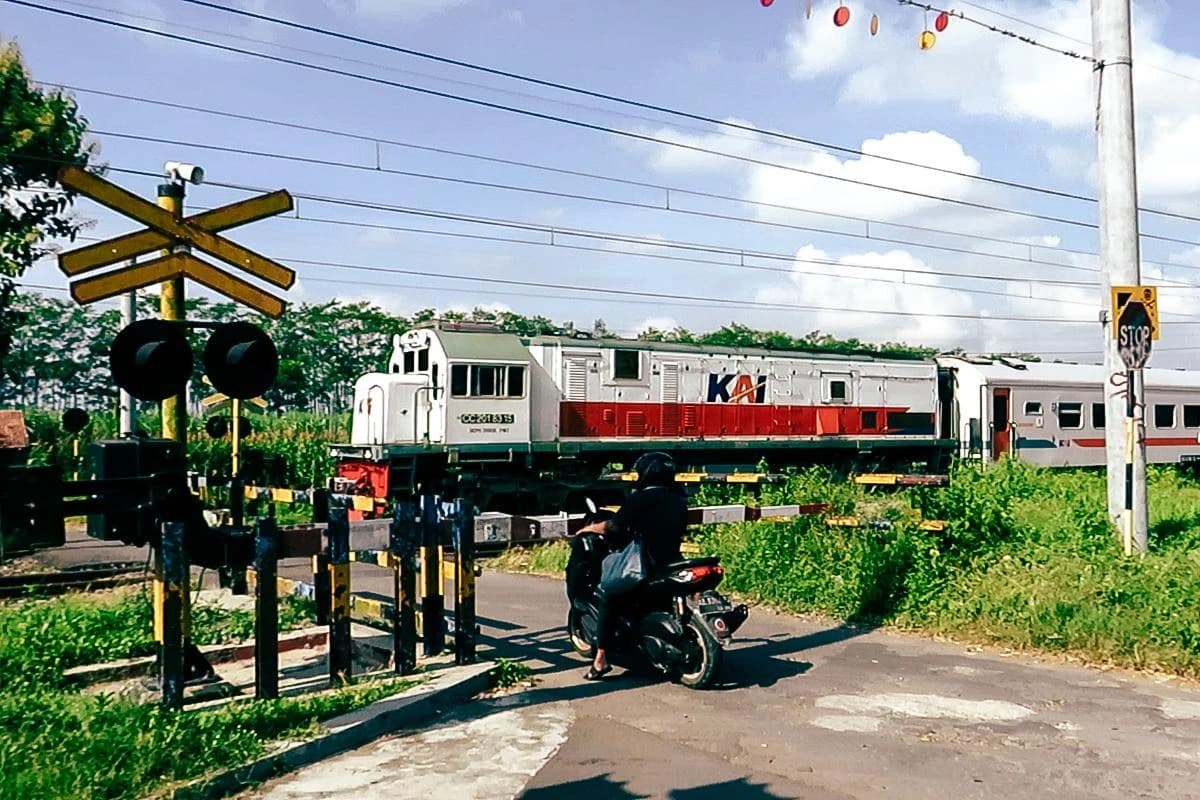
KAI President Director Reports Acceleration of Rail Level Crossing Safety Improvements to President Prabowo
A single rail level crossing might only take a few seconds to traverse. Yet, it is at that exact intersection where the safety of a train journey and the lives of road users meet within the same physical space. When traffic discipline weakens or safety infrastructure proves inadequate, the risk of an accident can materialize in a split second.
Consequently, managing level crossings remains an accelerated priority within national transportation infrastructure development. This targeted effort aims to eliminate high-risk points that have, for years, been the primary catalysts for accidents bridging rail lines and public roadways.
The latest milestones of this program were presented by the President Director of PT Kereta Api Indonesia (Persero), Bobby Rasyidin, to President Prabowo Subianto at the Presidential Palace. As of June 4, 2026, KAI, in collaboration with various stakeholders, has successfully closed 119 out of 172 priority level crossings targeted under the national safety roadmap this year. Furthermore, KAI is expediting interventions for 490 unauthorized level crossings and has initiated safety infrastructure enhancements across 1,148 active locations throughout its operational territories.
"Elevating safety standards at level crossings stands as a core operational focus for KAI. To date, 119 out of 172 priority crossings have been permanently closed. We are consistently sustaining this momentum by targeting unauthorized crossings and reinforcing safety assets across various regions,"
These decisive measures are propelled by an urgent need to mitigate accident risks that persist at level crossings. KAI’s internal data reveals that from January to June 4, 2026, 119 accidents occurred at level crossings, resulting in 97 casualties—comprising 43 fatalities, 23 severe injuries, and 31 minor injuries. Crucially, 52 percent of these incidents occurred at unguarded crossings, while motorist non-compliance—such as bypassing barriers when a train is approaching—remained the dominant cause, accounting for 87 percent of all recorded accidents.
KAI’s Vice President of Corporate Communication, Anne Purba, explained that the crossing closure program is driven by rigorous risk identification and comprehensive safety assessments. Each location is thoroughly evaluated based on its distinct risk matrix, train traffic volume, surrounding environmental conditions, and potential impacts on public safety.
"Every crossing closure undergoes a stringent evaluation process centered on public safety. Our primary objective is to phase out high-risk exposure zones that trigger accidents. The more vulnerable nodes we manage, the greater our capacity to establish a secure environment for both the commuting public and railway operations,"
The priority crossing closure initiative forms an integral part of broader safety upgrades targeting ,1,810 unguarded crossings within KAI's operational network. As of June 4, 2026, the closure of 119 out of 172 priority points represents approximately 69 percent completion of this year's target.
According to Anne, this achievement demonstrates a solidifying synergy among KAI, the central government, regional administrations, local law enforcement, and local communities in driving transportation safety. Given that each crossing possesses distinct local characteristics requiring tailored approaches, achieving long-term safety demands robust infrastructure, strict regulatory enforcement, and unwavering compliance from road users to consistently drive down accident rates.
Historical data from KAI shows that between 2022 and 2025, 1,244 accidents occurred at level crossings, with 913 incidents (73 percent) taking place at unguarded locations. This period recorded 1,152 casualties, including 437 fatalities, 294 severe injuries, and 421 minor injuries. These numbers reinforce that eliminating hazardous intersections remains a vital strategy for advancing national transport safety.
Parallel to crossing closures, KAI is also intensifying proactive public education and preventive campaigns. From 2022 to 2025, KAI carried out 6,259 safety socialization events at level crossings, closed 1,024 unauthorized and high-risk crossings, installed 2,646 warning banners, and organized 988 educational sessions at schools and places of worship adjacent to railway tracks. These initiatives were executed alongside regional governments, transportation departments (Dinas Perhubungan), local authorities, rail enthusiast communities, and residents.
"Safety is a long-term social investment whose benefits ripple across society. Every high-risk crossing we successfully secure translates to a potential accident prevented. Therefore, we call upon the public to strictly adhere to traffic regulations when traversing level crossings and protect the safety facilities we have collectively built,"
Moving forward, KAI will accelerate the completion of the remaining 53 priority crossings currently under evaluation to ensure the full target of closing 172 intersections in 2026 is met. Simultaneously, safety infrastructure enhancements across active locations will proceed continuously to eliminate accident risks and secure rail travel alongside public commutes.
VP of Corporate Communication KAI