
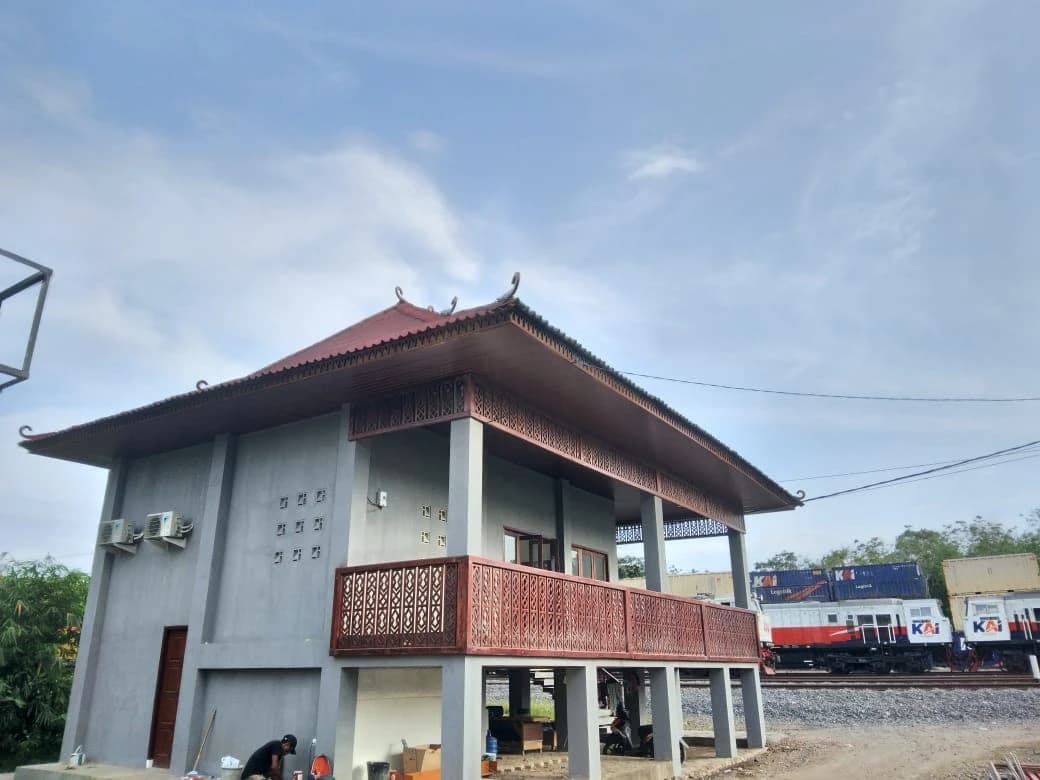
In the Middle of the Sumatra Route, KAI’s Transit House Brings the Atmosphere of a Limas House for Workers
Across several railway routes in South Sumatra and Lampung, there are stations located quite far from residential areas. Some are surrounded by plantations, forests, and travel routes that become increasingly deserted when night falls.
For station workers who finish their shifts at night, these conditions make the journey home something that needs to be carefully considered. PT Kereta Api Indonesia (Persero) provides transit houses at several points as a place to rest before workers continue their journey when conditions are more favorable.
KAI Vice President of Corporate Communication Anne Purba said that the transit houses are provided by adjusting to the characteristics of the work areas and the needs of workers in the field.
“In several locations, our workers are on duty quite far from residential areas, and the journey home may pass through plantations or deserted areas. When their shifts end at night, the transit houses give them the option to rest first,” said Anne.
In the Divre III Palembang area, these facilities are located, among others, in Payakabung, Serdang, Karangenda, Gunungmegang, Muaragula, Muaralawai, Sukacinta, Simpang, Gelumbang, Penanggiran, and Merapi. Meanwhile, in the Divre IV Tanjungkarang area, transit houses are available at several points such as Rengas, Tulungbuyut, Negeri Agung, Tanjungrajo, Waypisang, Sungai Tuha, Gilas, Lubukbatang, as well as other locations.
Interestingly, several of these transit houses carry the atmosphere of Rumah Limas, a traditional architecture closely associated with South Sumatra. Its characteristics can be seen in the dominant pyramid-shaped roof, elevated structure, wide eaves, geometric ornaments, latticework, and wood-themed elements.
Rumah Limas developed alongside the lives of the people of Palembang and the environment of South Sumatra, which is closely connected to the Musi River, wetlands, and tropical climate. In community life, the house also serves as a space for resting, gathering, and carrying out activities together. This spirit then gained a new context in KAI’s transit houses.
“The touch of Rumah Limas gives the workers’ resting spaces a connection with the region where they work. Its function follows current needs, while its architecture carries a local identity that remains present,” said Anne.
Attention to workers is an important part of KAI. As of June 2026, KAI’s parent company is supported by 28,003 workers, with 20,446 workers, or around 73 percent, in the 18–40 age range.
The experience of working at KAI has also received external recognition. In Indonesia’s Best Employers 2026, compiled by Tempo together with Statista, KAI ranked second nationally with a score of 96.25. The assessment covered, among others, work culture, development opportunities, work environment, diversity, company image, and workers’ recommendations of the company.
According to Anne, the quality of the work environment needs to be felt even at operational points far from city centers.
“Railway journeys are maintained by workers with very diverse working conditions. For colleagues who are on duty far from residential areas, a safe and comfortable resting space is an important part of maintaining their condition,” concluded Anne.
Amid the stretches of plantations, forests, villages, and cities crossed by railway tracks in South Sumatra and Lampung, transit houses serve as simple spaces with functions closely connected to the daily lives of workers.
VP Corporate Communication KAI