
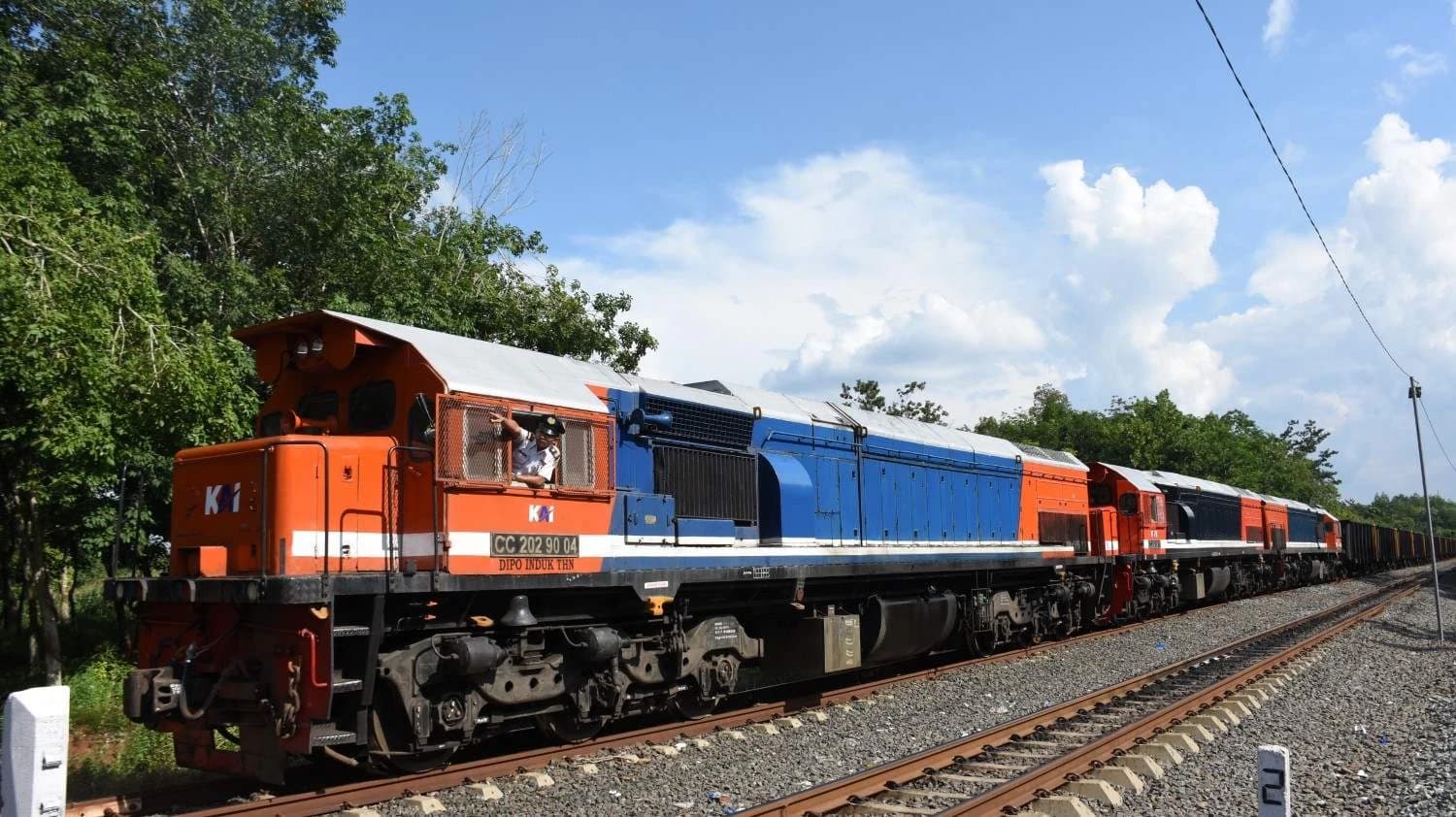
Amid Indonesia’s Large-Scale Coal Flow, KAI Moves 41,61 Million Tons by Rail
Coal remains one of the commodities with the largest logistics flows in Indonesia. Data from Statistics Indonesia (BPS) recorded national coal exports at 201.47 million tons during January–July 2026, with an average of around 28.8 million tons per month.
Amid the large-scale movement of this commodity, PT Kereta Api Indonesia (Persero) operates rail-based coal transportation in Sumatra. Throughout January–September 2026, KAI transported 41,607,561 tons of coal.
This volume accounted for approximately 82 percent of KAI’s total freight transportation volume of 50,756,132 tons during the first nine months of 2026. At this scale, coal became the largest commodity in KAI’s freight transportation portfolio.
Vice President Corporate Communication KAI Anne Purba said the large volume of coal transported every day requires a logistics system with adequate capacity, regular travel patterns, and connectivity between production areas and unloading points.
“More than 41.6 million tons of coal have been transported by train through September 2026. This figure provides an overview of the scale of logistics handled by KAI, particularly in Sumatra, to facilitate the scheduled movement of large volumes of commodities,” said Anne.
KAI’s coal transportation is concentrated in South Sumatra and Lampung, through the operations of Regional Division III Palembang and Regional Division IV Tanjungkarang. Through September 2026, the two regions recorded a combined volume of 41.61 million tons.
This scale takes place within the context of a large national industry. According to BPS, Indonesia’s coal exports during January–July 2026 were in the range of 26.85 million to 29.54 million tons per month. In July alone, national coal exports reached 29.02 million tons.
Anne said the data demonstrates that coal transportation requires logistics support from upstream to downstream, with capacity capable of keeping pace with industry needs.
“The characteristics of coal transportation require certainty in capacity and regularity. On the corridors served by KAI, trains play a role in transporting large volumes in a single journey and maintaining the flow of goods from production areas to the next distribution points,” said Anne.
Growth Recorded Among Several Customers
Amid the overall dynamics of coal transportation volume, several KAI freight transportation customers recorded increases throughout January–September 2026.
The transportation volume of PT Turba Bara Bany Enim increased from 911,612 tons in 2025 to 2,347,582 tons in 2026, representing a growth of 157.5 percent.
The volume of PT Mustika Indah Permai increased by 32.7 percent, from 2,721,149 tons to 3,609,664 tons. Meanwhile, the volume of PT Bukit Bara Alam increased by approximately 26 percent, from 514,316 tons to 647,986 tons.
These developments indicate an increase in capacity requirements among several customers and coal transportation corridors in Sumatra.
Overall, KAI’s coal transportation volume through September 2026 was recorded 1.48 percent lower than the same period in 2025, which stood at 42,234,185 tons. KAI views this movement as part of the dynamics of customer demand, production, and industry conditions.
“We see that each customer and corridor has different dynamics. Therefore, capacity management is carried out in a measured manner by taking into account customer needs, the readiness of rolling stock and infrastructure, as well as train travel safety,” said Anne.
Railways for Large-Scale Commodity Flows
BPS data also shows that Indonesia’s total exports during January–July 2026 reached US$167.03 billion, an increase of 4.43 percent compared with the same period the previous year. Non-oil and gas exports reached US$160.01 billion, growing by 5.21 percent.
Within this ecosystem, the availability of logistics networks is an important part of connecting production areas with distribution centers and subsequent trade routes.
KAI continues to manage route capacity, rolling stock, infrastructure, terminals, and freight transportation operating patterns to serve industry needs while maintaining railway travel safety.
“Rail-based freight transportation has significant room for further development, particularly for commodities with high volumes and regular delivery patterns. KAI will continue to adjust its services to industry needs so that railways become increasingly relevant to Indonesia’s logistics
VP Corporate Communication KAI