
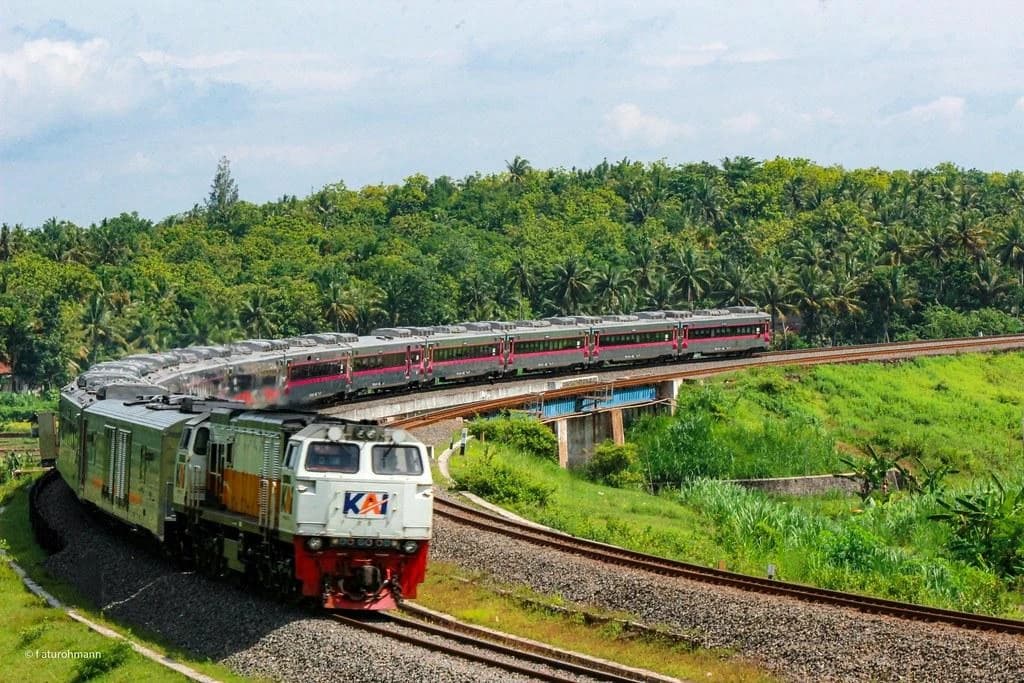
Eight Decades of KAI’s Journey, From Connecting Indonesia to Moving Forward with Modern Technology
Eight decades of PT Kereta Api Indonesia (Persero)’s journey have been part of the transformation of mobility in Indonesia. Since the early days of independence until entering the era of modern technology, rail transportation has continued to evolve in line with the needs of society, from services connecting various regions to introducing new generations of railway technology.
A significant milestone in Indonesia’s railway journey took place on September 28, 1945, when railway workers took over the management of the railway system from Japan following Indonesia’s independence. This event marked the beginning of the Djawatan Kereta Api Repoeblik Indonesia (DKARI), which was later commemorated as Indonesia’s Railway Day.
During the early years of the Republic of Indonesia, railways played an important role as a means of connecting cities and regions. Railway lines stretching across various areas became a driver of public mobility while also supporting economic activities amid the nation’s development process.
As times changed, society’s transportation needs continued to evolve. Railways, which previously served as a means of connecting journeys between regions, gradually developed into services with various characteristics, ranging from long-distance travel and local journeys to daily urban mobility.
Vice President of Corporate Communication of KAI Anne Purba said that KAI’s long journey reflects how rail transportation has continued to grow alongside Indonesian society.
“Railways have grown together with the nation’s journey. Over time, people’s needs continue to change, so KAI continues to provide services that keep pace with the times, from connecting regions to introducing modern transportation technology,” said Anne.
One of the important developments in Indonesia’s railway journey was the introduction of electric train services. The electrification journey began on April 6, 1925, with the operation of electric trains on the Tanjung Priok–Meester Cornelis (Jatinegara) route.
As urban areas continued to develop, Electric Multiple Unit (KRL) services became an important part of supporting public mobility, particularly in the Greater Jakarta area. Today, KRL has become one of the main modes of transportation serving large numbers of daily commuters.
The development of electric-based transportation entered a new chapter with the introduction of LRT Jabodebek in 2023.
With a route length of 44.43 kilometers, LRT Jabodebek uses Communication Based Train Control (CBTC) signaling technology with Grade of Automation Level 3 (GoA3).
This technology enables trains to operate automatically while remaining supported by staff supervision. The presence of LRT Jabodebek represents part of the development of modern electric-based urban transportation in Indonesia.
In the same year, Indonesia entered a new era of rail transportation with the operation of Whoosh, the first electric high-speed railway in Indonesia and the first high-speed railway in Southeast Asia.
Whoosh began commercial operations on October 17, 2023, after being inaugurated on October 2, 2023. The high-speed train uses CR400AF trainsets with an operating speed of up to 350 km/h.
The presence of Whoosh has introduced a new travel experience through high-speed technology while further expanding the development of rail-based transportation in Indonesia.
This long journey is reflected in the growing public demand for railway services. From January to August 2026, KAI Group served 351,602,397 customers, an increase of 7.09 percent compared with the same period the previous year, which reached 328,311,868 customers.
Of this total, 317.7 million customers, or 90.29 percent, used public service transportation, including commuter trains, local trains, and government-assigned services.
The growth in customers came from various services within the KAI Group ecosystem, ranging from KAI Commuter, Long-Distance and Local Trains, LRT Jabodebek, Airport Trains, Makassar–Parepare, to the Whoosh high-speed rail service.
Anne said the growth in railway travel demonstrates the changing role of rail transportation in people’s lives.
“Every journey has different needs and stories. Some customers use trains to work, study, trade, meet family, or enjoy a trip. KAI continues to evolve to serve the various needs of society,” said Anne.
Eight decades of KAI’s journey reflect major changes in Indonesia’s railway industry. From services connecting cities and regions, it has evolved into a modern transportation ecosystem supported by technology, digitalization, and service innovation.
As it approaches its 81st anniversary, KAI continues its journey alongside society through the development of services, technology, and connectivity to provide an increasingly service-oriented travel experience.
VP Corporate Communication KAI