
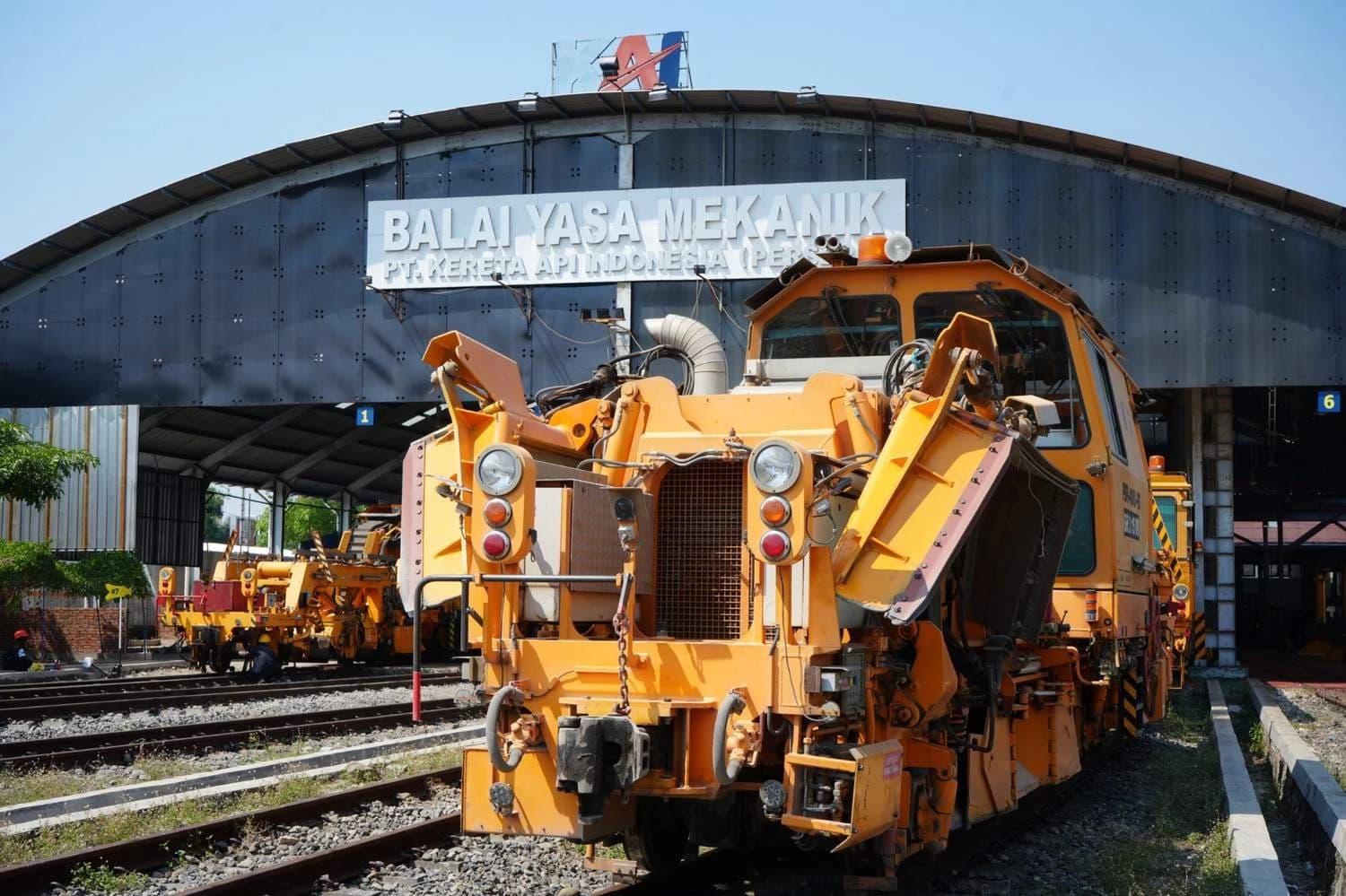
Balai Yasa Mekanik Cirebon Prujakan Maintains the Reliability of 51 Rail Maintenance Machines Across Java
The sound of lathes, welding activities, hydraulic system inspections, and component testing are part of the daily routine of workers at Balai Yasa Mekanik Cirebon Prujakan. At this facility, various rail maintenance machines are inspected and serviced before being redeployed across KAI’s operational areas throughout Java.
Balai Yasa Mekanik Cirebon Prujakan is a primary maintenance facility owned by PT Kereta Api Indonesia (Persero), located at Jalan Kesambi No. 2, Cirebon City, West Java. It is situated near Cirebon Prujakan Station.
This facility handles periodic maintenance, heavy maintenance, repairs, functional testing, and technical capability adjustments of Rail Track Maintenance Machines. In KAI’s technical asset records, these machines are also known as Rail Track Maintenance Vehicles (KPJR).
Vice President of Corporate Communication KAI, Anne Purba, stated that the work carried out at Balai Yasa Mekanik Cirebon Prujakan is closely related to track readiness and railway operational safety.
“Safe train operations require stable track conditions that meet technical standards. Rail maintenance machines help maintain these conditions. Therefore, each machine must be ensured reliable before being redeployed to the track,” said Anne.
Rail maintenance machines assist in lifting and aligning tracks, adjusting rail elevation, compacting ballast, shaping ballast profiles, and stabilizing tracks after maintenance processes.
Ballast consists of crushed stones placed beneath and around railway sleepers. This material supports the sleepers, distributes train loads, maintains track stability, and facilitates water drainage around the rails.
If the rail position or ballast density changes due to operational loads and environmental conditions, maintenance machines are used to restore track geometry according to technical requirements. Track geometry includes alignment, elevation, gauge, and cant.
In 2026, Balai Yasa Mekanik Cirebon Prujakan has a maintenance program covering 51 rail maintenance machines. As of 17 July 2026, 22 units or 43.1 percent have completed maintenance, and seven units are currently in progress. The remaining 22 units are scheduled for subsequent maintenance stages.
In general, MTT or Multiple Tie Tamper is used to lift, align, and compact railway tracks. PBR or Plasser Ballast Regulator is used to arrange and shape ballast profiles around sleepers.
A turnout is a track structure that allows trains to move from one track to another. The precision of turnout components must be maintained as it is directly related to routing train movements.
“Each machine has a different function. Some machines correct rail positions, compact ballast, arrange materials around sleepers, and assist with turnout work. All these functions support each other to ensure that tracks remain safe for train operations,” Anne added.
The machines maintained at Cirebon Prujakan support the operational needs of Daop 1 Jakarta, Daop 2 Bandung, Daop 3 Cirebon, Daop 4 Semarang, Daop 5 Purwokerto, Daop 6 Yogyakarta, Daop 7 Madiun, Daop 8 Surabaya, and Daop 9 Jember.
This coverage makes Balai Yasa Mekanik Cirebon Prujakan one of the key supporters of KAI’s infrastructure maintenance across Java. After maintenance and testing processes are completed, the machines can be redeployed according to the needs of each operational region.
Based on performance data, Balai Yasa Mekanik Cirebon Prujakan completed 50 machine maintenance works in 2024 and 53 in 2025. As of 17 July 2026, 22 works have been completed. In total, there have been 125 completed maintenance works from 2024 to mid-July 2026.
These works follow maintenance cycles of P12, P24, and P48 along with their respective stages. P12 refers to a 12-month cycle, P24 is conducted every two years, and P48 is carried out every four years with a broader scope of inspection.
The maintenance process includes inspection of mechanical, hydraulic, electrical, braking, propulsion systems, and machine working equipment. The scope of work is determined based on machine type, age, operating hours, component condition, and maintenance history.
The machines serviced range in production years from 1984 to 2024. A total of 23 units are from the 1984–1994 period, eight units from 2013–2015, and 20 units from 2020–2024.
This diversity in age and technology requires workers who understand mechanical systems across different generations. Older machines require meticulous component inspections and spare part adjustments, while newer machines are equipped with more complex control systems and electronic devices.
As of 1 May 2026, Balai Yasa Mekanik Cirebon Prujakan is supported by 48 personnel consisting of 21 permanent employees, 20 outsourced maintenance workers, three cleaning staff, and four security personnel.
The workers handle tasks ranging from maintenance planning, component disassembly, damage inspection, repairs, reassembly, functional testing, to quality control of completed work.
A Service Level Agreement assessment of 20 outsourced maintenance workers in April 2026 recorded an average score of 96.6. This score reflects performance based on quality, discipline, safety, and achievement of established targets.
Worker competencies are strengthened through certifications and training in Occupational Health and Safety (OHS), chemical safety, first aid, fire suppression, wastewater management, and hazardous and toxic waste management.
The facility also employs personnel certified in operating overhead cranes, forklifts, and lifting jacks, as well as technicians for lifting and transport equipment and power and production machinery.
“Machine reliability depends heavily on the accuracy and competence of workers. Each stage must be carried out according to procedures, from initial inspection, component repair, assembly, to testing before the machine is declared ready for operation,” said Anne.
To support these activities, Balai Yasa Mekanik Cirebon Prujakan is equipped with overhead cranes, lathes, milling machines, forklifts, cutting machines, hydraulic presses, lifting jacks, hand lifts, generators, nitrogen accumulator filling machines, scissor lifts, and high-pressure washers.
These tools assist workers in lifting large components, shaping materials, repairing parts, cleaning machinery, and performing work on both upper and lower sections of equipment.
Balai Yasa Mekanik Cirebon Prujakan implements ISO 9001:2015 Quality Management System and ISO 14001:2015 Environmental Management System. Environmental management is carried out through wastewater treatment facilities, hazardous waste management, tree planting, garden revitalization, and hydroponics.
Control data as of April 2026 recorded zero workplace accidents, zero environmental pollution incidents, and zero delays in maintenance processes.
“Operational safety is built from many activities that take place behind the scenes. Track readiness in the field, the reliability of maintenance machines, worker competence, and discipline in every process are interconnected elements that ensure safe train operations across Java,” Anne concluded.
VP Corporate Communication