
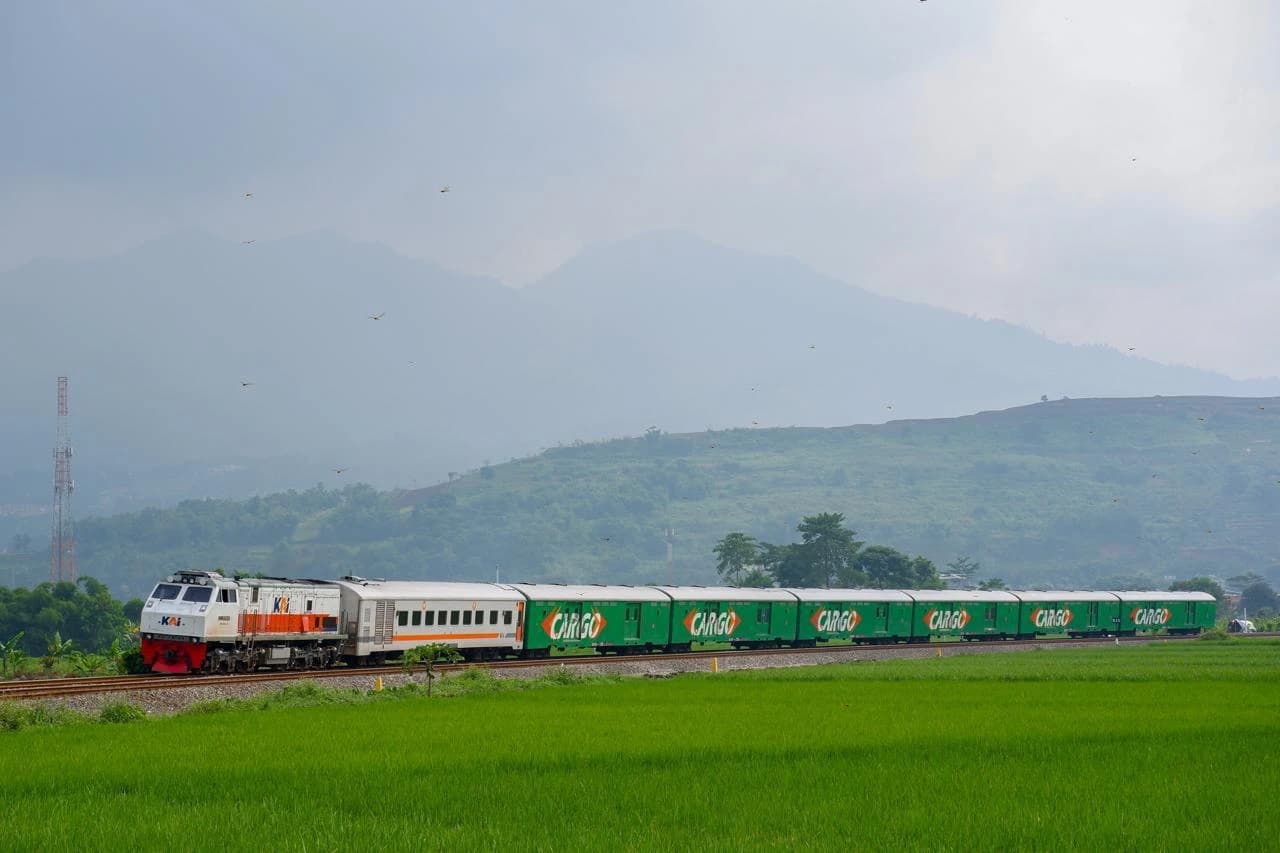
KAI Retail Freight Reaches 191,000 Tons Through September 2026, Growing by 2.96%
Shipping costs contribute to the price of goods when they reach consumers. When distribution involves traffic congestion, high fuel consumption, long transit times, or high handling costs, logistics expenses increase and can become part of a product’s overall cost structure. Statistics Indonesia (BPS) has also noted that changes in transportation costs can affect distribution and logistics expenses, as well as the prices of goods and services.
In this context, railways have greater potential to handle high-capacity freight transportation. From January to September 2026, KAI transported 191,232 tons of retail freight, an increase of 2.96% compared with approximately 185,733 tons during the same period in 2025. In terms of volume, this represents an additional 5,499 tons of goods transported through the railway network.
Vice President of Corporate Communication KAI Anne Purba said that this growth shows that businesses are beginning to utilize a wider range of transportation options to manage goods distribution.
“A total of 191,000 tons of retail freight was transported by rail during the first nine months of 2026. For business customers, having transportation options is important because each type of goods has different requirements in terms of volume, distance, delivery time, and cost,” said Anne.
Retail freight is part of KAI’s non-coal freight portfolio. As of September 30, 2026, non-coal freight volume reached 9,148,571 tons, an increase of 2.6% compared with 8,912,566 tons during the same period in 2025. The commodities transported include containers, fertilizer, cement, fuel, pulp, plantation products, and retail goods. Revenue from non-coal freight during this period reached approximately IDR 1.095 trillion, an increase of 7.2% compared with the previous year.
According to Anne, railways are well suited to transporting large volumes of goods on specific corridors with recurring shipment patterns. A single train formation can carry substantial loads in one trip, allowing some medium- and long-distance freight flows to shift from roads to rail.
“Railways are well suited to large-volume shipments with regular schedules. Trucks remain important for transporting goods from production sites to terminals and from terminals to their final destinations. This division of roles allows distribution chains to be designed more efficiently,” said Anne.
The Ministry of Transportation has noted that more than 90% of freight transportation in Indonesia still relies on roads. Heavy dependence on road vehicles contributes to traffic congestion, road damage, energy consumption, and distribution costs. Developing rail-based freight transportation is one option for reducing this burden.
Rail transportation is also relevant to interregional trade. BPS data shows that differences in commodity needs and availability across regions drive trade flows between provinces. An efficient distribution system is therefore important to ensure that goods can move at more predictable costs and remain competitively priced in destination markets.
KAI sees continued opportunities to develop retail freight services along corridors with sufficient shipment volumes and frequency. Development efforts focus on terminal connectivity, scheduled services, freight capacity, and integration with land-based logistics services.
“The more efficiently goods move from producers to markets, the less cost pressure the distribution chain has to bear. This is why KAI sees greater potential for railways to handle a larger share of freight transportation on suitable corridors, while also helping reduce the burden of heavy vehicles on roads,” Anne concluded.
VP Corporate Communication KAI