
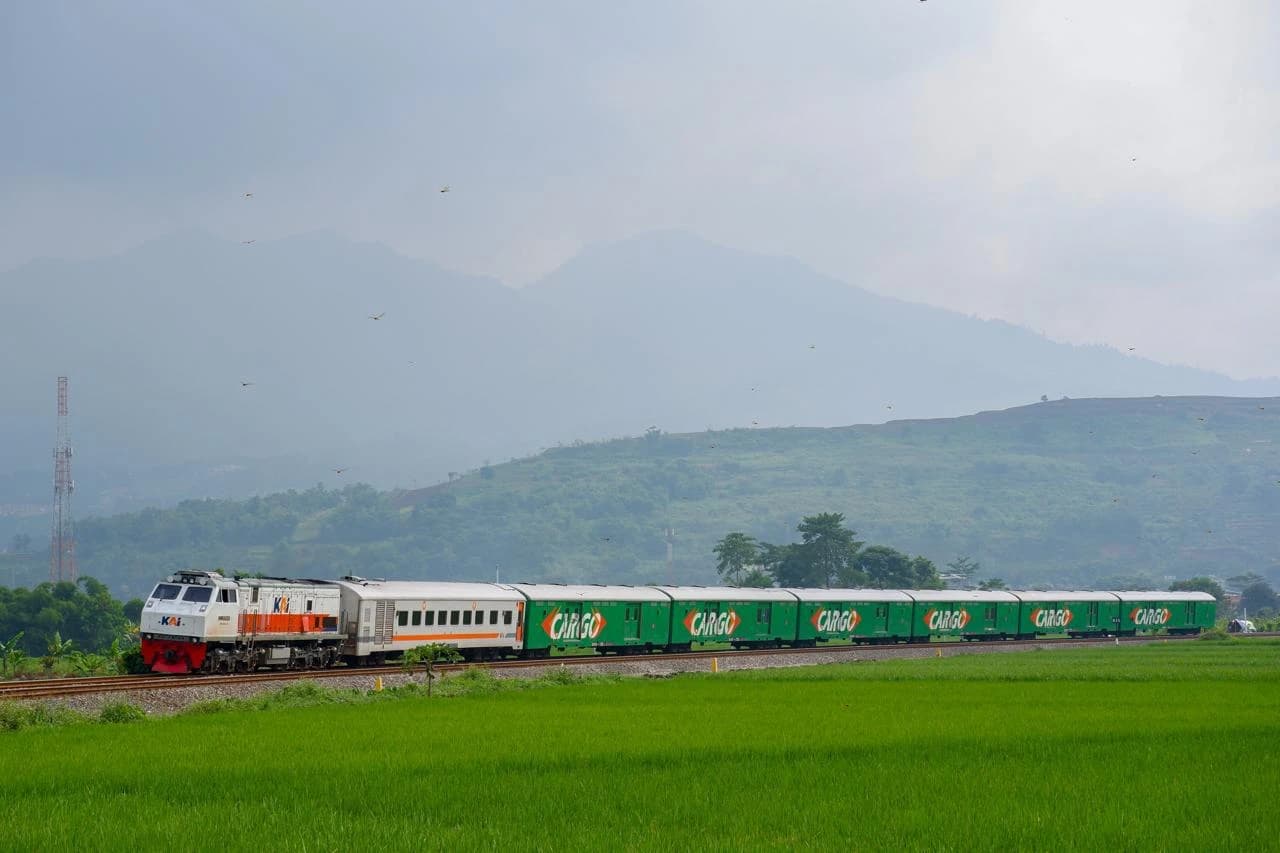
KAI's Retail Freight Volume Reaches 146,617 Tons, Up 19,59 Percent in Two Years
PT Kereta Api Indonesia (Persero) recorded a retail freight volume of 146,617 tons during January–July 2026. The figure increased by 3.59 percent compared to the same period in 2025, which reached 141,541 tons, and rose by 19.59 percent compared to January–July 2024, when it reached 122,598 tons.
Within two years, there was an additional approximately 24 thousand tons of retail goods transported through the railway network. This development indicates that the demand for scheduled, high-capacity, and integrated intercity distribution with other logistics networks is becoming stronger.
Vice President Corporate Communication KAI Anne Purba said that these figures should be viewed more broadly in terms of their economic benefits. Behind the movement of retail freight are the activities of business players, MSMEs, intercity trade, household needs, and various service businesses that depend on the certainty of goods reaching their destinations.
“For a business, freight transportation is part of business continuity. There are products that must reach buyers, business supplies that must remain available, and economic circulation that depends on distribution. Therefore, for KAI, retail freight is an important part of the logistics ecosystem that serves the economic needs of the community,” said Anne.
Within the logistics system, rail-based retail freight generally operates on the main intercity journey or middle-mile. Goods are consolidated by logistics companies, transported by train along the main corridor, and then forwarded through distribution networks to the recipients. KAI’s business model in this segment is Business to Business (B2B) in collaboration with logistics partners, allowing the public and business players to utilize the railway network through freight forwarding companies and logistics service providers that are KAI’s partners.
This pattern allows railways and road transportation to complement one another. Road vehicles can handle pickup and delivery at the origin and destination points, while railways take on the role of transporting goods along intercity routes that require large capacity and schedule reliability.
“Literacy regarding logistics is important. Goods received by the public at home or products that arrive at a store go through a long distribution chain. The better each part of that chain works, the greater the opportunity for distribution to become more efficient and for businesses to operate more sustainably,” said Anne.
The strengthening of this service is in line with the Government’s agenda to improve national logistics efficiency. Data referred to by the Government shows that Indonesia’s logistics costs account for 14.29 percent of GDP, with a target to reduce the figure to 12.5 percent by 2029 and 8 percent by 2045. The Government also places an efficient, integrated, and resilient logistics system as an important part of maintaining distribution while improving national economic competitiveness.
According to Anne, these figures show that logistics efficiency is a major undertaking requiring collaboration among various modes of transportation, business players, the government, and infrastructure operators. KAI plays its role according to the characteristics of railway transportation, particularly in transporting large volumes of goods through scheduled intercity services.
“Not all goods should be transported by train, and not every logistics need can be fulfilled by a single mode of transportation. What Indonesia needs is a system capable of placing each mode in the role where it is most efficient. Railways have the capacity to strengthen the main journey, while other modes continue the distribution to customers,” said Anne.
This direction is also in line with global developments. The World Bank identifies investment in rail-based logistics as one of the instruments to improve freight efficiency, strengthen supply chain resilience, reduce transportation costs, and support emission reduction. Strengthening the share of rail freight has become one of the approaches developed by various countries in responding to increasingly complex logistics needs.
For Indonesia, this need has become increasingly relevant as global supply chains face various pressures, ranging from changing trade patterns and geopolitical uncertainty to demands for more sustainable distribution. A strong domestic logistics system helps businesses maintain supply continuity and strengthen competitiveness when external conditions change.
“A product’s competitiveness is also determined by how the product reaches the market. Therefore, the strengthening of rail-based logistics needs to be developed rationally based on volume, distance, customer needs, and integration with other modes of transportation. The objective is clear, namely that goods can move more efficiently and that the economic benefits return to the community,” explained Anne.
KAI will continue its collaboration with logistics partners, business players, industrial estates, and other stakeholders in developing its retail freight services. Distribution integration, freight consolidation, schedule reliability, and the utilization of railway capacity will continue to be strengthened according to market needs.
“When a product from one city can reach a market in another city through an increasingly efficient distribution chain, business opportunities are created. We hope the growth of KAI’s retail freight service will continue to expand those opportunities and contribute to a more competitive Indonesian logistics system,” concluded Anne.
VP Corporate Communication KAI