
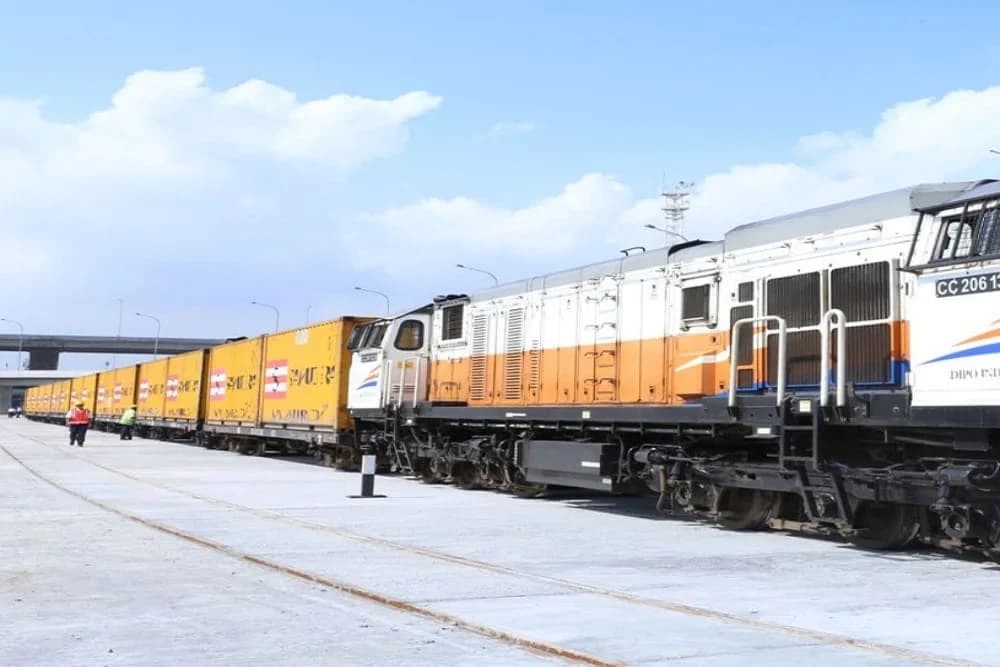
KAI Container Transportation Reaches 4.44 Million Tons Until September 2026, Grows 19.57 Percent
Container movement through the railway network increased during the first nine months of 2026. PT Kereta Api Indonesia (Persero) recorded 4,438,999 tons of containers transported from January to September 2026, up 19.57 percent compared to 3,712,477 tons in the same period in 2025. This increase represents an additional 726,522 tons of goods transported by rail.
Containers were the largest commodity in KAI’s non-coal freight segment. Of the total 9,148,571 tons of non-coal freight transported through September 2026, approximately 48.5 percent came from containers. Overall, non-coal freight volume grew by 2.6 percent compared to 8,912,566 tons in the same period last year, while revenue reached approximately Rp1.095 trillion, an increase of 7.2 percent.
KAI Vice President of Corporate Communication Anne Purba said that container growth should be viewed as part of a logistics chain connecting production areas, inland terminals, ports, and destination markets.
“Growth of nearly 20 percent shows that there is increasing potential to utilize rail for container transportation. The nature of this cargo is well suited to high-volume shipments, scheduled journeys, and consistent distribution corridors,” Anne said.
This growth occurred amid increasing trade activity in Indonesia. Statistics Indonesia (BPS) recorded Indonesia’s export value at US$193.64 billion from January to August 2026, an increase of 4.74 percent. Non-oil and gas exports reached US$185.63 billion, growing by 5.48 percent. During the same period, imports reached US$186.39 billion, increasing by 19.84 percent.
In international trade, connectivity between ports and hinterland areas is an important part of the supply chain. UN Trade and Development noted that maritime transport carries more than 80 percent of global trade by volume. This means that the efficiency of goods transportation does not end at ports; goods still require inland networks to reach industrial areas, warehouses, distribution centers, and consumers.
Railways play a role in this inland transportation segment. Rail can be used to transport large quantities of containers on main routes, while trucks handle collection and delivery for first-mile and last-mile transportation. This division of functions gives logistics customers options for arranging shipments based on volume, distance, schedules, and costs.
KAI is also mapping opportunities to develop new container connectivity. In the company’s long-term plan, one of the initiatives under consideration is connecting the Cilacap Container Terminal with the national railway network and the Semarang Container Terminal as part of multimodal freight development and the expansion of port hinterland connectivity.
“For logistics customers, what matters is certainty in capacity, schedules, and predictable goods transportation. KAI will assess corridors that meet these requirements so that the share of container freight transported by rail can continue to grow,” Anne concluded.
VP Corporate Communication KAI