
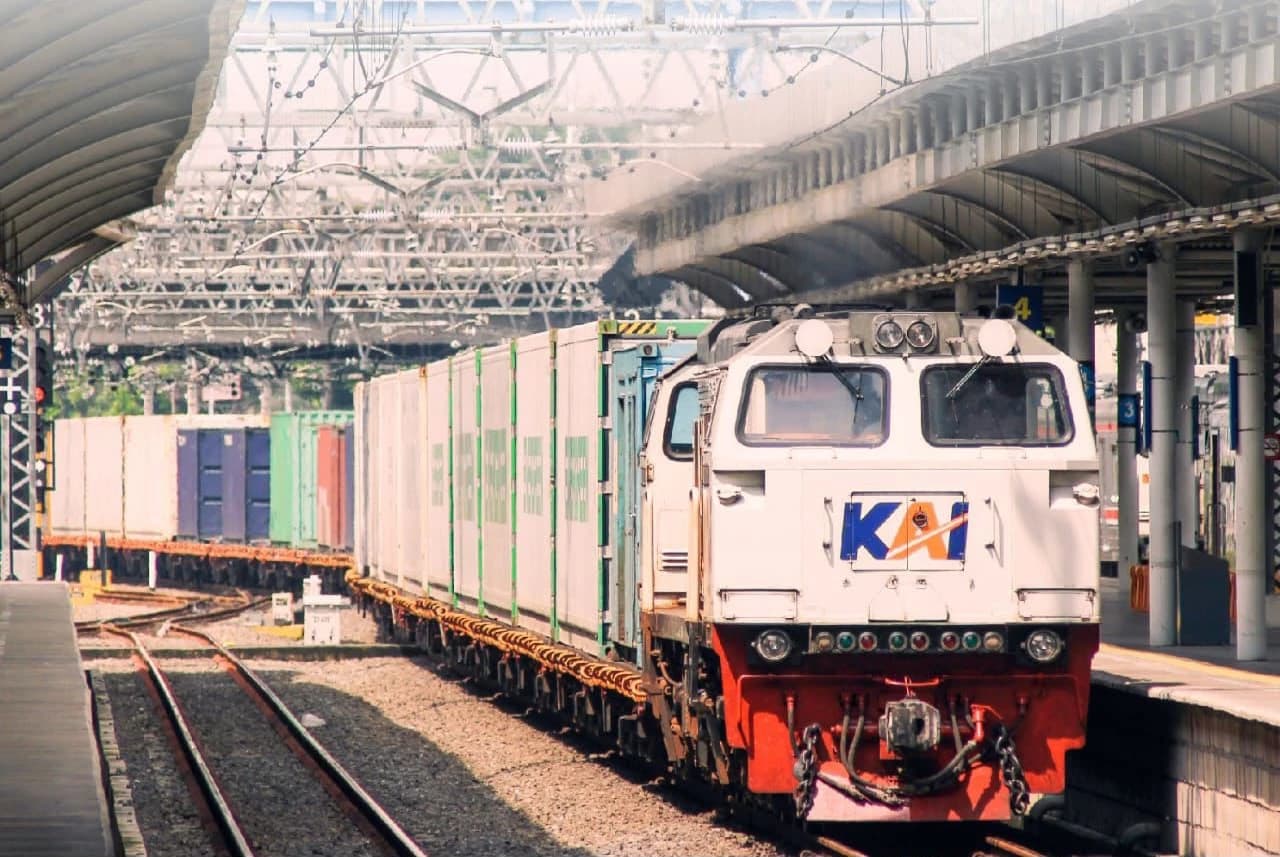
KAI's Container Freight Volume Rises 20.28 Percent, Strengthening Rail–Port Connectivity for National Logistics
PT Kereta Api Indonesia (Persero) continues to strengthen its container freight services as part of the national logistics system. From January to July 2026, KAI transported 3,437,795 tons of containerized cargo, an increase of 20.28 percent compared to the same period in 2025, which recorded 2,858,244 tons.
The increase was also reflected in the monthly performance. In July 2026 alone, KAI transported 521,892 tons of containerized cargo, up 22.80 percent from 424,999 tons in July 2025.
The growth in container freight transportation reflects increasing demand from businesses for a logistics mode that offers high capacity, scheduled operations, and connectivity with industrial estates, container terminals, warehouses, and seaports. Most containerized cargo consists of manufactured products, industrial raw materials, consumer goods, and various commodities that require reliable distribution.
KAI Vice President of Corporate Communication Anne Purba said container freight transportation plays a strategic role in ensuring the smooth movement of goods from production centers to ports, distribution centers, and market destinations.
"The growth in container freight volume indicates that more businesses are utilizing rail transportation as part of their supply chains. KAI continues to strengthen connectivity between industrial estates, container terminals, and ports to ensure the distribution of manufactured products becomes more efficient, scheduled, and reliable," Anne said.
For the manufacturing sector, smooth logistics are essential to maintaining production continuity. Delays in raw material deliveries can affect factory schedules, while delays in finished goods can disrupt distribution to the market. In this context, rail-based container freight has become one of the preferred solutions for maintaining a stable flow of goods in large volumes.
Rail transportation offers high carrying capacity in a single trip and operates on a scheduled basis. These characteristics support the industry's need for time certainty, efficient asset utilization, and the continuous movement of raw materials and finished products.
Its role becomes even more strategic when railway services are integrated with ports. Containers from industrial estates can be transported by rail to container terminals and seaports before being shipped to various regions across Indonesia. Likewise, raw materials and commodities arriving at ports can be transported by rail to industrial areas, warehouses, and distribution centers.
"Connectivity between railways and ports helps establish a more organized flow of goods. Manufactured products can be transported in large volumes from industrial areas to ports before continuing their journey by sea to various islands," Anne added.
The integration of railways and ports has the potential to reduce long-distance truck movements, ease road congestion, accelerate cargo transfers, and provide greater schedule reliability for industries. These benefits will be further enhanced by rail access to ports, adequate container terminals, cargo handling facilities, warehousing, and the digitalization of documentation and services.
Therefore, improving logistics infrastructure capacity must be carried out in an integrated manner. The development of railway lines and freight terminals should go hand in hand with the strengthening of ports, industrial estates, distribution centers, shipping services, and last-mile transportation to ensure more efficient container movement from origin to destination.
KAI continues to enhance container freight capacity, optimize freight terminals, accelerate digitalization, and expand collaboration with port operators, shipping companies, industrial estate managers, warehouse operators, and logistics service providers.
These efforts are also aimed at creating a more balanced two-way flow of goods. Containers departing from Java primarily carry manufactured products and consumer goods to various regions, while return cargo is not always available in the same volume.
Empty return containers can increase distribution costs. Therefore, consolidating regional commodities, strengthening production centers, and expanding market access for local products are essential to improving transportation productivity.
Containers delivering manufactured products can return carrying agricultural products, plantation commodities, fisheries products, handicrafts, and MSME products from destination regions.
Utilizing two-way cargo movements can help reduce distribution costs while expanding market opportunities for regional products.
Logistics to Reduce Regional Disparities and Create Opportunities
Indonesia faces significant logistics challenges because production centers and consumer demand are spread across a vast archipelago. Most industrial, manufacturing, and warehousing activities remain concentrated on Java, while demand extends across Sumatra, Kalimantan, Sulawesi, Maluku, Papua, and many other islands.
This situation makes distribution costs one of the factors affecting consumer prices. The farther a region is from production centers, the longer goods must travel, the more transport modes they require, and the greater the costs of cargo handling and storage.
Ultimately, these costs are reflected in the prices paid by consumers. Clothing, construction materials, medicines, household goods, and educational supplies can become more expensive because they must travel long distances before reaching their destinations.
For families with limited incomes, even a difference of several tens of thousands of rupiah can have a significant impact. It may determine whether they can purchase school uniforms, educational supplies, household necessities, or postpone other essential expenses.
This is ultimately an issue of equitable access. Families in major cities generally enjoy lower prices for school uniforms, shoes, books, and household necessities because they are closer to production and distribution centers. Meanwhile, families living in remote or island regions often face higher prices due to longer supply chains.
Anne explained that logistics efficiency is directly linked to ensuring equal access to essential goods.
"Where a person lives should not determine whether they have to pay significantly more for basic necessities, school supplies, clothing, or household goods. Strengthening logistics connectivity should therefore be directed toward reducing distribution cost disparities between regions," Anne said.
Equitable logistics also means ensuring that distance no longer becomes a burden for communities. Children in remote areas should still have access to reasonably priced school uniforms, shoes, and books. Likewise, families living in island regions deserve access to household necessities at increasingly affordable prices.
At the same time, regional communities should have greater opportunities to market their products nationwide. MSMEs, farmers, fishermen, and local producers require a distribution system that enables their products to move from production areas to consumer markets at increasingly competitive costs.
Through balanced two-way cargo flows, regions can serve not only as production centers but also as integral parts of the national trade network. This approach helps improve container utilization, expand market access for local products, and create a more balanced distribution system.
"Behind every container lies production activities, trade, and the daily needs of communities. As rail and port connectivity continues to strengthen, the benefits will be reflected in smoother distribution, broader market access for regional products, and reduced cost disparities between regions," Anne said.
Anne added that the growth in container freight volume must be accompanied by stronger intermodal integration so that its benefits can reach more regions. Railways, ports, ships, warehouses, industrial estates, and connecting transport services need to be integrated into one efficient distribution network.
"The growth of container freight transportation should be directed toward strengthening industry, improving distribution, and expanding equitable access to goods. KAI will continue to promote collaboration so that stronger rail–port connectivity delivers benefits to businesses and communities across Indonesia," Anne concluded.
VP Corporate Communication KAI