
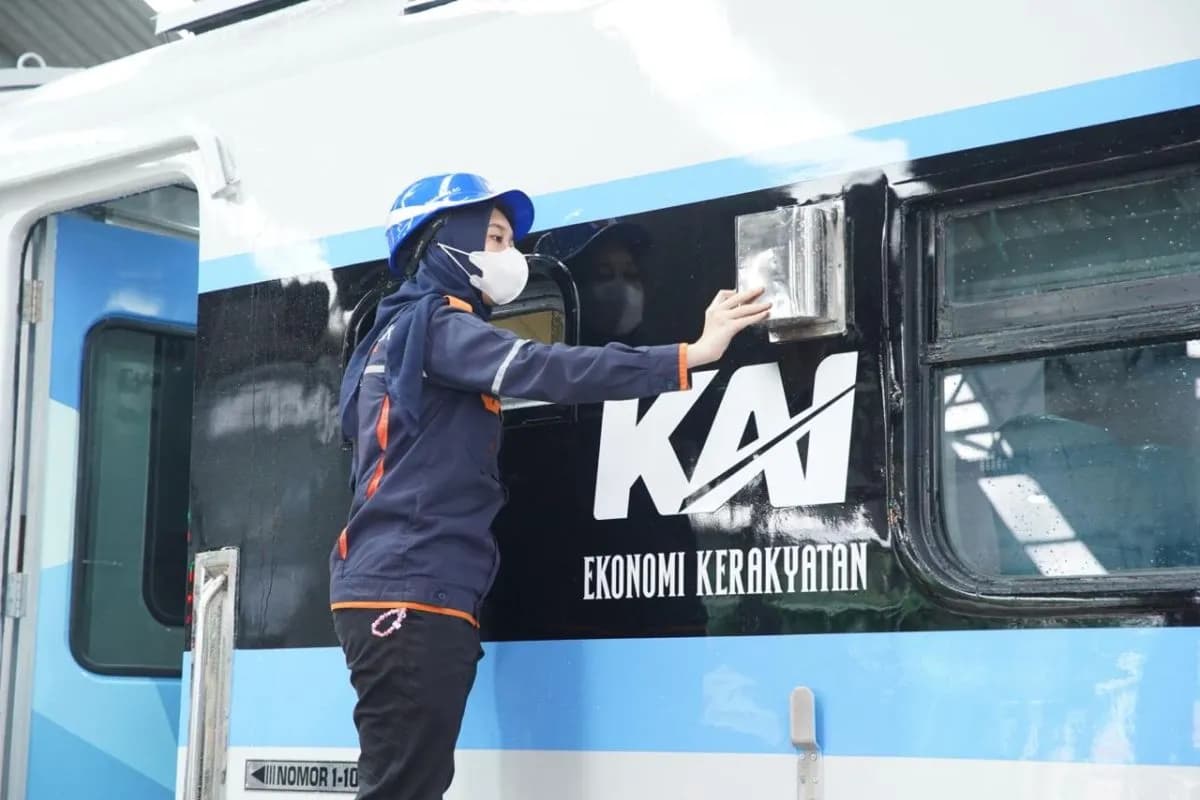
Starting 10 June 2026, Cikuray Train Uses Economy-Class Rolling Stock to Serve More Customers
Garut is known as one of the regions that has grown through agricultural activities, trade, and community-based businesses. From this fertile mountainous area, various agricultural products move daily toward markets in different cities. At the same time, people travel for work, education, trade, business development, and other daily needs. This mobility has become an important part of driving the regional economy.
To support these needs, PT Kereta Api Indonesia (Persero) will introduce a new concept for the Cikuray Train operating on the Garut–Pasar Senen round-trip route starting 10 June 2026 through the People’s Economy Rail concept. This concept will be implemented through the operation of People’s Economy-Class Rolling Stock, designed to strengthen public transportation access while supporting real-sector economic activities along the railway corridor.
Vice President of Corporate Communication KAI Anne Purba stated that this transformation is an effort to provide services that are increasingly aligned with the needs of communities that serve as key drivers of regional economic activity.
"The Cikuray Train has long been part of the daily lives of communities across the regions it serves. Through the People’s Economy Rail concept, KAI aims to provide services that support public mobility while strengthening economic activities carried out by farmers, market traders, MSMEs, workers, students, and various other community groups."
This transformation is the result of innovation by KAI employees through Balai Yasa Manggarai. The development process was carried out by adjusting the design and service characteristics to make them more adaptive to the needs of the communities who are the main users of the Cikuray Train.
Public enthusiasm for the Cikuray Train has continued to show positive growth. In 2022, the Cikuray Train served 293,265 customers. This number increased to 514,767 customers in 2023. In 2024, customer volume rose again to 591,089 customers and reached 615,723 customers in 2025. Meanwhile, from January to May 2026, the Cikuray Train has served 266,993 customers.
This growth shows that the Cikuray Train has increasingly become a preferred transportation option for communities traveling between regions at affordable costs. As a Public Service Obligation (PSO) railway service supported by the government through the Directorate General of Railways of the Ministry of Transportation, the Cikuray Train offers a maximum fare of Rp45,000 for the Garut–Pasar Senen route, making it accessible to various segments of society.
The People’s Economy-Class Rolling Stock was developed as an inclusive transportation service to expand public mobility access. This concept is designed to reduce geographical and economic barriers, allowing communities to have broader opportunities to reach educational centers, commercial areas, industrial zones, and other activity centers.
Through the PSO support scheme provided by the government, this service is also expected to help maintain affordable transportation costs for the public. Easier and more affordable access will provide greater opportunities for communities to engage in productive activities, develop businesses, and expand their economic reach.
For real-sector communities such as farmers, market traders, and MSME operators, connectivity plays a very important role. Smooth mobility helps connect production centers with trading hubs, expand market access, and strengthen economic relationships between regions served by the Cikuray Train route.
According to Anne, the People’s Economy Rail concept was developed with the spirit of providing transportation that is increasingly relevant to community needs.
"The better the available connectivity, the greater the opportunities that communities can access. Smooth mobility will support business productivity, strengthen trade activities, and provide wider access to education and employment opportunities."
In addition to introducing the People’s Economy-Class Rolling Stock starting 10 June 2026, KAI is also preparing the development of the Farmers and Traders Train service as the next stage of the People’s Economy Rail concept. This service is designed as a mobility solution and business support facility for farmers, market traders, and MSME operators who play an important role in regional economic activities.
The development of the Farmers and Traders Train is expected to further strengthen connectivity between production centers, traditional markets, and commercial hubs served by the Cikuray Train route. Through this initiative, the benefits of railway connectivity can reach a wider range of communities who drive real-sector economic activities.
In its operations, the Cikuray Train serves 12 stations: Garut, Cibatu, Leles, Kiaracondong, Bandung, Cimahi, Purwakarta, Cikampek, Karawang, Cikarang, Bekasi, and Pasar Senen. This route connects regions with diverse and complementary economic characteristics.
The journey begins in Garut, which is known as one of West Java’s agricultural and horticultural production centers. Various commodities such as potatoes, carrots, cabbage, tomatoes, chilies, spring onions, oranges, and avocados are cultivated in this region. The journey then continues toward Greater Bandung, which has developed as a center for education, trade, services, and the creative economy. After that, the Cikuray Train serves Purwakarta, strategic industrial areas in Karawang and Cikarang, as well as Bekasi and Jakarta as national economic centers.
This corridor demonstrates how a single railway route can connect commodity-producing regions, commercial centers, industrial zones, and consumer markets within an integrated transportation network. Such connectivity is an important factor in supporting economic activities while strengthening regional economic resilience.
"Railway transportation grows together with the communities it serves. As mobility and economic activities continue to develop across various regions, KAI will continue providing services that meet community needs while delivering broader benefits for regional growth and public welfare."
VP Corporate Communication