
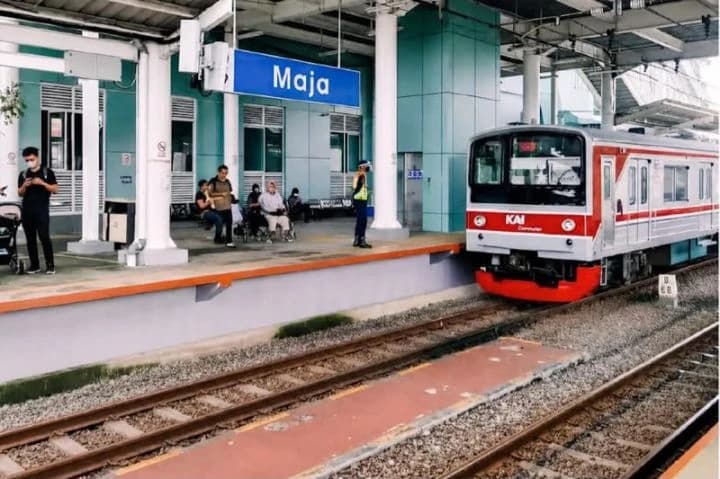
Rangkasbitung Line Prepares to Increase Capacity, KAI Accelerates Power Strengthening and Signaling Modernization
Community mobility on the Tanah Abang–Rangkasbitung corridor continues to show significant growth. To anticipate the increasing demand for service capacity, PT Kereta Api Indonesia (Persero), together with the Directorate General of Railways (DJKA) of the Ministry of Transportation, is preparing electrical system strengthening and signaling modernization on the corridor.
This corridor serves as one of the main railway routes connecting residential areas in western Greater Jakarta with economic, educational, governmental, and public service centers in Jakarta and its surrounding areas.
PT Kereta Api Indonesia (Persero) recorded that the number of KRL Commuter Line users on the Rangkasbitung corridor has continued to increase in recent years. In 2022, the number of customers reached 43,317,716 people. The figure increased to 62,085,471 customers in 2023, then reached 69,999,362 customers in 2024, and rose again to 77,552,716 customers in 2025. During January to May 2026, the number of customers has reached 33,397,420 people.
This growth shows the increasingly important role of the Rangkasbitung Commuter Line in supporting daily community activities. Every day, this service is used by workers, students, university students, business actors, and people traveling to access various services across the Greater Jakarta area. Rail-based mass transportation has become an efficient, affordable, and reliable choice amid increasing urban mobility.
Along with the increase in customer numbers, peak-hour occupancy levels have also continued to rise. Currently, the peak occupancy of the Rangkasbitung Line reaches approximately 161 percent, the highest among other Commuter Line corridors. For comparison, the peak occupancy of the Bogor corridor is around 130 percent, while the Bekasi/Cikarang corridor is approximately 140 percent.
President Director of PT Kereta Api Indonesia (Persero) Bobby Rasyidin explained that the high density level is influenced by limitations in the available train capacity and infrastructure on the Tanah Abang–Rangkasbitung corridor.
“Public demand for the Rangkasbitung Commuter Line service continues to increase. Therefore, KAI together with the Ministry of Transportation’s DJKA is preparing various capacity improvement measures so that customer journeys can become more comfortable and more travel options can be provided,” said Bobby.
The first step to be implemented is strengthening the Overhead Catenary System (Listrik Aliran Atas/LAA) on the Tanah Abang–Rangkasbitung corridor. Currently, the electrical power capacity on this corridor is 3,000 volts, while the Bogor and Bekasi corridors are already supported by 4,000 volts. This difference in capacity means that 12-car train formations cannot yet be operated, so passenger capacity still relies on 8-car and 10-car train formations.
To support increased service capacity, KAI will add 11 traction substations along the Tanah Abang–Rangkasbitung corridor. Strengthening the power supply will become an important foundation to support the operation of 12-car train formations. With larger capacity, the number of customers served on each journey will increase, improving passenger movement during peak hours.
The capacity improvement program is carried out through coordination and synergy between KAI and the Ministry of Transportation’s DJKA as the national railway regulator. The collaboration includes electrical system strengthening planning, corridor capacity development, and modernization of operational systems needed to address growing mobility demands on the Tanah Abang–Rangkasbitung corridor.
The benefits of this electrical system strengthening will be directly experienced by the community. Greater transport capacity will provide opportunities for more comfortable services, reduce congestion on certain trips, and support the growing mobility needs of communities in western Greater Jakarta.
In addition to electrical power strengthening, KAI together with the Ministry of Transportation’s DJKA will also modernize the signaling system. Currently, some signaling systems on the Rangkasbitung corridor still use a closed block system that limits the number of trains operating within one corridor. Under this system, one block covering several stations can only be occupied by one train at a time.
This condition affects the current train headway, which is approximately 10 minutes. As a comparison, the Bekasi and Bogor corridors have been able to serve trains with headways of around 3 to 4 minutes. Through signaling modernization, corridor capacity will increase, allowing more frequent train services and shorter waiting times for customers.
Increased service frequency will provide greater flexibility for communities in determining departure and return times. With more travel options available, customer distribution can become more evenly spread, improving overall service quality.
“Capacity improvement must be carried out comprehensively, starting from rolling stock, electrical power, to signaling systems. Through these steps, transport capacity can increase and the community can receive better services,” said Bobby.
KAI views the improvement of the Rangkasbitung Line capacity as a long-term investment to support community mobility and regional development. As residential areas, economic activities, and social activities continue to grow along the corridor, the need for safe, reliable, and high-capacity mass transportation will continue to increase.
Through collaboration between KAI and the Ministry of Transportation’s DJKA, electrical system strengthening and signaling modernization are expected to provide greater service capacity, shorter train intervals, and a more comfortable travel experience for the community.
Vice President of Corporate Communication KAI Anne Purba stated that improving Rangkasbitung Line capacity is part of a long-term effort to address the continuously growing mobility needs of the community.
“The collaboration between KAI and the Ministry of Transportation’s DJKA is an important foundation in developing Rangkasbitung Commuter Line services. Through gradual infrastructure strengthening and operational system improvements, service capacity can continue to increase so that the community can experience more comfortable, safe, and reliable journeys in the future,” concluded Anne.
VP Corporate Communication KAI