
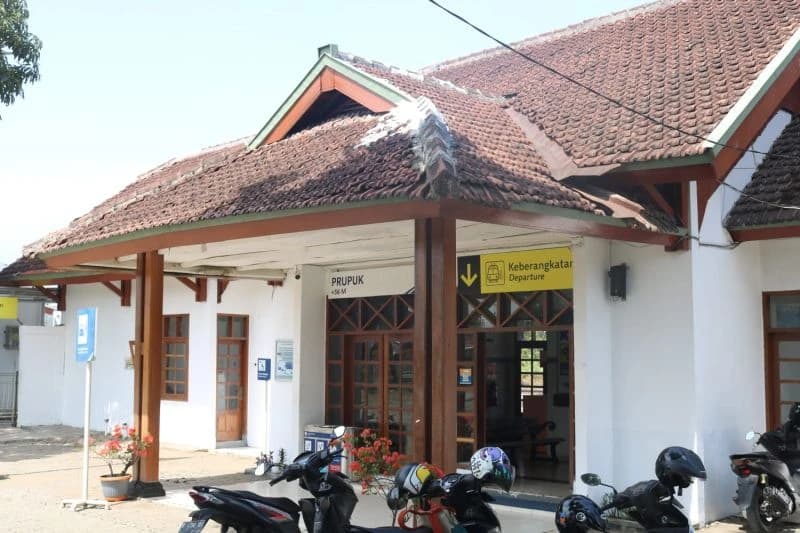
The Northern Gateway to the South: Prupuk Station Drives Emerging Economic Growth in Tegal Regency
The transformation of a region can often be seen through the way its people move. As employment opportunities expand, economic centers grow, and trade activities become more vibrant, the need for travel also increases. In the southern part of Tegal Regency, this dynamic is reflected in the growing mobility at Prupuk Station.
Located in Margasari District, the station occupies a strategic position within Java's railway network. Prupuk Station serves as a junction connecting the Central Java railway corridor of Cirebon–Purwokerto–Kroya with the northern coastal route through Tegal. This position makes Prupuk one of the key gateways for the movement of people, logistics, and economic activities linking various regions across Java.
The growth in public mobility is reflected in the increasing number of customers using rail services to and from the station. From January to April 2026, a total of 15,297 customers departed from Prupuk Station, an increase of 21.96 percent compared with 12,542 customers during the same period in 2025. Over the same period, the number of arriving customers reached 15,205, representing growth of 23.65 percent compared with 12,296 customers in the previous year.
The simultaneous increase in both departures and arrivals indicates that economic activity in the region is expanding in two directions. People use rail transportation for work, education, trade, and tourism to various cities, while at the same time the southern part of Tegal Regency is increasingly attracting travelers from outside the region.
This phenomenon is in line with the demographic and economic development of Tegal Regency. According to Statistics Indonesia (BPS) data for 2025, the population of Tegal Regency reached approximately 1.69 million. Margasari District is one of the most populous areas, with more than 116,000 residents. This large population has created increasing mobility needs as social and economic activities continue to grow.
At the same time, the employment structure of Tegal Regency has also shown significant changes. Data from BPS Tegal Regency in 2025 recorded that formal employment accounted for approximately 41.48 percent of the workforce. This indicates that more people are working in jobs requiring regular travel to economic centers, commercial areas, educational institutions, and service sectors. Under these circumstances, public transportation with reliable schedules and predictable travel times has become increasingly important.
KAI Vice President of Corporate Communication Anne Purba stated that the growth in customer numbers at Prupuk Station reflects the increasingly close relationship between transportation connectivity and regional economic development.
"The growth of public mobility generally goes hand in hand with expanding economic activity. As employment opportunities increase, trade develops, and people become more productive, the demand for travel also rises. Prupuk Station serves as one of the transportation hubs that helps connect communities with these opportunities."
This role has become even more relevant as the southern part of Tegal Regency has developed into a productive agricultural region in recent years. Margasari and its surrounding areas are recognized as one of Indonesia's growing shallot production centers. This horticultural commodity has become a key driver of the local economy while generating increasingly intensive distribution activities to various market destinations.
"Good mobility brings broad benefits to a region. Farmers gain easier access to markets, businesses enjoy wider market opportunities, and communities have more options for employment and entrepreneurship. Transportation connectivity is one of the factors that accelerates regional economic circulation."
To support these needs, Prupuk Station serves various intercity train services, including the Progo, Gajahwong, Kutojaya Utara, Bengawan, Jayakarta, and Gaya Baru Malam Selatan trains. For agglomeration and regional services, customers are also served by the Kamandaka and Joglosemarkerto trains, connecting various cities across Central Java and its surrounding areas. In addition to passenger services, the station also supports the national logistics network through the operation of the Pupuk Indonesia Freight Train, which serves the agricultural sector along the southern Java railway corridor.
Beyond its transportation function, Prupuk Station also serves as a gateway to several of Tegal Regency's leading tourist destinations. Visitors arriving by train can continue their journey to the Guci tourist area, Bumijawa, and various mountain destinations on the slopes of Mount Slamet. This tourism flow generates economic benefits for local businesses, ranging from connecting transportation and accommodations to culinary businesses and micro-enterprises around the tourism areas.
Anne added that the development of a railway station can ultimately be measured by the benefits experienced by the surrounding community. As mobility increases, economic opportunities become more accessible and regional connectivity grows stronger.
"Every customer departing from or arriving at Prupuk Station has a different story and purpose. Some travel for work, education, business, or to reunite with family. Rail transportation is here to connect all of these journeys while supporting more inclusive regional economic growth. KAI will continue to maintain reliable services so that the benefits of this connectivity can be enjoyed by even more communities,"
VP Corporate Communication KAI