
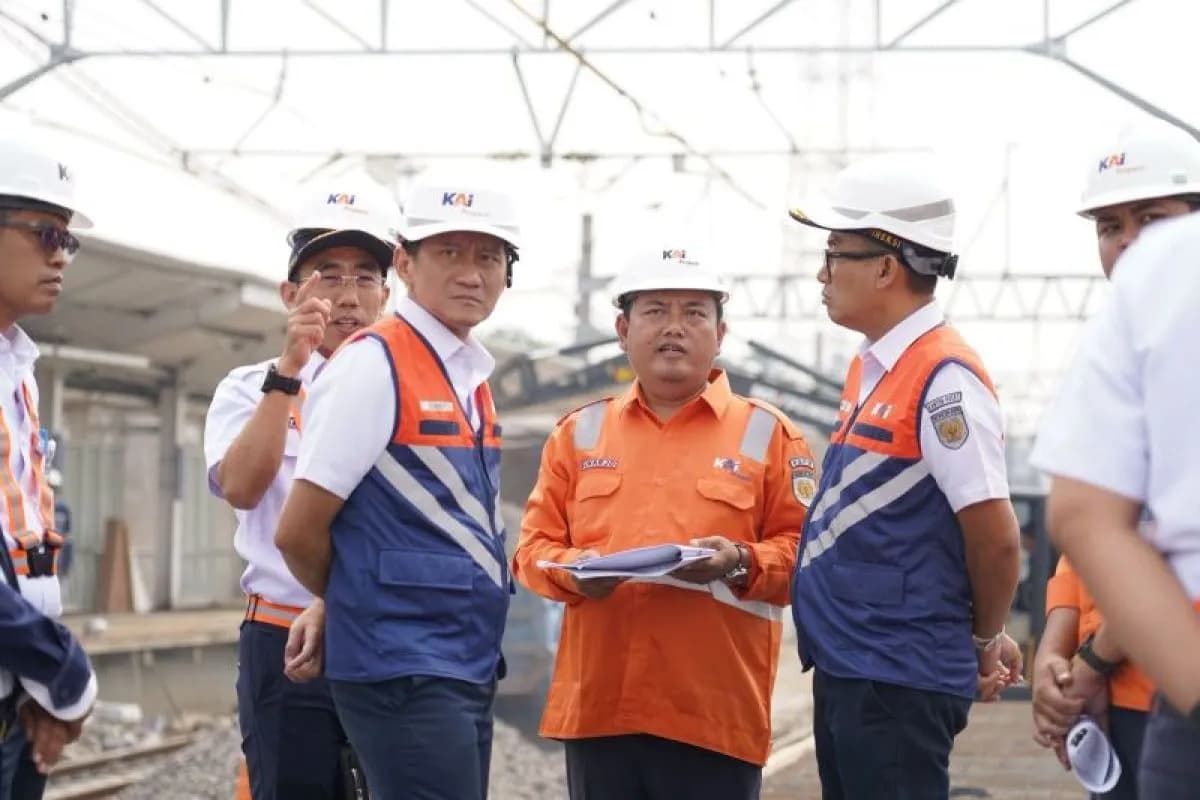
KAI President Director Directly Inspects the Development of Bogor and Bogor Paledang Stations, Bogor Line Capacity Prepared for 12-Train Operations
PT Kereta Api Indonesia (Persero), together with the Directorate General of Railways (DJKA) of the Ministry of Transportation of the Republic of Indonesia, continues to prepare for increased service capacity through the development of Bogor Station and the strengthening of connectivity with Bogor Paledang Station. During a direct inspection of the development of Platforms 6, 7, and 8 at Bogor Station on Monday (1/6), KAI President Director Bobby Rasyidin stated that the acceleration of the ongoing work is an important step in responding to the growing public demand for Commuter Line services.
"Alhamdulillah, the development of Platforms 6, 7, and 8 at Bogor Station is progressing faster than the established target. This acceleration is good news because service capacity can soon be increased to meet the continuously growing mobility needs of the public on the Bogor Line."
The development of Platforms 6, 7, and 8 began on 15 April 2026 and is targeted for completion in July 2026. The platforms are being extended to support the operation of 12-car Commuter Line trainsets (SF12), which have greater passenger capacity.
KAI Vice President of Corporate Communication Anne Purba explained on the same occasion that passenger growth on the Bogor Line has shown a consistently positive trend over the past several years. In 2022, passenger volume reached 102,054,022, increasing to 133,040,885 in 2023, then to 145,920,264 in 2024, and rising again to 155,009,997 in 2025. As of April 2026, passenger volume on the Bogor Line had reached 51,868,066. Over the past three years, passenger volume on the Bogor Line has increased by approximately 52.9 million passengers, representing growth of around 51.9 percent.
According to Anne, this growth indicates that the Bogor Line has developed into one of the main pillars of mobility in the Greater Jakarta area. As the number of passengers continues to increase each year, the need for greater service capacity also continues to grow, both on board trains and at service hubs such as stations. The characteristics of Commuter Line users show that 91 percent of passengers are of productive working age, while 52 percent of trips are made for work or school. A total of 42 percent of users are private-sector employees, and 55 percent have monthly incomes of up to Rp5 million. These figures illustrate the strategic role of rail-based transportation in supporting the daily economic and social activities of the community.
This dynamic is clearly reflected at Bogor Station, which serves as the starting and ending point for the journeys of millions of passengers each year. As the main station on the Bogor Line corridor, passenger activity at the station continues to grow alongside increasing public mobility. Throughout 2025, gate-in volume reached 18,199,619 passengers, while gate-out volume reached 18,171,350 passengers. These figures were higher than in 2024, when gate-in volume reached 17,124,802 passengers and gate-out volume totaled 17,276,284 passengers. During the January–April 2026 period, gate-in volume reached 6,140,074 passengers, while gate-out volume totaled 5,959,832 passengers.
This high level of passenger activity is accompanied by a very high frequency of Commuter Line services. Currently, Bogor Station serves 392 Commuter Line trips on weekdays and 373 trips on weekends. This frequency makes Bogor Station one of the busiest operational stations within the Greater Jakarta Commuter Line network.
Growing mobility in the Bogor area has also strengthened connectivity with surrounding regions. From Bogor Station, passengers can now continue their journey to Sukabumi via Bogor Paledang Station, which is connected through an inter-station skybridge. This facility makes it easier for passengers to transfer from the Commuter Line to the Pangrango Train while also strengthening integration with Trans Pakuan and JR Connexion services, expanding travel access to and from the Bogor area.
This improved connectivity is also reflected in the increasing number of Pangrango Train passengers serving the Bogor–Sukabumi corridor. Passenger volume increased from 786,001 in 2023 to 874,789 in 2024 and rose again to 1,109,398 in 2025. In the first quarter of 2026, the service carried 281,659 passengers. This growth trend demonstrates the increasingly strong mobility connection between Bogor and Sukabumi supported by rail transportation.
Passenger growth on the Bogor Line, high activity at Bogor Station, and increasing connectivity to Sukabumi provide the basis for KAI to continue strengthening service capacity along this corridor. Through the extension of Platforms 6, 7, and 8, Bogor Station is being prepared to support the operation of SF12 trainsets with greater carrying capacity per trip, enabling more optimal passenger distribution, particularly during peak hours. In addition to increasing service capacity, this development also reinforces Bogor Station's role as an integration hub connecting urban mobility with travel to the southern region of West Java.
In addition to work on the platform area, the development also includes the construction of a new canopy connected to the station concourse to improve passenger comfort when transferring between platforms or waiting for trains. The project has now entered the stage of reinstalling the Overhead Catenary System (LAA) poles and constructing the new platform structure. All work is being carried out in phases while maintaining railway operational safety and ensuring uninterrupted customer service.
Throughout the construction process, KAI, together with KAI Commuter, continues to manage passenger flow, optimize staff services, and provide intensive travel information. Passenger flow management is also implemented during peak periods to ensure smooth mobility within the station area. Passengers heading to the West Hall may be directed through the Paledang Pedestrian Overpass (JPO), while access to the Hat Park Hall and the East Entrance of Bogor Station continues to be optimized to support smooth passenger movement.
During the inspection, Bobby was accompanied by KAI Director of Business and Development Rafli Yandra, KAI Director of Operations Awan Hermawan Purwadinata, KAI Director of Infrastructure Management Heru Kuswanto, KAI Director of Safety and Security Dadan Rudiansyah, KAI Director of Finance and General Affairs Indarto Pamoengkas, along with other members of KAI's management.
"The Bogor Line is the corridor with the highest passenger volume in the Greater Jakarta Commuter Line network. Therefore, we will continue to improve service capacity and quality in stages. The development of Bogor Station, the strengthening of connectivity through Bogor Paledang, and intermodal integration are all part of KAI's efforts to provide journeys that are increasingly easier, more comfortable, and better connected for the public,"
VP Corporate Communication KAI