
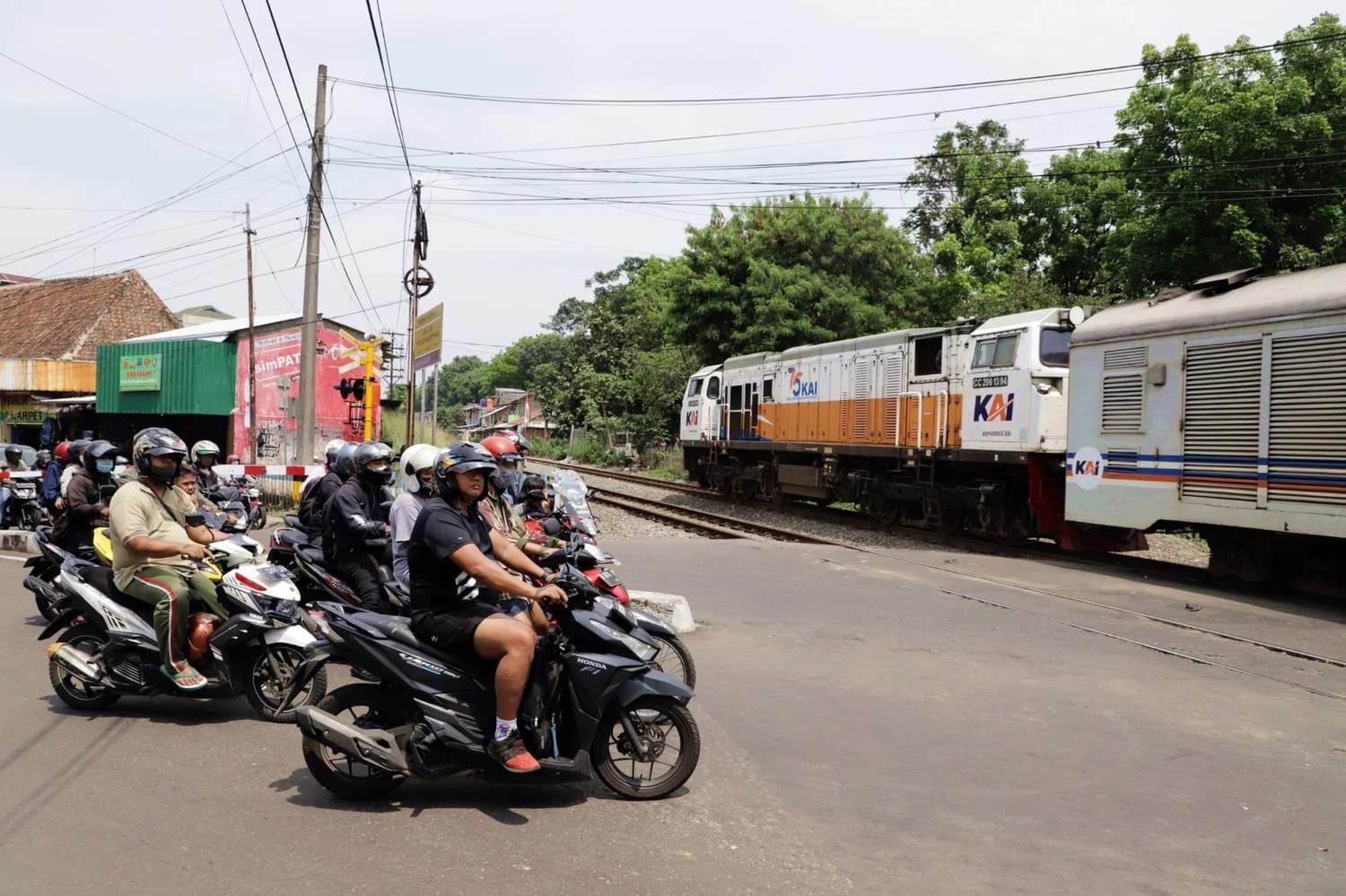
Look Both Ways Before Crossing Railway Tracks, Safe Travel Starts with Discipline at Level Crossings
Public mobility has increased again at the start of the week. Commuting to work, taking children to school, logistics distribution, and intercity travel have led to heavier traffic in many areas, including around railway level crossings.
PT Kereta Api Indonesia (Persero) reminds the public to always stop briefly, look both left and right, ensure the track is clear, and give priority to train movements when crossing railway level crossings.
KAI Vice President of Corporate Communication Anne Purba said that safety at level crossings largely depends on the discipline of road users. In many cases, accidents occur because motorists are in a hurry, force their way through crossings, or fail to ensure that the tracks are clear before crossing.
"Taking a few seconds to stop and observe track conditions can help protect many lives. We encourage the public to be more disciplined when crossing railway level crossings, especially during the busy morning and evening hours," she said.
Currently, there are 3,674 railway level crossings in Indonesia, with 1,810 locations identified as priority areas for intervention. These priorities are determined based on risk levels in the field, including traffic volume, road width, proximity to residential areas and public activity centers, as well as the geometric conditions of the crossings that affect the safety of both train operations and road users.
Of these, 172 locations have been designated for closure due to limited road conditions and high risk levels, while the remaining 1,638 locations require gradual improvements to safety facilities, including the deployment of crossing guards, installation of warning devices, and enhancement of safety systems.
As of 23 May 2026, KAI, together with relevant stakeholders, has completed the closure of 94 level crossings, representing approximately 55 percent of the initial intervention target. Several operational regions have even achieved 100 percent progress, including Divre I North Sumatra, Divre III Palembang, Daop 2 Bandung, Daop 3 Cirebon, Daop 6 Yogyakarta, Daop 7 Madiun, and Daop 8 Surabaya.
At the same time, KAI continues to promote enhanced safety measures at active level crossings that still experience high traffic volumes. Based on field inventory results, several crossings are located in areas experiencing continuous growth in residential development and economic activity.
In South Sumatra and Lampung, for example, the Sukamerindu–Tanjung Rambang crossing has a road width of up to 13 meters, while the Air Asam–Sukamerindu crossing has a road width of 12 meters. Both crossings are used daily by logistics vehicles and local residents.
Meanwhile, in Central Java, West Java, and the Pantura region, a number of level crossings are located along agricultural distribution routes, access roads to traditional markets, small industrial areas, and commuter routes with heavy vehicle activity from morning until night.
According to Anne, these conditions make the need to improve safety at level crossings increasingly urgent. In addition to reorganizing and closing high-risk crossings, KAI is also encouraging the acceleration of flyover and underpass construction in areas with high traffic volumes.
"Public mobility continues to grow from year to year. Therefore, improvements to level crossings must also progress more rapidly so that the safety of both train operations and road users can be equally safeguarded," she said.
From a technical perspective, trains require a considerable safe distance to brake. At a speed of 120 kilometers per hour, the ideal braking distance can range from 800 to 1,200 meters. Therefore, ensuring that the tracks are completely clear before a train passes is a crucial factor in maintaining operational safety.
In addition to infrastructure improvements, KAI is also accelerating the deployment of level crossing guards. Currently, more than 4,914 crossing attendants (PJL) are needed to support safety operations at the 1,638 priority locations. Recruitment, training, and certification are being carried out gradually in collaboration with regional governments and the Directorate General of Railways (DJKA).
"Railway operational safety requires consistent efforts in the field. The sooner high-risk locations are identified, improved, and jointly monitored, the greater the level of safety that can be provided for the public," she concluded.
VP Corporate Communication KAI