
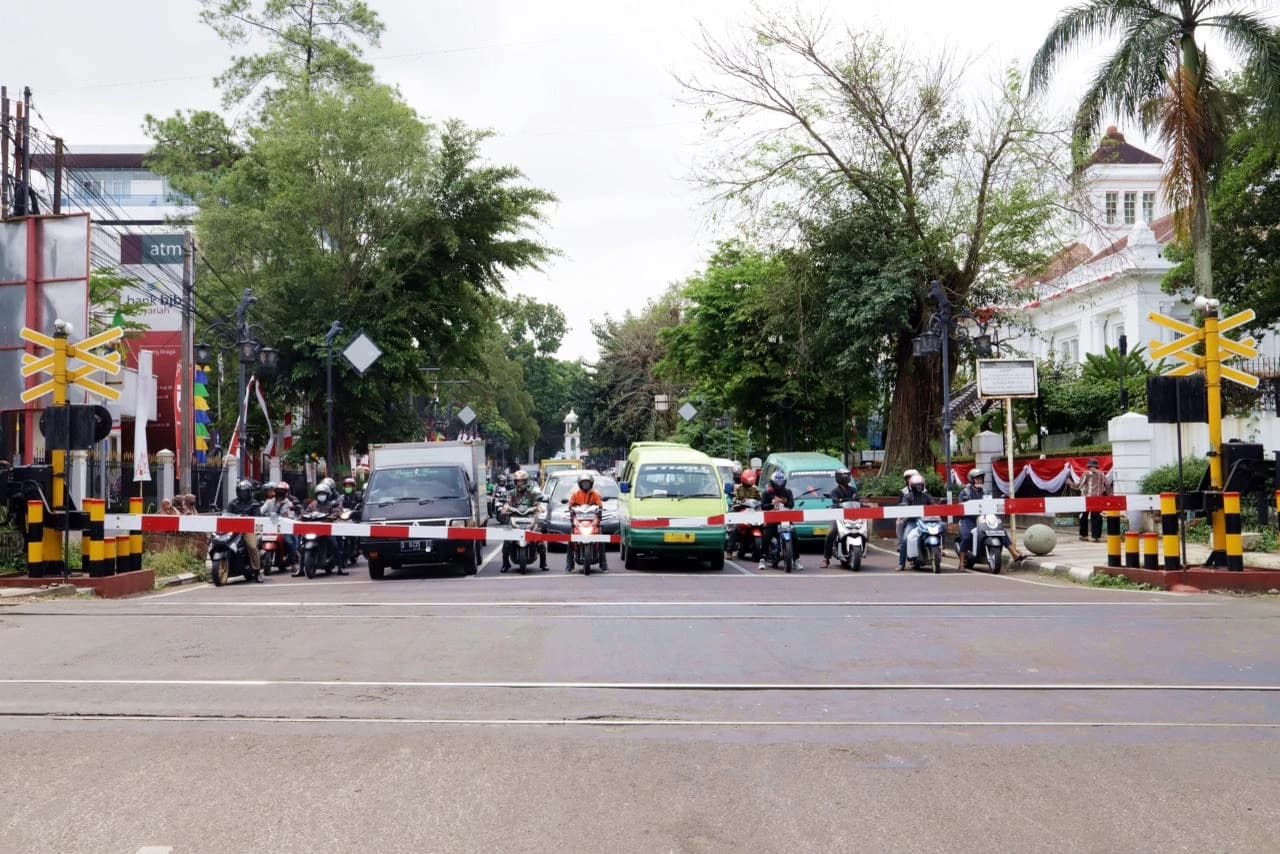
Traveling This Weekend? Look Both Ways Before Crossing Railway Tracks
Weekend travel brings increased public mobility across many regions. Families head to tourist destinations, people return to their hometowns, visit traditional markets, or explore other cities. Amid this surge in activity, PT Kereta Api Indonesia (Persero) reminds the public to remain vigilant when crossing railway level crossings.
Vice President Corporate Communication KAI Anne Purba stated that safety at railway crossings largely depends on the discipline of road users. Motorists are urged to stop before crossing, look both ways, ensure that no train is approaching, and always give priority to trains.
“Sometimes a destination feels close and people are in a hurry, but taking just a few seconds to stop and check the railway can save many lives. We encourage the public to remain disciplined and exercise greater caution when crossing railway tracks at level crossings.”
According to Anne, many active railway crossings are located in areas where community activities continue to grow. Some serve as primary access routes to schools, traditional markets, residential areas, local commercial centers, as well as agricultural and logistics distribution routes.
KAI records show that there are still 40 active railway crossings with relatively wide roadways and heavy vehicle traffic across various operational regions. In Banten, for example, several crossings are located between Tigaraksa and Rangkasbitung, serving as key access routes for residential communities and daily commuters.
In West Java, several crossings are situated around Purwakarta and rural railway corridors, where they are crossed daily by motorcycles as well as vehicles transporting agricultural products.
Meanwhile, within Operational Area 3 Cirebon, railway crossings are located in Jatibarang, Kertasemaya, Pegadenbaru, Cipunegara, Arjawinangun, and Bangoduwa. These areas experience busy daily traffic, including agricultural transport, local commerce, and the mobility of workers and students.
In Central Java, several crossings are located along the Pemalang, Slawi, Prembun, Grobogan, Randublatung, and Pantura corridors, which serve as important routes supporting local economic activities. During peak hours, these crossings experience heavy motorcycle and car traffic.
Similar conditions are found in the Special Region of Yogyakarta and southern Central Java, including Srowot, Brambanan, and Masaran, where crossings are located in densely populated communities and along routes leading to key public activity centers.
In South Sumatra and Lampung, several crossings are located on intercity transportation routes and logistics distribution corridors. Some crossings feature wide roadways but are not yet fully guarded. For example, the Sukamerindu–Tanjung Rambang crossing has a road width of 13 meters, while the Air Asam–Sukamerindu crossing is 12 meters wide and serves daily logistics transportation and community mobility.
“Field observations show that many of these crossings are located on busy roads. Some serve community traffic from morning until night, while others have developed into important routes supporting regional economic distribution.”
Anne explained that the expansion of residential areas and economic activities has significantly increased traffic volumes at many railway crossings compared with several years ago. Therefore, improving railway crossing safety infrastructure has become increasingly important.
KAI continues to encourage the accelerated construction of flyovers and underpasses at locations with heavy road traffic and higher safety risks to further enhance the safety of both railway operations and road users.
“Flyovers and underpasses provide a long-term solution for areas with high traffic volumes. As at-grade crossings are gradually reduced, the safety of both the public and railway operations will continue to improve.”
VP Corporate Communication KAI