
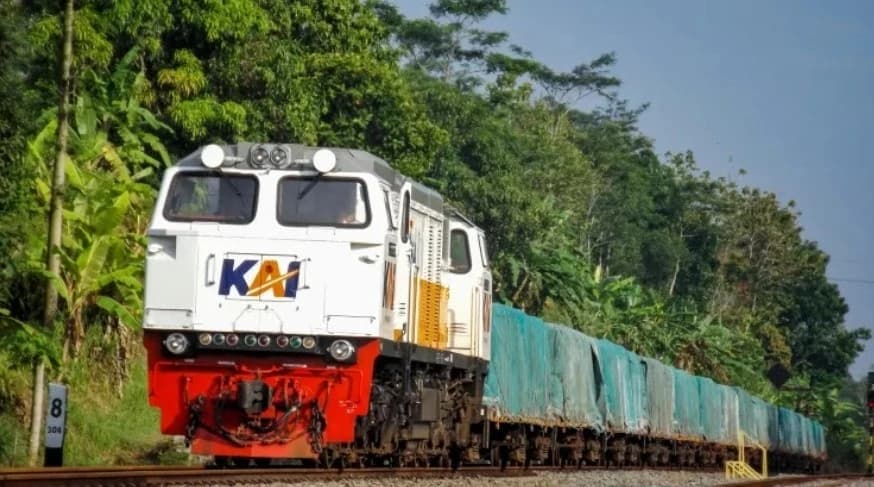
KAI's Container Freight Transportation Grows 21.75% in January–April 2026
National logistics movement continues to grow alongside increasing industrial activity, trade, and goods distribution across various regions of Indonesia. Amid the growing need for faster and more efficient supply chains, rail-based transportation is playing an increasingly significant role as a high-capacity freight distribution mode that offers greater certainty in terms of time, cost, and carrying capacity.
PT Kereta Api Indonesia (Persero) recorded container freight volume of 1,912,392 tons during January–April 2026, an increase of 21.75% compared with 1,570,835 tons during the same period in 2025. This growth reflects the increasing demand for rail-based logistics distribution, particularly to support connectivity between industrial estates, ports, and distribution centers across Java.
Vice President Corporate Communication KAI Anne Purba stated that the increase in container freight reflects a shift in logistics distribution patterns toward a more efficient and integrated mass transportation system.
“Rail-based freight transportation is capable of carrying large volumes of cargo in a more predictable manner. When goods distribution becomes more efficient, the benefits extend throughout industrial supply chains, businesses, and ultimately the public as end users of products.”
According to Anne, the growth in container freight is also closely related to industry's increasing demand for a more competitive distribution system. As logistics activities continue to expand, the need for transportation modes with larger capacity and more reliable transit times becomes increasingly important.
KAI continues to strengthen the development of freight logistics infrastructure through collaboration with various stakeholders. One such initiative is the signing of a Memorandum of Understanding on the development of rail-based logistics at the Dry Port of the Batang Industropolis Special Economic Zone (SEZ), in partnership with PT Kawasan Industri Terpadu Batang, PT Pelabuhan Indonesia (Persero), PT Sarana Pembangunan Jawa Tengah (Perseroda), and Perumda Aneka Usaha Kabupaten Batang.
The dry port development is intended to establish a logistics system that directly connects industrial estates, railway networks, and ports. This scheme is expected to reduce dependence on road freight transportation, which currently faces high levels of congestion.
“When industrial estates are directly connected to railway networks and ports, the distribution process becomes more efficient. Goods can be transported in large volumes through a more stable operational pattern and at more competitive logistics costs.”
Currently, Indonesia's logistics costs remain in the range of 15% to more than 20% of Gross Domestic Product (GDP), while the global benchmark is around 7–8%. This gap represents both a significant challenge and an opportunity to develop a more efficient national logistics system.
On the island of Java alone, approximately 60% of national logistics activities take place, with logistics costs estimated at Rp2.4–2.5 quadrillion annually. At this scale, improving distribution efficiency can have a substantial economic impact on national industrial production costs.
KAI also continues to increase freight transportation capacity by strengthening its rolling stock. The company currently operates freight wagons with an average capacity of 50 tons per wagon and is developing capacity to reach 70 tons per wagon. With a single train consisting of up to 60 wagons, total carrying capacity can reach approximately 4,200 tons in one trip.
In addition to carrying capacity, operational punctuality remains a key factor in national logistics distribution. During January–April 2026, KAI recorded an on-time performance (OTP) of 95.97% for freight train departures and 91.77% for arrivals. These figures demonstrate how rail-based freight transportation provides the schedule reliability increasingly required by industrial estates, ports, and national supply chains.
This substantial carrying capacity illustrates how rail freight can help reduce congestion on highways. In a single journey, freight trains are capable of transporting large cargo volumes simultaneously while requiring less energy and distribution space.
In addition to strengthening carrying capacity, KAI is also promoting the development of direct railway connections to ports to improve freight distribution flexibility. Currently, freight transportation to Tanjung Priok Port still relies on existing rail infrastructure with certain operational time limitations. The development of direct connectivity is expected to accelerate the movement of goods from industrial areas to export ports and domestic distribution hubs.
Anne added that the development of rail-based logistics also creates opportunities for new economic growth in various regions. The presence of dry ports and freight distribution networks can stimulate the development of warehousing areas, logistics consolidation centers, and supporting economic activities around distribution hubs.
“Freight rail is becoming an essential component in building a more efficient and interconnected national supply chain. As distribution improves, industries become more competitive, the movement of goods becomes smoother, and regional economic growth also advances.”
VP Corporate Communication KAI