
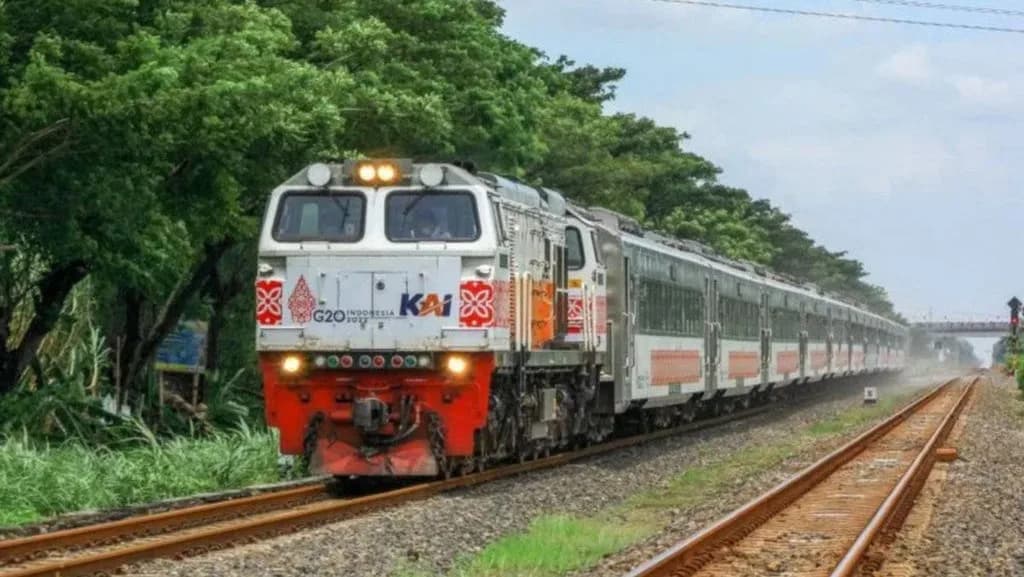
Railway Development Outside Java Deemed Crucial to Strengthen National Logistics
The development of industrial estates, ports, and commodity centers outside Java Island makes national logistics connectivity needs continue to move following the direction of new economic growth. In this condition, rail-based transportation is beginning to be seen as having an increasingly strategic role to maintain the smooth distribution of goods in large volumes sustainably.
Therefore, the government continues to accelerate discussions on the development of the Trans Sumatra, Kalimantan, and Sulawesi railway networks as part of strengthening long-term national connectivity.
Coordinating Minister for Infrastructure and Regional Development Agus Harimurti Yudhoyono stated that the development of the rail network is one of the infrastructure development priorities currently being discussed across ministries and institutions.
"We hope trains can play a larger role for both passengers and freight transport. That way, regional connectivity and productivity can continue to increase," AHY said after a coordination meeting on the development of the national railway network at Tanah Abang Station, Jakarta, Tuesday (22/4).
In line with that, KAI Vice President of Corporate Communication Anne Purba stated that the current national logistics distribution needs are increasingly closely tied to the development of production and industrial areas in various regions, especially outside Java Island.
According to Anne, the distribution pattern of commodities in large quantities requires a transportation system capable of moving stably, on schedule, and connected to production centers as well as ports.
For example, KAI recorded that plantation transport volume throughout January–April 2026 reached 213,857 tons, an increase of 6.18 percent compared to the same period in 2025 which was 201,408 tons.
Most of this transport was dominated by crude palm oil (CPO) and palm oil derivatives used for food industry needs to national biodiesel blends.
"The growth in plantation transport shows that the distribution activity of strategic commodities continues to develop. The mobility of production outputs in large quantities requires connectivity support that can maintain the continuity of goods travel from production areas to processing facilities and ports,"
She explained that in a number of commodity-producing regions, logistics distribution often travels long distances between regions. In such situations, rail-based transportation becomes an important part in supporting distribution efficiency because it has a large hauling capacity and consistent travel patterns.
According to Anne, the development of the railway network will also strengthen connectivity between economic nodes, ranging from industrial estates, ports, to regional distribution centers.
"When inter-regional connectivity gets better, logistics movement becomes more integrated and regional economic growth space also develops,"
The government estimates that the need for national rail network development reaches around 14,000 kilometers which will be carried out gradually through various development priorities and financing schemes.
In addition to supporting logistics connectivity, the development of rail-based transportation is also part of strengthening a sustainable transportation system. In the coordination meeting, Coordinating Minister AHY conveyed that train carbon emissions are relatively small compared to road-based land transportation modes.
Currently, the national railway network is still dominated in Java Island. Sumatra already has a continuously developing rail network, while Sulawesi and Kalimantan are part of the government's medium and long-term development plans.
"Railway development requires cross-sector synergy because transport connectivity will determine the smoothness of distribution, regional competitiveness, and future economic growth,"
VP Corporate Communication KAI