
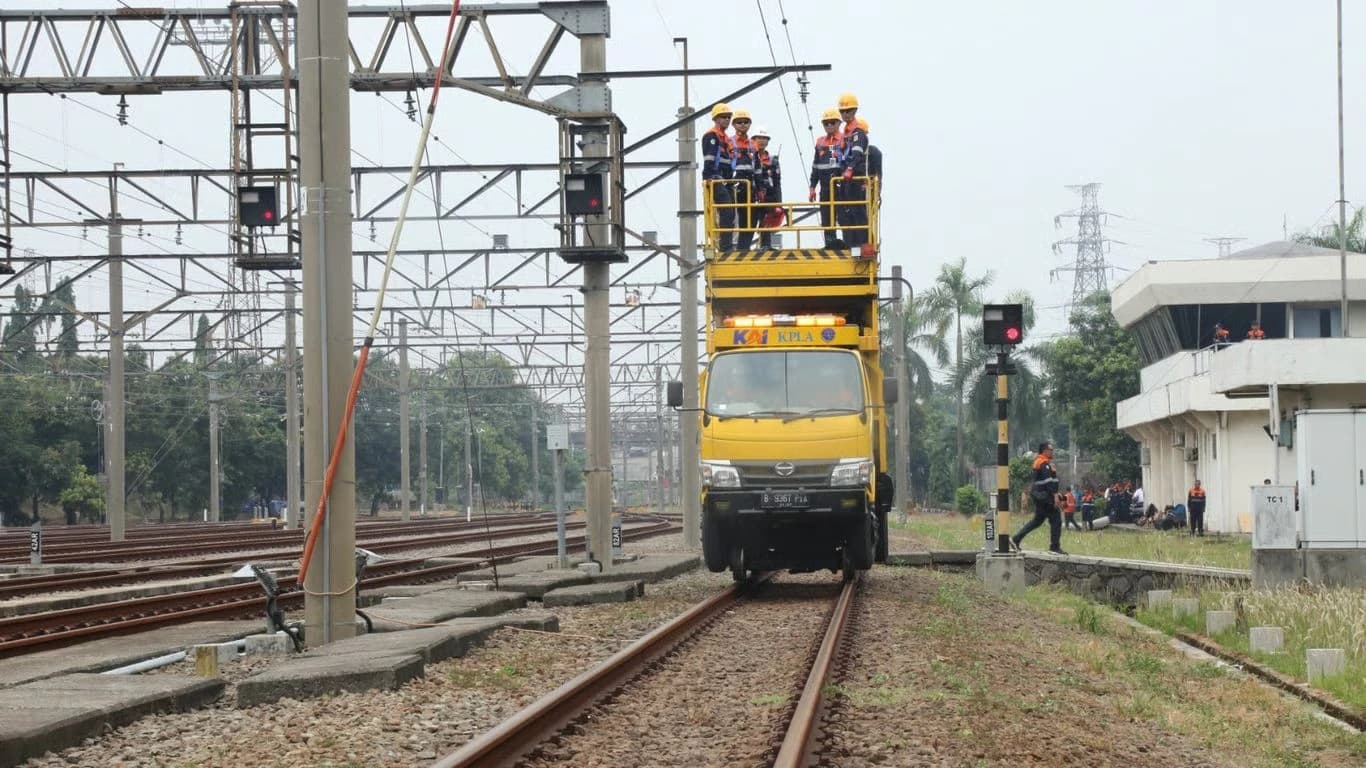
Railway Electrification Becomes the Main Driver of Modern Urban Mobility
The growth of urban mobility over the past decade has driven the need to strengthen railway electrification across metropolitan areas. The increasing number of Commuter Line (KRL) services, the expansion of suburban residential areas, and the growth of economic activity centers have all increased the demand for electrical power to ensure smooth railway operations.
Vice President Corporate Communication KAI Anne Purba stated that electrification plays a vital role in modern urban transportation systems because it is directly related to service capacity, operational stability, and the reliability of signaling systems managed in collaboration with the Directorate General of Railways (DJKA) of the Ministry of Transportation.
“As the number of Commuter Line services continues to increase, the demand for electrical power also grows. Strengthening railway electrification is essential to maintain operational stability, support signaling systems, and ensure that Commuter Line services remain safe and reliable on increasingly busy corridors.”
According to research on urban travel and railway electrification, Commuter Line ridership has increased significantly over the past decade, rising from 257 million passenger journeys in 2015 to 401 million in 2025. During this period, urban mobility increased by more than 140 million passenger journeys. Mobility also recovered rapidly following the pandemic, with passenger growth reaching 50% in 2022 and increasing by another 31% in 2023.
This growth in mobility is also reflected in the increasing number of daily Commuter Line services. In 2015, there were 881 train services per day, increasing to 1,063 daily services by 2025. The Bogor Line recorded the highest service frequency with 299 daily trips, followed by the Bekasi Line with 232 trips and the Serpong Line with 204 trips. These figures demonstrate the growing need for greater capacity and operational stability across high-density urban railway corridors.
Anne explained that as train headways become shorter, railway operations require increasingly strong and stable electrification systems. Adequate power supply is essential for maintaining Commuter Line performance, including supporting signaling equipment, traction power substations, and operational control across busy corridors coordinated with the Directorate General of Railways (DJKA) of the Ministry of Transportation.
“Electrification is closely related to the railway system's ability to accommodate growing travel demand. As urban mobility increases rapidly, power infrastructure must be strengthened to ensure stable operations and minimize the risk of service disruptions.”
The research also shows that Greater Jakarta's urban mobility has become one of the largest in Southeast Asia, reaching 349.3 million passenger journeys in 2025. This figure is significantly higher than other urban regions such as Bandung with 18.7 million passenger journeys, Surabaya with 16 million, and Yogyakarta with 10.1 million.
This development has gone hand in hand with the continuous transformation of urban railway services led by the Directorate General of Railways (DJKA) of the Ministry of Transportation together with railway operators, including station revitalization, intermodal integration, service digitalization, enhanced connectivity to strategic areas, and the development of new mobility hubs in metropolitan regions. Electrification forms an essential part of supporting these integrated and sustainable transportation systems.
As part of strengthening the urban railway power system, KAI also supports the planned development of electrification infrastructure at Jatake Station, which is projected to become one of the strategic power supply points for future Commuter Line operations. This development is expected to help maintain operational stability, improve signaling system reliability, and anticipate future increases in train frequencies across urban corridors.
Looking ahead, the need to strengthen railway electrification is expected to become even more important alongside the development of new urban areas, increased service frequency, optimized train headways, and greater transport integration with strategic areas and emerging activity centers, including business districts, integrated residential developments, and international activity hubs.
“Rail-based transportation has become the backbone of urban mobility. Therefore, railway electrification development should be viewed as a long-term investment in strengthening the transportation system to maintain service capacity, improve travel efficiency for the public, and enhance connectivity across urban areas.”
VP Corporate Communication KAI