
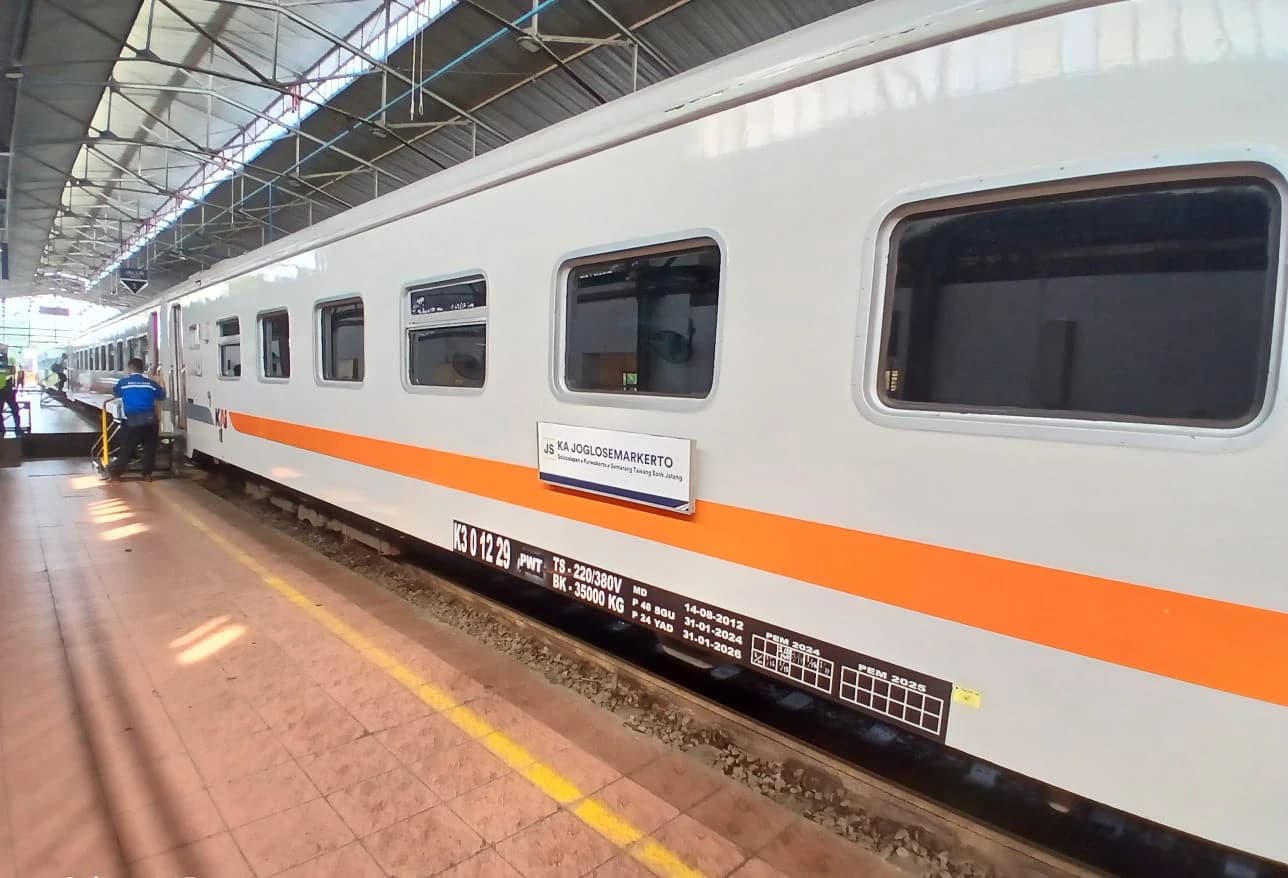
Joglosemarkerto Train Connects Education, Tourism, and Economic Mobility Across Central Java and Yogyakarta
The Special Region of Yogyakarta and Central Java have long been recognized as one of Indonesia's major centers for education, tourism, and economic activity. Every year, thousands of students from across the country come to Yogyakarta, Solo, Semarang, Purwokerto, and Tegal to pursue higher education, work, or conduct business activities. At the same time, tourism and intercity travel within the region continue to grow alongside increasing public mobility.
According to Statistics Indonesia (BPS) 2025 data, the Gross Enrollment Rate (GER) for higher education in the Special Region of Yogyakarta reached 74.70%, the highest in Indonesia and well above the national average. Meanwhile, Central Java is one of the provinces with the largest concentration of higher education institutions in Indonesia, spread across cities such as Semarang, Surakarta, Purwokerto, and Salatiga. These conditions have created highly dynamic intercity mobility involving students, workers, tourists, and business communities.
Amid this high level of mobility, the Joglosemarkerto Train has become one of the railway services playing a strategic role in connecting major cities across Central Java and the Special Region of Yogyakarta. During January–April 2026, the Joglosemarkerto Train served 458,938 passengers, an increase of 11.41% compared with 411,931 passengers during the same period in 2025.
Vice President Corporate Communication KAI Anne Purba stated that the growing number of Joglosemarkerto Train passengers reflects the increasing demand for intercity travel across Central Java and Yogyakarta, particularly for education, tourism, and economic activities that are closely interconnected.
“The Joglosemarkerto Train has a unique travel pattern because it connects many cities along a circular route. Public mobility becomes more efficient, as passengers can travel between cities without changing trains, whether for education, work, tourism, or other economic activities.”
During January–April 2026, the two train services with the highest passenger volumes were Train No. 187, operating on the Solo Balapan–Semarang Tawang–Tegal–Purwokerto–Solo Balapan–Semarang Tawang route, serving 168,971 passengers, and Train No. 193, operating on the Solo Balapan–Purwokerto–Tegal–Semarang Tawang–Solo Balapan route, serving 160,401 passengers. The high passenger volume demonstrates the strong connectivity among Solo, Semarang, Tegal, and Purwokerto, which serve as major centers of activity in Central Java.
KAI has observed increasingly diverse travel patterns among Joglosemarkerto Train passengers. Many passengers use the service for educational travel to Yogyakarta and Solo, which are widely recognized as student cities, while others rely on the train for business and commercial activities in Semarang, Pekalongan, Tegal, and Purwokerto. This pattern has made rail travel an essential part of supporting productivity across various sectors.
In addition to education and economic activities, the Joglosemarkerto Train route also provides direct access to many of Central Java and Yogyakarta's leading tourist destinations. From Yogyakarta, passengers can visit the Malioboro area, Yogyakarta Palace, and Prambanan Temple. In Solo, attractions include the Surakarta Palace, Mangkunegaran Palace, and Laweyan Batik Village. Meanwhile, Semarang offers the Old Town, Lawang Sewu, and its continuously developing historical tourism district.
The journey continues toward the northern coastal region, including Pekalongan, known as Indonesia's batik city; Tegal, renowned for its culinary attractions and regional trade; and Purwokerto, the gateway to the Baturraden tourism area and the slopes of Mount Slamet. This connectivity gives the Joglosemarkerto Train a broader role than conventional transportation services, as it also links economic growth centers and tourism destinations throughout Central Java.
According to Statistics Indonesia (BPS) 2025 data, Central Java recorded more than 58 million domestic tourist trips throughout 2024, while the Special Region of Yogyakarta welcomed more than 9 million tourist visits. These figures indicate that demand for safe, efficient, and affordable intercity transportation continues to increase year after year.
Since commencing operations on 1 December 2018, the Joglosemarkerto Train has grown into one of the railway services with the longest and most unique connectivity patterns on the island of Java. Its circular route enables passengers to reach numerous cities in a single journey while simultaneously supporting local economic activities at various stations, including culinary businesses, connecting transportation services, accommodations, and small and medium-sized enterprises (SMEs) surrounding the stations.
Anne added that the continued growth in Joglosemarkerto Train ridership demonstrates that rail-based transportation is increasingly becoming the preferred choice for intercity travel.
“Railways have become an essential part of supporting the increasingly dynamic mobility of the public. The Joglosemarkerto Train demonstrates how transportation connectivity can strengthen access to education, support regional tourism growth, and drive economic activity throughout Central Java and the Special Region of Yogyakarta.”
VP Corporate Communication KAI