
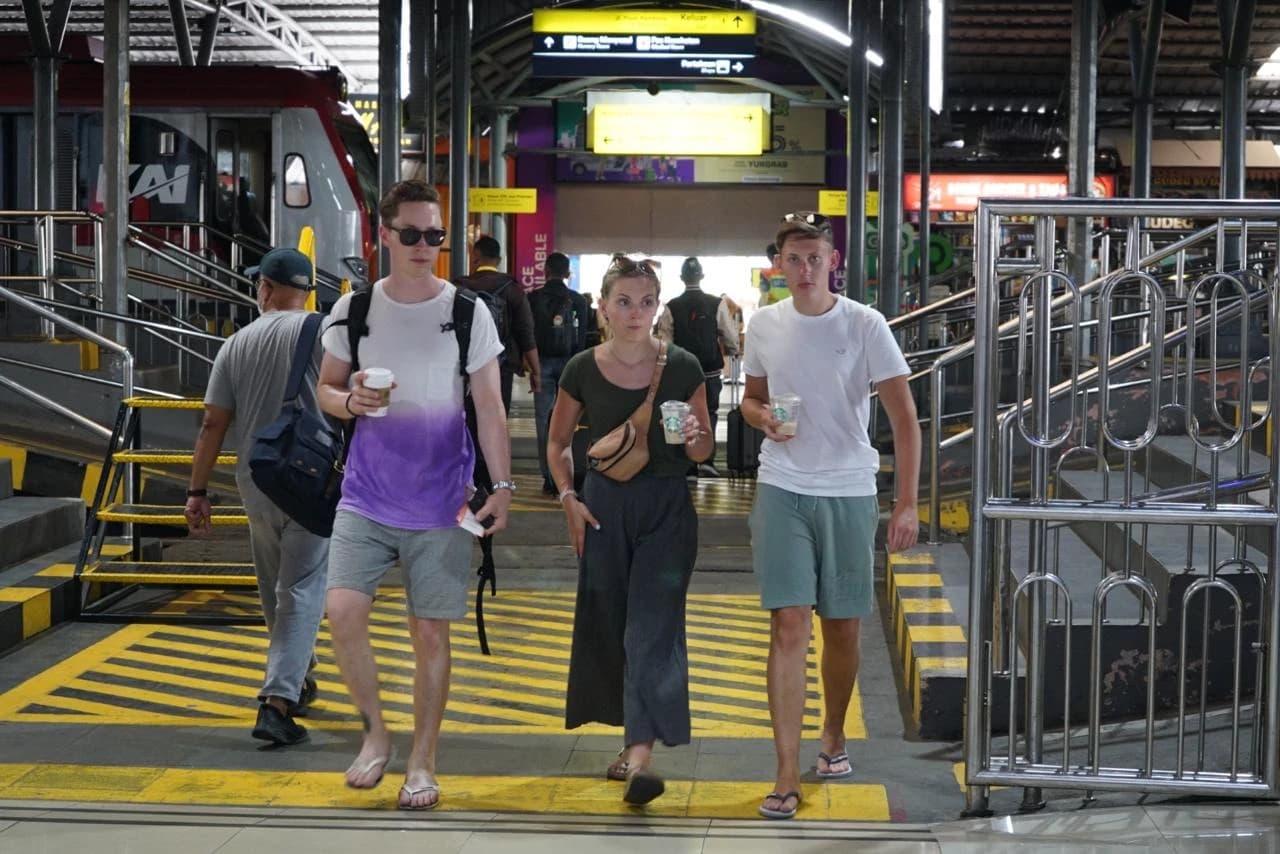
Public Order Culture in Shared Spaces Helps Shape Tourists’ Experience in Indonesia
There are small things that often seem ordinary in everyday life, yet quietly leave a lasting impression on people visiting Indonesia. One of these can be seen in public transportation.
When someone pauses at a level crossing, waits patiently for a train to pass while observing their surroundings, allows passengers to disembark before boarding, or remains orderly in a busy station, these moments become part of the experience that tourists take away during their stay in Indonesia.
Railways provide a shared space where people from different backgrounds come together on the same journey. In this space, tourists can observe how people share public areas, queue patiently, maintain mutual comfort, and respect the safety of others during travel.
Vice President of Corporate Communication KAI, Anne Purba, stated that international tourists' experiences while using public transportation are often shaped by the simple moments they encounter throughout their journey.
“Tourists usually remember the atmosphere they experience while visiting a country from the way people wait for trains and the environment at stations to how individuals respect one another in public spaces. These are the kinds of experiences that often remain in their memories,” said Anne.
Between January and April 2026, a total of 180,670 international tourists used KAI's long distance train services. In April 2026 alone, the number reached 51,565 customers, marking the highest monthly figure recorded so far this year.
Cumulatively, the ten stations with the highest number of international tourist departures between January and April 2026 were Gambir Station with 29,013 customers, Yogyakarta Station with 26,365 customers, Bandung Station with 15,780 customers, Pasarsenen Station with 10,486 customers, Surabaya Gubeng Station with 9,043 customers, Semarang Tawang Station with 6,946 customers, Malang Station with 5,435 customers, Surabaya Pasar Turi Station with 4,650 customers, Cirebon Station with 4,215 customers, and Solo Balapan Station with 3,747 customers.
According to Anne, the growing interest of international tourists in traveling by train indicates that intercity rail journeys have become an integral part of the tourism experience across Java and Sumatra. During these trips, visitors can observe everyday life firsthand, from the atmosphere at railway stations and urban areas to the communities surrounding railway lines.
It is in these moments that a culture of order in public spaces contributes to the overall visitor experience. Throughout their journey, tourists witness how local communities carry out their daily activities while respecting shared safety.
“Level crossings are one of the public spaces that demonstrate how communities work together to maintain travel safety. When road users wait patiently and give priority to passing trains, it creates a sense of safety and comfort for everyone,” Anne explained.
She added that tourists' positive impressions often grow from the simple experiences they encounter firsthand while visiting Indonesia. Some appreciate the orderly nature of their journey, others enjoy the lively yet well-organized atmosphere at stations, while many notice how people continue to value safety in public spaces.
According to Anne, these experiences often become the stories that tourists take home after returning to their own countries.
“When tourists feel comfortable during their journey and observe an orderly society, they are likely to share those positive impressions with others. That is how trust grows, and positive experiences about Indonesia continue to spread,” Anne concluded.
VP Corporate Communication KAI