
KAI’s Coal Transport Plays a Vital Role in Energy Distribution Across Java and Bali
In Java and Bali, electricity needs continue to move following community activities and economic growth. Schools, hospitals, public transportation, digital data centers, industrial estates, to government services require a stable energy supply every day.
In the national electricity structure, coal remains one of the main energy sources for power plants. Therefore, the continuity of coal distribution is an important part of maintaining the stability of community activities and the national economy.
One such distribution is carried out through train transport. From January to April 2026, PT Kereta Api Indonesia (Persero) transported 16,631,048 tons of coal. Specifically for April 2026, the transport volume reached 4,633,495 tons.
Most of this transport is used to support power plant needs, especially in Java and Bali which, according to 2025 Central Bureau of Statistics (BPS) data, are inhabited by more than 163 million residents or about 58 percent of Indonesia's population.
KAI Vice President of Corporate Communication Anne Purba stated that energy distribution requires a transportation mode with large capacity, stable operation patterns, and the ability to maintain supply continuity in the long term.
"Energy distribution has a direct connection with community activity and economic productivity. Therefore, a stable transport pattern is important so that the energy supply chain can run well," Anne said.
In the national logistics system, trains are considered to have characteristics suitable for long-distance mass commodity transport. In addition to large capacity, railway tracks separated from highway traffic make distribution more measurable in terms of travel time and operating patterns.
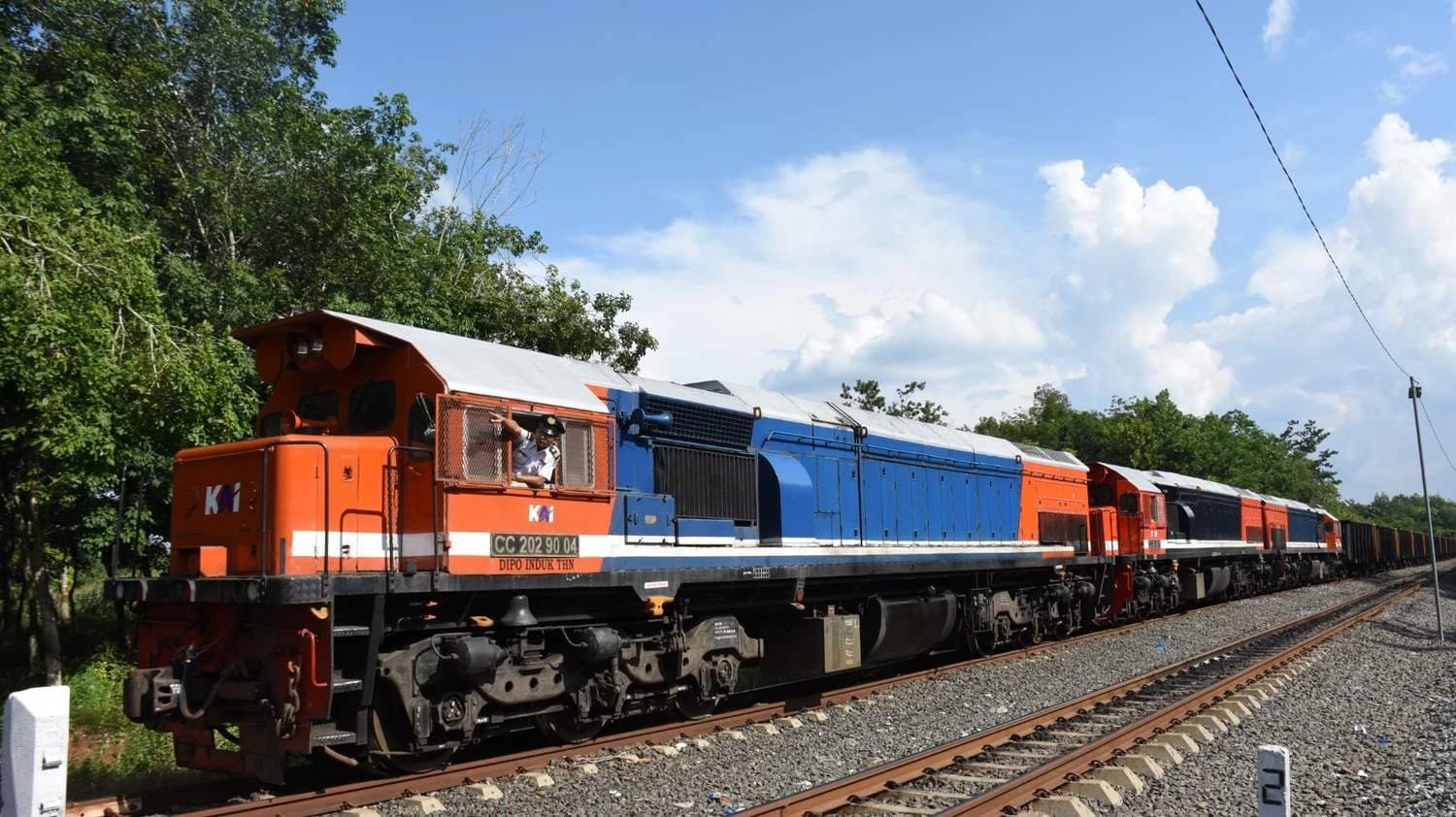
The CC205 locomotive, for example, is capable of pulling up to 61 wagons or equivalent to about 3,050 tons of goods in a single journey. This capacity is estimated to be equivalent to about 120 40-foot container trucks.
From a logistics perspective, large hauling capacity in a single journey also provides distribution efficiency and helps reduce the movement of heavy vehicles on highways on certain routes.
To increase coal transport capacity, KAI continues to strengthen facilities and operational testing. One of them is through a single CC205 locomotive test on May 12, 2026, on the South Sumatra route.
The testing was carried out by pulling a series of 60 coal wagons on an uphill track. In the simulation, the train was stopped at several uphill points, then the track was sprayed with water to test the locomotive's adhesion capability when the journey was resumed under more severe track conditions.
The test results showed that the locomotive was still able to pull the trainset with a load of about 4,000 tons on that track. This testing was carried out to measure facility performance in supporting the increasing volume of coal transport that continues to develop.
According to Anne, strengthening freight transport capacity needs to be done gradually because national logistics distribution needs also continue to increase.
"The reliability of logistics distribution will be one of the important factors in supporting national economic growth and energy security. Therefore, capacity development is carried out with a measurable approach based on long-term needs," Anne said.
The development of these facilities is part of KAI's investment worth USD 222.5 million or around Rp3.56 trillion. This investment is projected to support the coal transport target of 111.2 million tons and non-coal transport of 10.9 million tons by 2029.
KAI also encourages the strengthening of national industry through the use of domestic production facilities. All 54-ton flat wagons BM are produced domestically through cooperation with PT INKA by optimizing the Domestic Component Level (TKDN).
In addition to supporting the increase in logistics capacity, the development of these facilities is prepared to support transport growth in the South Sumatra region, including the Tarahan II and Kertapati projects which are projected to increase goods distribution volume in the coming years.
Anne added that energy distribution often works behind community activities without being seen much, but has a major influence on the continuity of daily life.
"When energy distribution runs stably, study rooms will remain bright, health services will continue to operate, and economic activity can continue to move," Anne concluded.
VP Corporate Communication KAI