
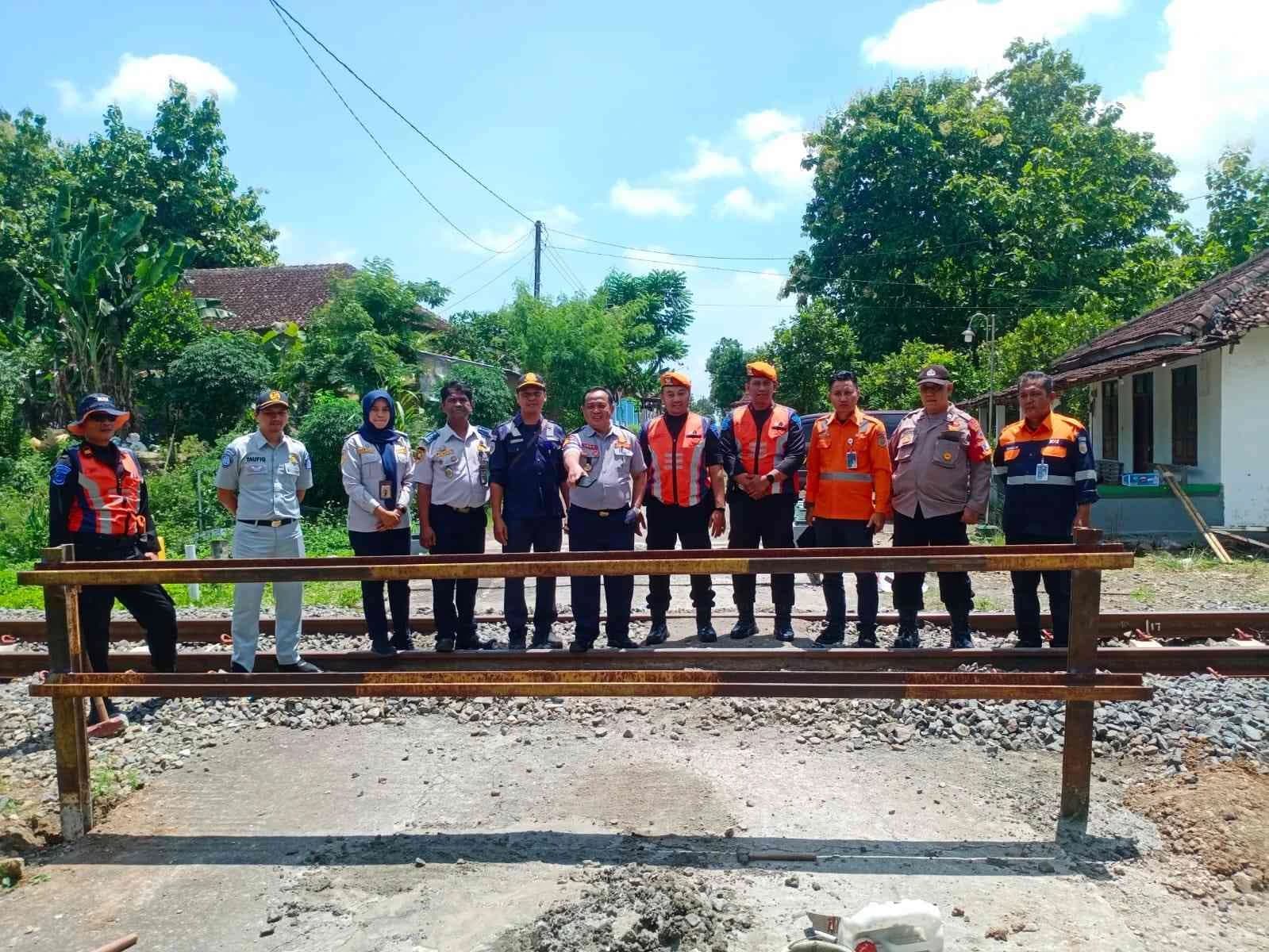
KAI Accelerates Closure and Narrowing of Illegal Crossings for Public Safety
The incident at Eastern Bekasi, which resulted in numerous casualties, serves as a sobering reminder that safety at level crossings requires shared attention and concern. PT Kereta Api Indonesia (Persero), together with the Directorate General of Railways (DJKA) of the Ministry of Transportation, local governments, regional authorities, and various stakeholders, continues to accelerate the management of unauthorized and high-risk level crossings to protect public safety.
During the period of April 27 to May 9, 2026, a total of 24 crossing closures and 5 crossing access narrowings were carried out across various regions. These steps were taken to reduce potential accidents and enhance the safety of communities crossing near railway tracks.
KAI Vice President of Corporate Communication Anne Purba stated that level crossing management is an essential part of collective efforts to prevent similar occurrences in the future.
"The incident at Eastern Bekasi brings deep sorrow to many. Safety at level crossings is a serious concern because trains have long braking distances and cannot stop abruptly when encountering obstacles on the tracks," said Anne.
In the Jakarta and surrounding areas, management measures were implemented at several unauthorized and unguarded crossings, including at KM 58+5/6 on the Tigaraksa–Cikoya line segment in Banten Province, KM 42+3/4 on the Parung Panjang–Cilejit line segment in West Java Province, and KM 58+3/4 on the Sukabumi–Gandasoli line segment in West Java Province. Closures were also executed at JPL 152 KM 56+202 between Tenjo–Tigaraksa, JPL 143 KM 53+285 between Daru–Tenjo, JPL 132 KM 49+178 between Cilejit–Daru, JPL 187 KM 81+346 between Rangkas Bitung–Jambu Baru, JPL 176 KM 73+438 between Citeras–Rangkas Bitung, and JPL 168 KM 64+526 between Maja–Citeras.
In West Java, an unguarded level crossing at KM 187+225 on the Cicalengka–Nagreg line segment was narrowed, and an unguarded level crossing at KM 71+805 on the Cireungas–Lampegan line segment was closed. Pedestrian access was also closed at KM 325+3/4 of the Patuguran Station Yard, Winduaji Village, Paguyangan District, Brebes Regency.
In the Yogyakarta and Solo Raya regions, closures were carried out at five crossing points: along the Purwosari–Wonogiri line at KM 6+2/3, KM 17+7/8, and KM 17+8/9 in the Sukoharjo area; along the Brambanan–Yogyakarta line at KM 525+3/4 in the Sentolo area; and along the Wates–Rewulu line at KM 528+718 in the Bantul area.
Meanwhile, in the Madiun, Blitar, and Jombang regions, closures took place at five crossing points: KM 214+5/6 Kutorejo Village, Nganjuk Regency; KM 191+7 Gampengrejo Village; JPL 206 KM 127+9/0 Biluk area, Blitar Regency; JPL 203 KM 125+8/9 Sanankulon area, Blitar Regency; and JPL 209 KM 130+3/4 Kandangan area, Blitar Regency. Narrowing measures were also conducted at JPL 245 KM 154+5/6 Plosokandang Village and JPL 76 KM 86+1/2 Jatipelem, Jombang Regency.
In eastern East Java, unauthorized crossing closures were performed at KM 95+7/8 between Bayeman–Probolinggo, KM 158+2/3 between Jatiroto–Tanggul, and KM 34+4/5 between Mrawan–Kalibaru. Access narrowing and track normalization were also carried out at KM 55+7/8 between Kalisetail–Temuguruh and KM 197+9/0 between Jember–Arjasa.
In North Sumatra, safety measures were applied at an unguarded crossing at KM 172+100 along the Tanjung Balai–Kisaran line in Asahan Regency.
In West Sumatra, closures were conducted at three crossing points: KM 4+400 on the BKP–IMA line segment in the Kampung Jua Nan XX area, Padang City; KM 12+600 on the IMA–IDA line segment in the South Limau Manis area, Padang City; and KM 38+9/0 on the DUK–LA line segment in Lubuk Alung, Padang Pariaman Regency.
In South Sumatra, a closure was implemented at an unguarded unauthorized crossing at KM 322+7/8 of the Prabumulih Station Yard.
Currently, there are 3,674 level crossings across Indonesia, with 1,810 points identified as key management targets. Of that total, 172 crossings are targeted for closure due to limited road conditions, while 1,638 other crossings require gradual upgrades to their safety facilities.
Safety evaluation data indicates that during the 2023 to 2026 period, 948 casualties were recorded in level crossing accidents, with approximately 80 percent of occurrences taking place at unguarded crossings. This condition forms the basis for accelerating joint action among stakeholders to continually reduce accident risks.
In addition to crossing closures and narrowings, KAI together with DJKA Ministry of Transportation continues to implement various other safety improvement measures, such as crossing logging, coordination with local governments, public safety awareness campaigns, and the gradual development of safety facility enhancements at priority points.
Anne invited the public to support safety efforts by maintaining discipline when crossing level crossings and refraining from reopening closed unauthorized access points for the sake of collective safety.
"We invite the entire community to work together to maintain safety around railway tracks. We hope that unauthorized crossings that have been closed will not be reopened, as these closures are carried out based on safety evaluations and potential risks," Anne concluded.
VP Corporate Communication KAI