
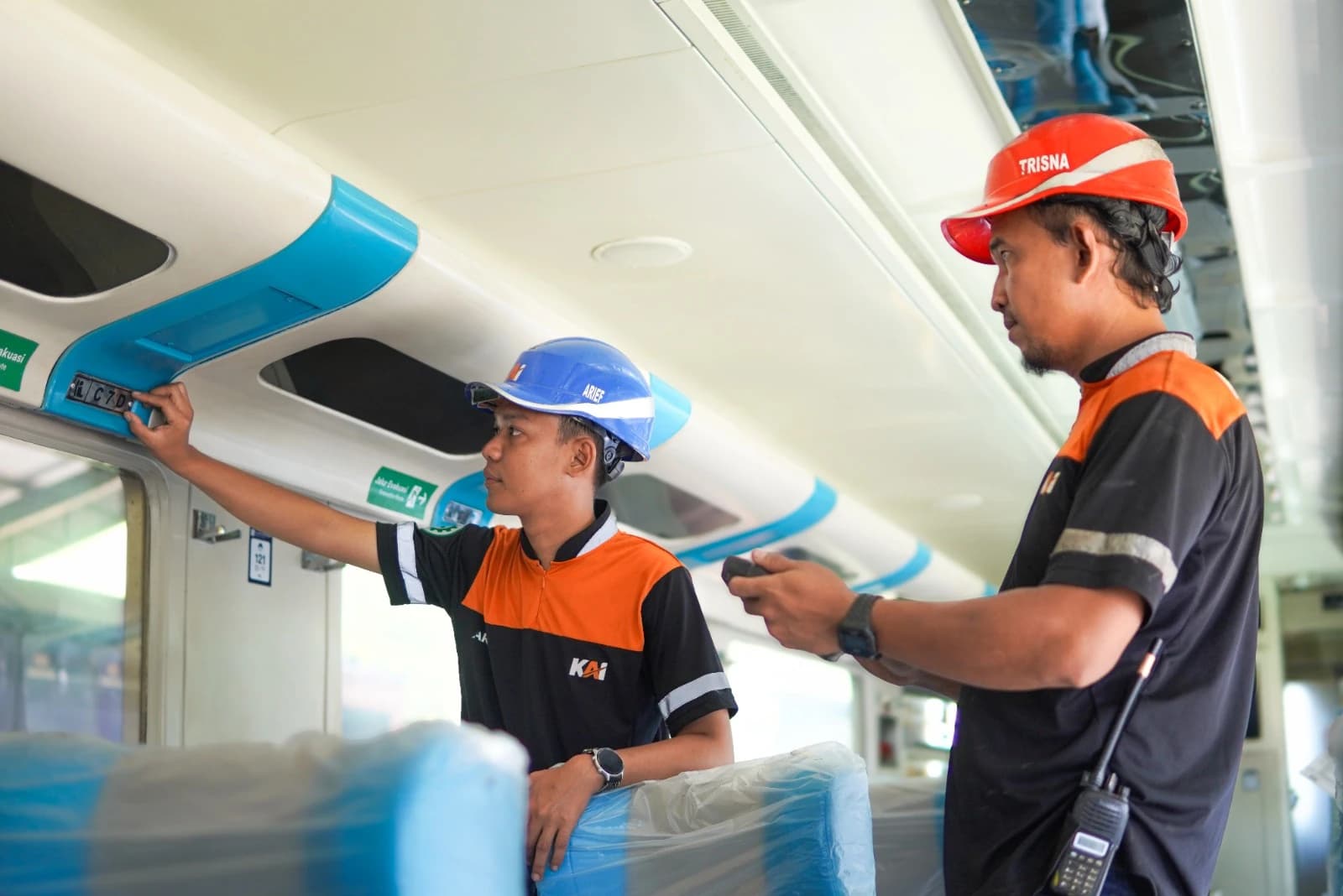
Train Operations Demand High Discipline to Serve Millions of Passengers Daily
Every day, millions of customers entrust their journeys to railway transportation. Behind a journey that appears smooth and punctual lies a complex operational system executed with strict discipline by thousands of railway personnel across various job functions.
Railway operations function through interconnected coordination at every second of travel. From train crews, train dispatchers, operational controllers, track inspectors, rolling stock and infrastructure maintenance staff, to level crossing guards, everyone carries responsibilities directly tied to travel safety.
KAI Vice President of Corporate Communication Anne Purba stated that railway safety is built on competence, precision, discipline, and consistent adherence to operational procedures.
"Railways operate on a highly detailed system. Every staff member holds a crucial role, and every process must run with precision. Therefore, all railway personnel are required to possess high competence, readiness, and discipline before undertaking operational duties," said Anne.
As part of strengthening human resource competence, KAI continues to increase the number of certified workers year after year. In 2022, over 14,150 certified workers were recorded, rising to over 15,983 workers in 2023, then 16,186 workers in 2024, and reaching 19,167 certified workers in 2025.
For 2026, KAI plans for 18,297 certified workers distributed across strategic operational roles. This figure includes 4,129 Railway Vehicle Crew (ASP), 440 Special Railway Vehicle Crew, 2,260 Train Dispatchers (PPKA), 229 Train Controllers, and 1,542 certified Assistant PPKA.
Additionally, there are 1,482 infrastructure maintenance personnel for Track and Bridges, 1,437 maintenance personnel for Railway Operational Facilities, 1,854 infrastructure inspection personnel for Track and Bridges, 119 inspection personnel for Railway Operational Facilities, 2,652 Rolling Stock Inspectors, 1,990 Rolling Stock Maintenance personnel, and 163 certified Level Crossing Guards (PJL).
Anne explained that every operational worker must undergo education, training, competency testing, and certification before taking on field duties.
Beyond certification from authorized bodies, including the National Professional Certification Agency (BNSP), KAI continuously conducts education and training, workshops, discussion forums, operational simulations, and competency refresher courses to ensure workforce readiness is maintained.
"In railway operations, decisions made by staff must be fast, accurate, and in line with procedures. Therefore, competency building is conducted continuously so that every staff member is prepared to handle various field operational conditions," Anne explained.
KAI also conducts routine inspections of rolling stock and infrastructure to maintain operational reliability. Pervasive checks are carried out periodically following established operating procedures to ensure all travel aspects remain reliable and safe for use.
Inspections cover track lines, switches, signals, bridges, operating systems, and rolling stock conditions through direct field inspections, detailed track observations, cab rides (lok ride), and platform rides (bordes ride) led by competent and certified personnel in their respective fields.
Through the Safety Railway Information (SRI) application, every employee can report potential hazards or unsafe conditions that could compromise train safety. These reports are subsequently acted upon for risk mitigation and prevention.
Beyond internal operational factors, railways face various external challenges, such as indiscipline at level crossings, stone-throwing at trains, theft of railway assets, unauthorized structures along tracks, as well as weather and natural conditions including floods, landslides, and earthquakes.
Consequently, KAI continues to strengthen coordination and collaboration with the government, regulators, regional authorities, communities, and the public to safeguard overall travel safety.
"Every train journey that runs safely is, in reality, guarded by many dedicated personnel working with full discipline 24 hours a day. Safety is built on precision, procedural compliance, human resource competence, and collaboration with stakeholders and the public in protecting railway operations. KAI will continue to reinforce all these aspects so that the trust of millions of customers remains well-preserved on every journey," Anne concluded.
VP Corporate Communication KAI