
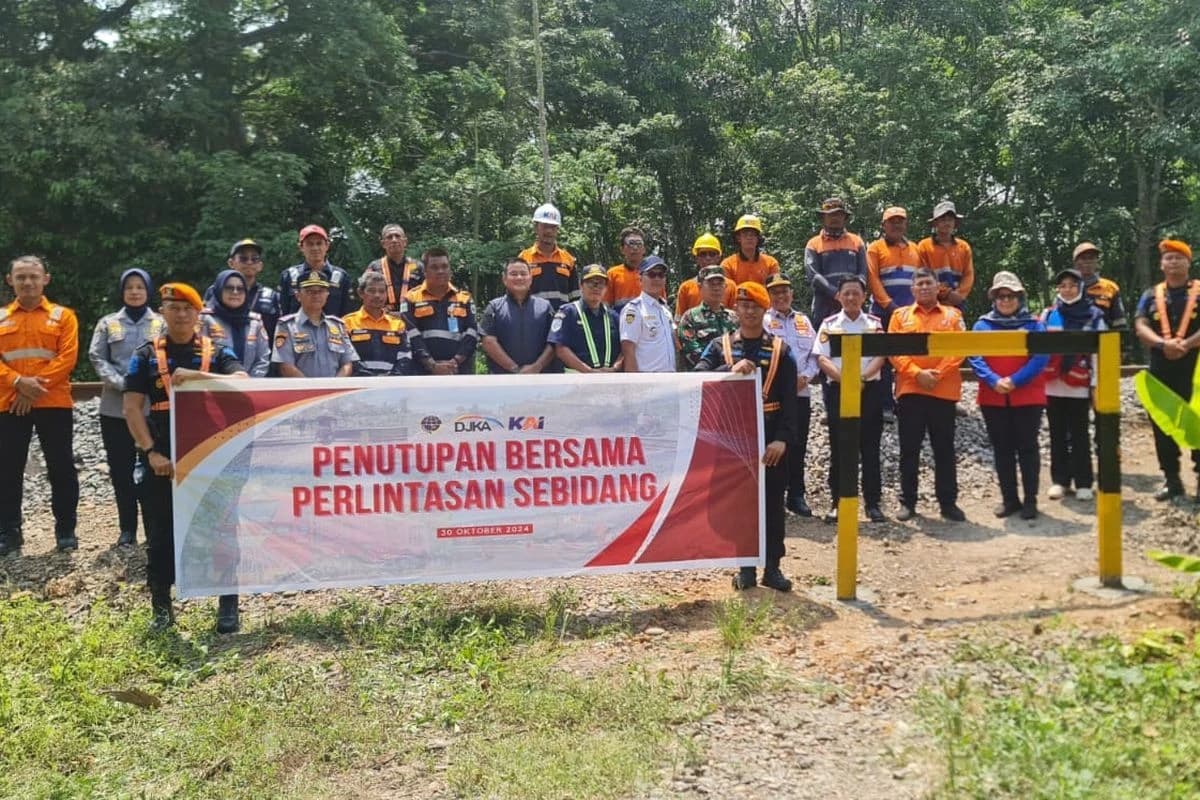
Illegal Level Crossings Must Be Closed Immediately for Public Safety
PT Kereta Api Indonesia (Persero) emphasizes that safety at level crossings is a serious concern requiring consistent management. The existence of unauthorized (illegal) crossings at various points poses significant risks as they are not equipped with adequate safety measures and operate outside official regulations, making the safe space between train operations and community activities increasingly limited.
President Director of KAI Bobby Rasyidin stated that every crossing must be in a condition that meets safety standards to ensure the protection of both the public and train journeys.
"Every crossing point carries safety consequences. For locations that do not yet comply with regulations, management is carried out alongside the government through established mechanisms, including closures. This step is taken to protect the safety of the public and train travel," said Bobby.
He added that managing level crossings is part of safety preservation efforts that require the involvement of various parties across regulations, infrastructure, and on-ground behavior.
KAI Vice President of Corporate Communication Anne Purba explained that there are currently 3,888 level crossings across Java and Sumatra, with 1,089 of them classified as unauthorized crossings, thus requiring collective attention in their management.
"This data shows that crossing areas still carry a level of risk that needs to be consistently managed. Closing unauthorized crossings is part of structuring efforts so that the interaction between train trips and road traffic can take place more safely," explained Anne.
From 2017 to April 2026, KAI together with stakeholders has closed 2,220 unauthorized crossings as part of risk control measures at vulnerable points. This effort is conducted to create a better-managed safe environment and reduce the potential for accidents at crossings.
This measure is directed at restricting non-compliant crossing areas and redirecting the public to safer crossing points.
KAI, alongside the Ministry of Transportation and local governments, has also handled 564 crossing points through closures or by upgrading them into grade-separated crossings via the construction of flyovers and underpasses. These efforts continue in accordance with field requirements.
During the period from 2024 to April 2026, KAI strengthened safety initiatives through 4,988 socialization activities at crossings, 687 educational sessions at schools and places of worship, as well as 1,745 installations of warning media at various locations.
This approach is aimed at building collective awareness that crossing safety is closely tied to a culture of traffic discipline.
Anne added that safety practices in various countries show that public discipline is the primary factor in minimizing accident risks. The habit of stopping, looking left and right, and waiting until it is completely safe before crossing is part of daily behavior that needs to be consistently maintained.
"Trains serve hundreds to thousands of customers in a single trip and require long braking distances. Under certain conditions, trains cannot stop abruptly. Therefore, discipline when crossing level crossings is crucial. When this habit is practiced together, safety can be better maintained," she said.
KAI invites all parties to maintain order at level crossings as part of shared safety. Crossings that have been organized and closed are part of protective measures for the community.
"Keeping crossing conditions orderly is essential. Any risk that arises at a crossing can have a widespread impact on road users, their families, and the surrounding environment," Anne concluded.
VP Corporate Communication KAI