
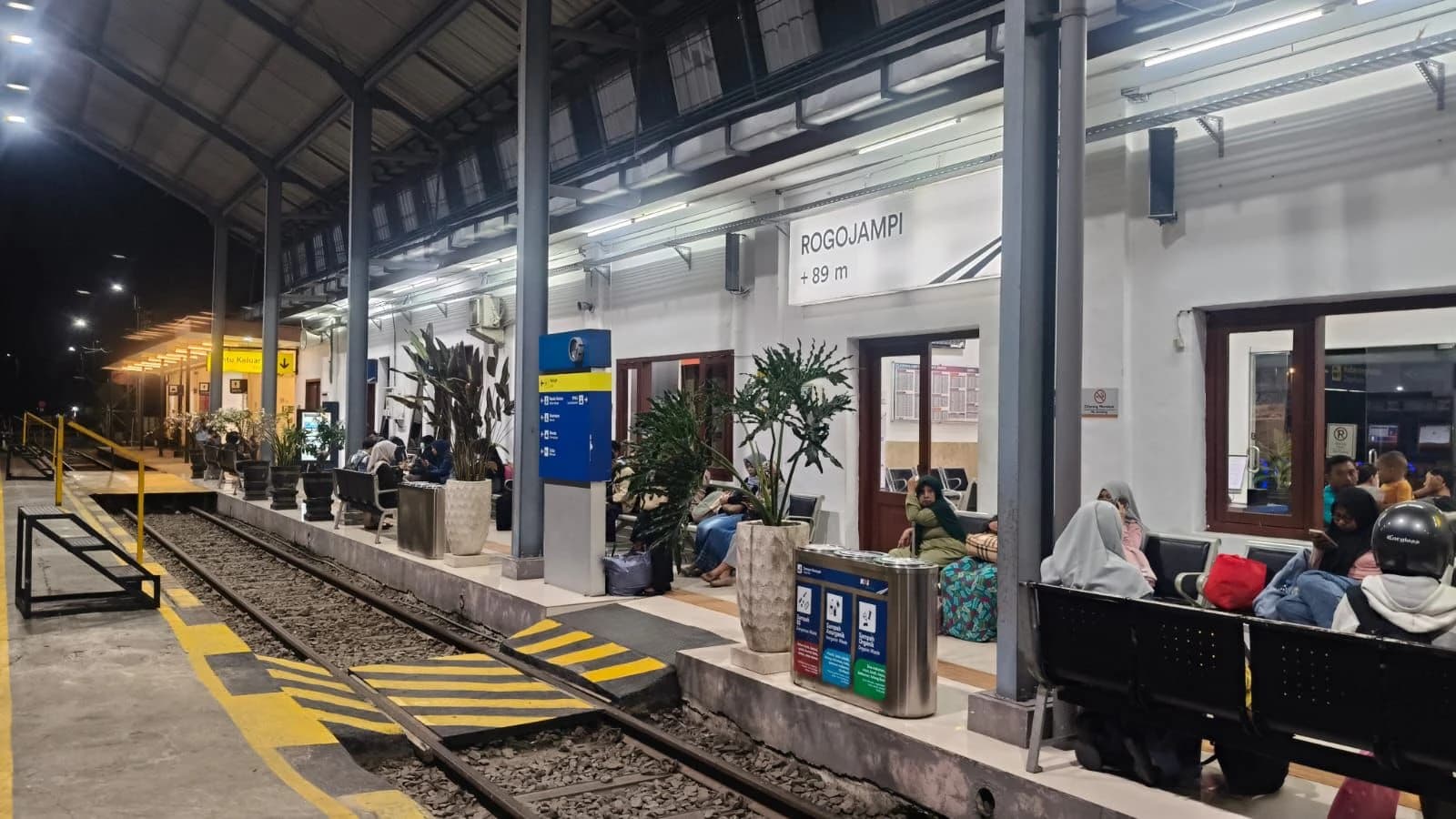
Located Near Banyuwangi Airport, Rogojampi Station Bolsters Local Economy and Regional Tourism
Amidst the bustling activities of Rogojampi Market, Rogojampi Station serves as a hub that brings together various interests at a single point. From morning until evening, the movement of the community continues. Some depart for work, trade, pursue education, or access health services. Journeys connected through these rail tracks help keep the rhythm of life moving.
This role stems from a long history established since the early 20th century. Rogojampi Station was inaugurated in 1903 by Staatsspoorwegen as part of the 58-kilometer Mrawan–Rogojampi–Banyuwangi line. In its era, this route facilitated the distribution of plantation yields to the port. Over time, this function evolved to meet the increasingly dynamic needs of the community, shifting from commodity distribution to driving community mobility and economic activity.
This development is increasingly felt in the daily lives of the Rogojampi community. Based on data from the Central Bureau of Statistics of Banyuwangi Regency for 2024 as the latest official release, Rogojampi District is inhabited by more than 90 thousand residents with a high density level. Geographically, this region lies in the connecting corridor between downtown Banyuwangi on the eastern side and the Genteng and Benculuk areas on the western side. This location makes Rogojampi an active movement node, with a continuous flow of people and goods throughout the day.
This condition is directly reflected in the economic activities around the station. Rogojampi Market, located not far from the platform area, serves as a lively daily trading center. Traders, farmers, and small business actors utilize the ease of train access to reach a wider market. Journeys become more predictable, goods distribution is smoother, and logistics costs can be suppressed so that community businesses continue to thrive.
The proximity of Rogojampi Station to Banyuwangi International Airport, located about 8 kilometers away, further expands the community's range of movement. Traveling from the train to air transportation can be done in a short time. For tourists, this convenience provides more practical access to reach Banyuwangi from various regions. For local residents, travel choices become more diverse and flexible.
From a social perspective, maintained transportation access helps the community reach various needs more easily. Journeys to educational centers, health services, and social activities can be carried out with more definite timing. Smooth mobility also brings together people from various regions, ensuring that social interactions remain established and strengthen interregional relations.
Amidst this movement, Rogojampi's cultural identity remains strong. The Osing language is still used in daily conversations around the station. Traditions such as Kebo-keboan in Aliyan Village continue to take place and attract the attention of many people. Easy transportation access helps outsiders arrive and experience this culture directly, keeping traditions preserved and widely recognized.
This connectivity also opens up major opportunities for the tourism sector. From Rogojampi Station, passengers can continue their journey to various leading destinations in Banyuwangi such as Alas Purwo National Park, the De Djawatan Trembesi forest area, as well as the coast of Pulau Merah and Mustika Beach. More practical travel helps tourists manage their visit times more comfortably and in a planned manner.
The travel experience is further complemented by the presence of local culinary delights around the station. Sego Cawuk, Rujak Soto, and Pecel Pitik become part of the story carried home by every passenger. This activity provides a direct impact on local business actors, ranging from food vendors to advanced transportation service providers.
KAI Vice President of Corporate Communication Anne Purba stated that close transportation access brings broad benefits to the community.
"Easier travel helps the community carry out activities more efficiently. Close access between the station and the airport opens business opportunities, strengthens economic movement, and supports the development of regional tourism and culture," Anne explained.
All train journeys to and from Banyuwangi currently stop at Rogojampi Station. Local train services like Probowangi support daily community mobility, while long-distance trains such as Wijayakusuma and Blambangan Ekspres connect Banyuwangi with various major cities. The addition of the Sangkuriang train service on the Bandung–Banyuwangi route (round trip) further expands travel reach.
This growth is visible in increasing public trust. In the first quarter of 2026, boarding passengers were recorded at 67,212, growing by about 19.9% compared to 56,056 passengers in the first quarter of 2025. Meanwhile, alighting passengers reached 67,109, a 12.2% increase compared to 59,794 passengers in the same period of the previous year.
These figures show that Rogojampi Station is increasingly close to the community's needs. More certain journeys help people manage their time, maintain productivity, and open new opportunities across various sectors. Economic activity moves, social interactions are maintained, culture stays alive, and tourism continues to develop within a single interconnected travel network.
"Public trust serves as encouragement for KAI to continuously maintain service quality. Every journey is expected to provide convenience, a sense of security, and benefits that can be directly felt by the community," Anne concluded.
VP Corporate Communication KAI