
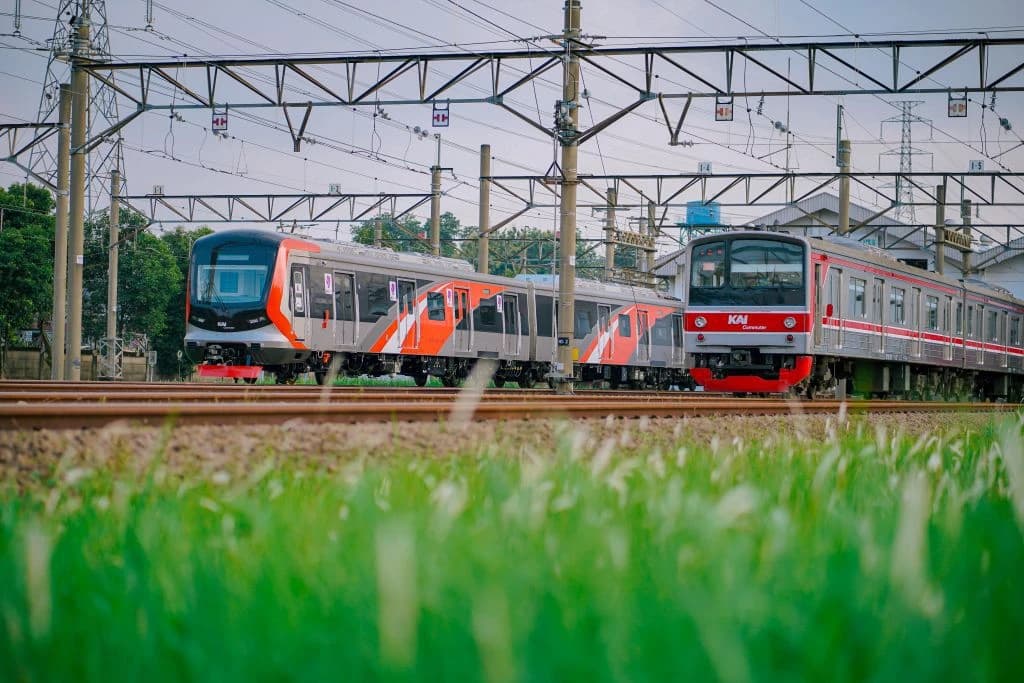
Greater Jakarta Urban Rail: Infrastructure Gradually Shaping the Direction of Society's Civilizationa
In the Greater Jakarta area, which continues to grow, mobility has become an essential part of daily life. Travel time, arrival reliability, and daily transportation costs influence how people work, carry out their activities, and manage their lives.
In this environment, the Greater Jakarta Commuter Line (KRL) has evolved into a transportation system that delivers broad benefits to the public. Service improvements, increased capacity, and easier intermodal connectivity have created a new pattern of mobility that is more efficient and affordable.
KAI Vice President Corporate Communication Anne Purba stated that changes in public travel behavior have gone hand in hand with improvements in the quality of the transportation system.
"When a transportation system becomes more reliable, people naturally follow. The choice to use public transportation comes because the service provides convenience, affordability, reliability, and a sense of safety," said Anne.
This trend is reflected in the growth of passenger volume across all Greater Jakarta Commuter Line routes. On the Bogor Line, passenger volume increased from 102,054,022 passengers in 2022 to 133,040,885 passengers in 2023, then to 145,920,264 passengers in 2024, and reached 155,009,997 passengers in 2025. From January to March 2026, the figure had already reached 38,203,481 passengers.
On the Cikarang Line, passenger volume totaled 55,660,235 passengers in 2022, increasing to 71,636,443 passengers in 2023, then to 84,426,385 passengers in 2024, and reaching 85,936,774 passengers in 2025. In the first quarter of 2026, passenger volume reached 21,717,664.
The Rangkasbitung Line also recorded consistent growth, from 43,317,716 passengers in 2022 to 62,085,471 passengers in 2023, followed by 69,999,362 passengers in 2024 and 77,552,716 passengers in 2025. From January to March 2026, passenger volume reached 20,197,205.
On the Tangerang Line, passenger volume increased from 15,333,812 passengers in 2022 to 21,451,515 passengers in 2023, then to 24,430,279 passengers in 2024, and 27,280,453 passengers in 2025. In the first quarter of 2026, passenger volume reached 6,987,364.
Meanwhile, the Tanjung Priok Line also showed an upward trend, with passenger volume increasing from 1,599,107 passengers in 2022 to 2,676,363 passengers in 2023, followed by 3,377,633 passengers in 2024 and 3,531,311 passengers in 2025. From January to March 2026, passenger volume reached 873,658.
The growth across all these routes reflects gradual changes in people's daily lives. More reliable travel times allow daily activities to be planned more effectively. Time that was previously spent on commuting can now be used for work, study, or rest.
From a cost perspective, affordable fares ensure that mobility remains accessible to people from all walks of life. This efficiency allows households to allocate more of their spending toward other productive needs, such as education, healthcare, and daily living expenses.
The shift toward public transportation has also had a positive impact on road conditions. Traffic congestion has eased, travel has become smoother, and the risk of accidents has been reduced. The environment has also benefited from lower pollution as fewer people rely on private vehicles.
Around railway stations, economic activity continues to grow alongside increasing passenger movement. Small businesses, feeder transportation services, and residential developments are expanding within a more active ecosystem. Better-connected mobility directly supports the movement of local economic activity.
KAI believes that well-planned transportation infrastructure can shape long-term public travel habits. As the network becomes more connected, capacity continues to increase, and services become more integrated, the shift toward public transportation will occur naturally and sustainably.
Strengthening urban railway systems in cities beyond Java and Sumatra has become increasingly relevant as mobility needs continue to grow. Consistent network expansion and capacity improvements will extend these benefits to more communities while encouraging a more efficient way of life.
"Continued investment in transportation infrastructure delivers increasingly reliable public services. Its impact is reflected in people's daily lives, making travel more efficient, preserving valuable time, and enabling daily activities to become more productive," Anne concluded.
VP Corporate Communication KAI