
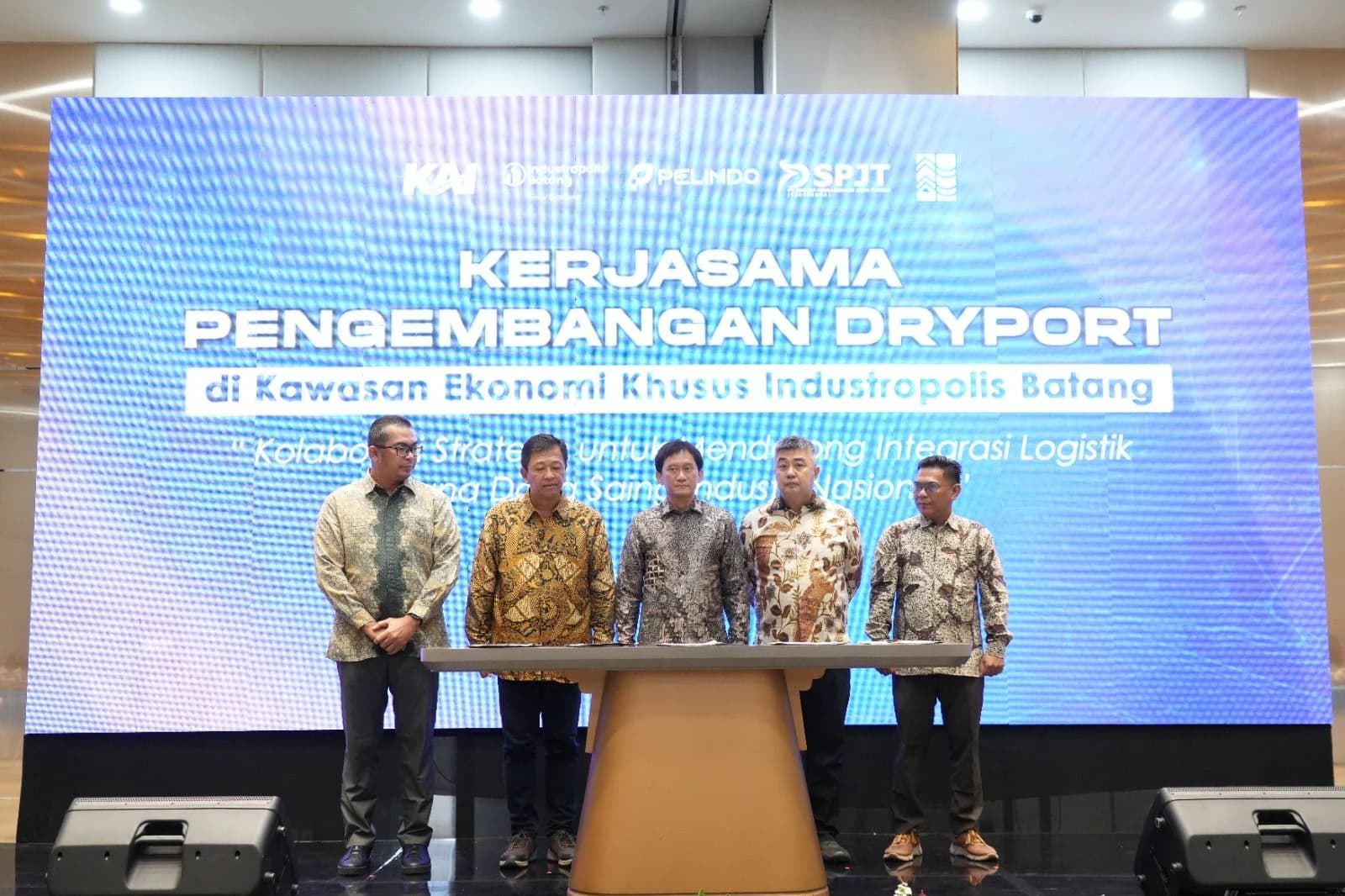
KAI Drives National Logistics Breakthrough, Strengthening Rail Integration via Industropolis Batang SEZ Dry Port
PT Kereta Api Indonesia (Persero), in collaboration with PT Kawasan Industri Terpadu Batang, PT Pelabuhan Indonesia (Persero), PT Sarana Pembangunan Jawa Tengah (Perseroda), and Perumda Aneka Usaha Kabupaten Batang, signed a Memorandum of Understanding for the development of rail-based logistics at the Dryport of the Industropolis Batang Special Economic Zone (KEK) on Tuesday, April 21.
This collaboration is directed toward building a more integrated logistics system while addressing the challenge of Indonesia's high national logistics costs. With a rail-based approach, goods distribution is expected to become more efficient, measurable, and competitive.
KAI President Director Bobby Rasyidin stated that the development of the dryport in Batang is part of the broader direction of building an integrated national logistics ecosystem stretching from industrial zones to ports.
"An industrial zone connected to a self-sustaining city will grow here in Batang. KAI is present as the transporter from the dryport to the port, and at the endpoint, Pelindo ensures connectivity to global markets. With this integration, we are driving logistics costs down to be more competitive," Bobby said.
He added that Indonesia's logistics costs currently still range from 15% to over 20% of the Gross Domestic Product (GDP), whereas global standards sit around 7-8%. This condition presents a massive window for improvement in enhancing the competitiveness of national industries.
"If we can significantly reduce logistics costs, industrial production costs will also decrease. The impact will be directly felt on the competitiveness of Indonesian products in the global market," Bobby continued.
This effort is reinforced by a strategy to increase freight transport capacity. KAI currently operates freight cars with an average capacity of 50 tons per car, which is being upgraded to 70 tons. With a single trainset consisting of up to 60 cars, hauling capacity can reach 4,200 tons in a single trip.
Furthermore, KAI is also preparing the development of a direct line to the port to reduce operational bottlenecks. Currently, distribution to Tanjung Priok Port still utilizes existing lines with limited operational windows of around five hours per day. With a direct line, goods distribution will become more flexible and efficient.
On the other hand, KAI also sees massive potential in Java as the center of national logistics movement. Approximately 60% of Indonesia's logistics activities take place on Java Island, with logistics costs estimated at Rp2,400 to Rp2,500 trillion per year. A mere 30% efficiency gain could generate savings of up to approximately Rp1,000 trillion.
The development of the Industropolis Batang KEK Dryport is also directed to serve as a logistics consolidation center in Central Java. Based on internal studies, container movements in this region reach around 10 million per year and are projected to continue growing alongside industrial estate expansion.
"We are pushing this dryport to become a logistics aggregator, serving not only the Batang area but also a wider region in Central Java. With a network of over 600 stations owned by KAI across Java Island, the potential for rail-based distribution is immense," Bobby explained.
This initiative is bolstered by KAI's freight transport performance, which continues to show a positive trend. Throughout the first quarter of 2026, KAI handled 14,948,442 tons of freight, reflecting the strategic role of railways in supporting national distribution.
During the same period, container freight reached 1,371,036 tons, increasing from 1,196,600 tons in the first quarter of 2025. This growth signals a shift in transportation modes toward more efficient rail-based options.
Operationally, punctuality performance also improved. Freight departure punctuality was recorded at 95.97% and arrival punctuality at 91.77%, increasing compared to the previous year's figures of 95.89% and 87.04%, respectively.
"Through the development of this rail-based dryport, KAI targets the formation of a more integrated, efficient national logistics system capable of lowering logistics costs. This effort is expected to serve as the foundation for enhancing the competitiveness of Indonesian industry globally while strengthening inter-regional connectivity domestically," Bobby concluded.
VP Corporate Communication KAI