
KAI Enhances Services and Safety Through 5G and AI-Based Digital Transformation
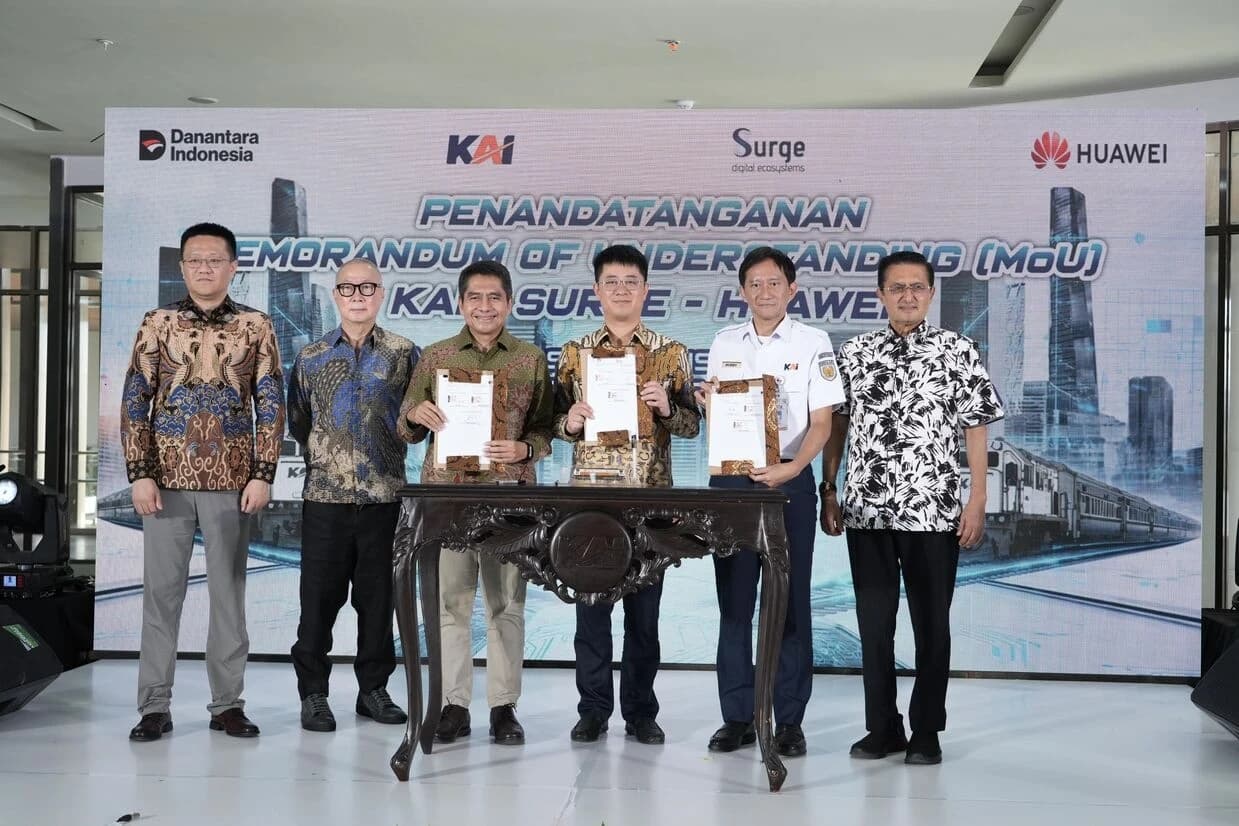
As the national railway operator, PT Kereta Api Indonesia (Persero) continues to strengthen its technology-based service transformation to meet increasingly dynamic mobility needs. This commitment was marked by the signing of a Memorandum of Understanding (MoU) with PT Solusi Sinergi Digital Tbk (SURGE) and Huawei at Tanah Abang Station, Jakarta, on Wednesday (4/15).
This collaboration serves as a strategic step for KAI in building a more modern, integrated, and digital technology-based railway system.
The reinforcement is focused on three main aspects. First, the development of a more reliable, integrated, and broadband-based (5G) railway operations facility (fasopka) support network, enabling faster and more precise train communication and control.
Second, the enhancement of customer services through high-speed internet and video streaming aboard trains. This service provides added comfort for customers to stay connected during their journey.
Third, the development of stations toward a smart and intelligent railway station concept based on Artificial Intelligence (AI), supporting more efficient operational management and real-time service quality improvements.
President Director of KAI Bobby Rasyidin stated that this collaboration is part of the company's strategic steps in raising railway service standards in Indonesia.
"We are directing this collaboration to strengthen safety, improve operational performance, and deliver increasingly relevant services to our customers. By utilizing 5G and AI, KAI accelerates operational response, strengthens communication systems, and opens up digital service space during journeys. This is an important step in driving KAI toward becoming a reliable and integrated world-class railway operator," said Bobby.
The signing of this MoU serves as the starting point of the concrete transformation KAI is currently undergoing. Through the adoption of Future Railway Mobile Communication System (FRMCS) and Artificial Intelligence (AI) technologies, KAI is transitioning from conventional communication systems to a more integrated digital ecosystem.
This transformation is aimed at strengthening operational safety through faster and more responsive communication systems, enhancing train trip performance, and delivering more modern services to customers. Technology integration also creates opportunities for digital in-transit services that are increasingly aligned with public needs.
This step marks KAI's shift toward a data- and technology-driven railway system that connects operations, services, and customer experience within a single integrated ecosystem.
From January to March 2026, KAI Group served 128,055,072 customers, an increase of 9.97% compared to 116,451,006 customers in the same period of 2025.
Bobby noted that these figures reflect growing public trust in train services.
"Trains are becoming increasingly attractive to the public because they can meet diverse travel needs. From daily routines to intercity travel, everything is connected in one increasingly integrated service system," said Bobby.
Long-Distance and Local train services managed by KAI served 14,515,350 customers, an 18.40% increase compared to 12,261,632 customers in the first quarter of 2025.
On the other hand, KAI Commuter served 101,382,889 customers, an 8.11% increase compared to 93,773,976 customers in the same period of the previous year.
"Every day, millions of people rely on the Commuter Line to travel from home to work, school, and back again," Bobby explained.
LRT Jabodebek served 7,754,946 customers, an increase of 22.10% compared to 6,351,283 customers in the first quarter of 2025.
KAI Bandara services served 1,755,275 customers, an 8.48% increase compared to 1,618,119 customers in the previous year.
LRT Sumsel served 1,084,242 customers, an increase of 7.38% compared to 1,009,737 customers in the first quarter of 2025.
Whoosh served 1,408,815 customers, a 4.07% increase compared to 1,353,760 customers in the same period of the previous year.
The Makassar–Parepare train served 75,421 customers, a 66.45% increase compared to 45,312 customers in the first quarter of 2025.
KAI Wisata served 78,134 customers, a 110.10% increase compared to 37,187 customers in the previous year.
In closing, Bobby emphasized the direction of the company's ongoing transformation.
"This collaboration moves KAI further in utilizing technology to strengthen safety, increase operational response speed, and deliver services that are increasingly relevant to customers. With 5G and AI, we push every journey to become more reliable, more efficient, and increasingly connected with future public needs," Bobby concluded.
VP Corporate Communication KAI