
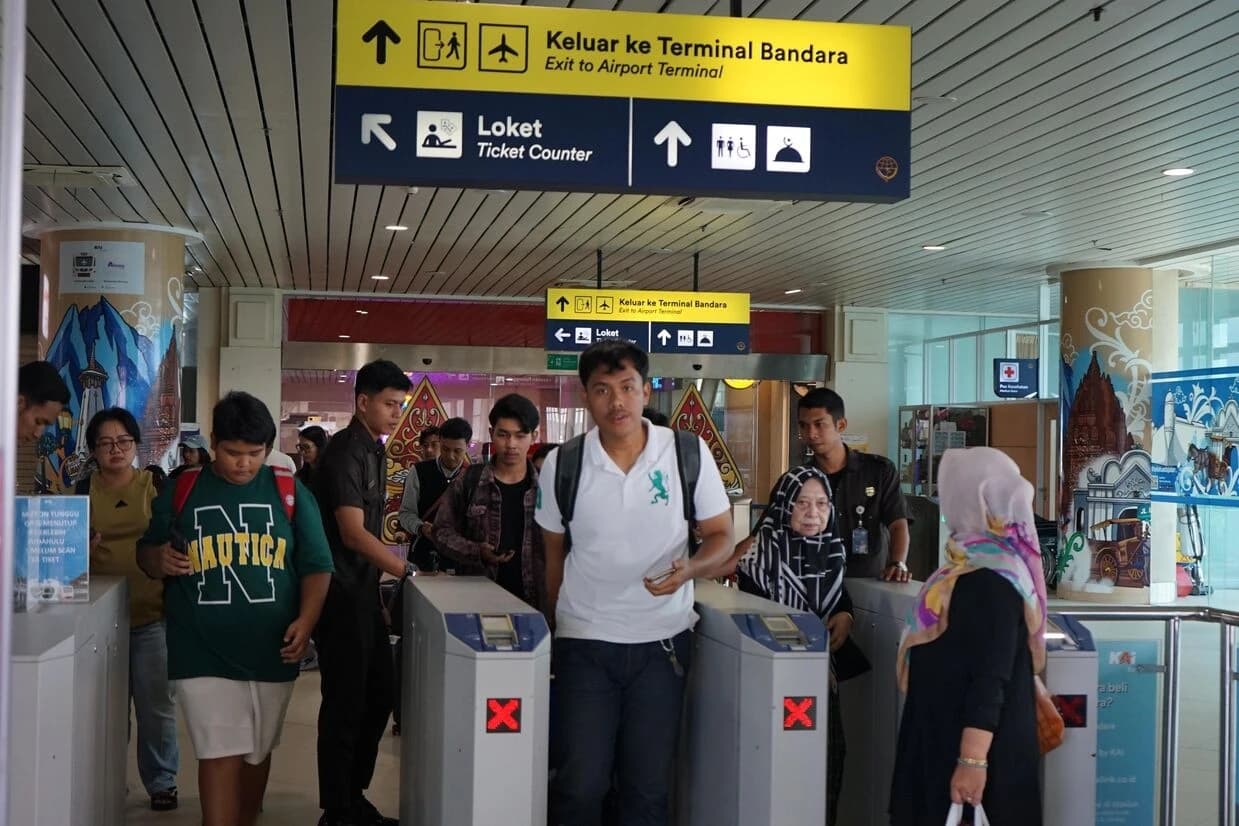
KAI Group's Airport Train Services to Serve 3.74 Million Customers in Q1 2026, Strengthening Land-Air Connectivity
The start of the week always brings its own stories. There are those returning to distant cities for work, those continuing their journey to another town, and those who have just stepped off a plane wanting to reach their destination promptly. Amid this flow of movement, train travel acts as a vital bridge—making journeys feel more orderly, predictable, and comfortable.
During the first quarter of 2026, KAI Group's land–air integrated services—which include airport train services managed by KAI Bandara, the Soekarno-Hatta Airport Commuter Line, South Sumatra LRT, KA BIAS, and KA Minangkabau Ekspres—served 3,743,082 passengers. This figure reflects how connected intercity-to-airport travel is increasingly becoming a routine part of everyday life.
Of that total, airport train services managed by KAI Bandara served 1,755,275 passengers, representing an 8.48% increase compared to 1,618,119 passengers in Q1 2025. Many passengers now choose rail transport because travel times are predictable, bringing greater certainty to trips headed to the airport.
In Yogyakarta, travel to YIA has become a daily staple. The YIA PSO service served 469.615 passengers, while YIA Xpress carried 227,652 passengers. From the city center to the airport, journeys feel more measured with predictable travel times, allowing passengers to depart with peace of mind.
In North Sumatra, the KA Srilelawangsa continuously connects Medan with Kualanamu Airport and its surrounding areas. A total of 406,936 passengers utilized the Medan–Kualanamu Airport route, while 651,071 passengers continued their travels to Binjai and Kualabingai. Trains have seamlessly integrated into local daily mobility.
In Jakarta, the Soekarno-Hatta Airport Commuter Line served 640,510 passengers, up from 517,166 passengers in the previous year—a growth of approximately 23.85%. For many travelers, heading to the airport now offers greater peace of mind since it no longer depends entirely on road traffic conditions.
In Palembang, the South Sumatra LRT served 1,084,242 passengers. From the airport to the city center and the Jakabaring area, journeys feel cohesive along a clear transit line.
Meanwhile, in Central Java, KA BIAS (Adi Soemarmo Airport Train) served 208,583 passengers, an increase from 159,092 passengers during the same period last year, marking a growth of approximately 31.11%. From Madiun and Solo straight to the airport, travel feels closer and far more accessible.
In West Sumatra, KA Minangkabau Ekspres served 54,472 passengers in Q1 2026. This service remains a vital link connecting Minangkabau International Airport to Padang City and Pulau Aie. Its critical role was particularly felt during recent floods and landslides in Padang, enabling smoother transit for relief volunteers and emergency supply distribution.
Vice President of Corporate Communication at KAI, Anne Purba, stated that connected transit is becoming an increasingly essential need for the public.
"Passenger travel today is more interconnected than ever. Trains help facilitate smooth transitions from the city center to the airport and onward to the next destination. We want every journey to feel calm, punctual, and reliable," said Anne.
VP Corporate Communication KAI