
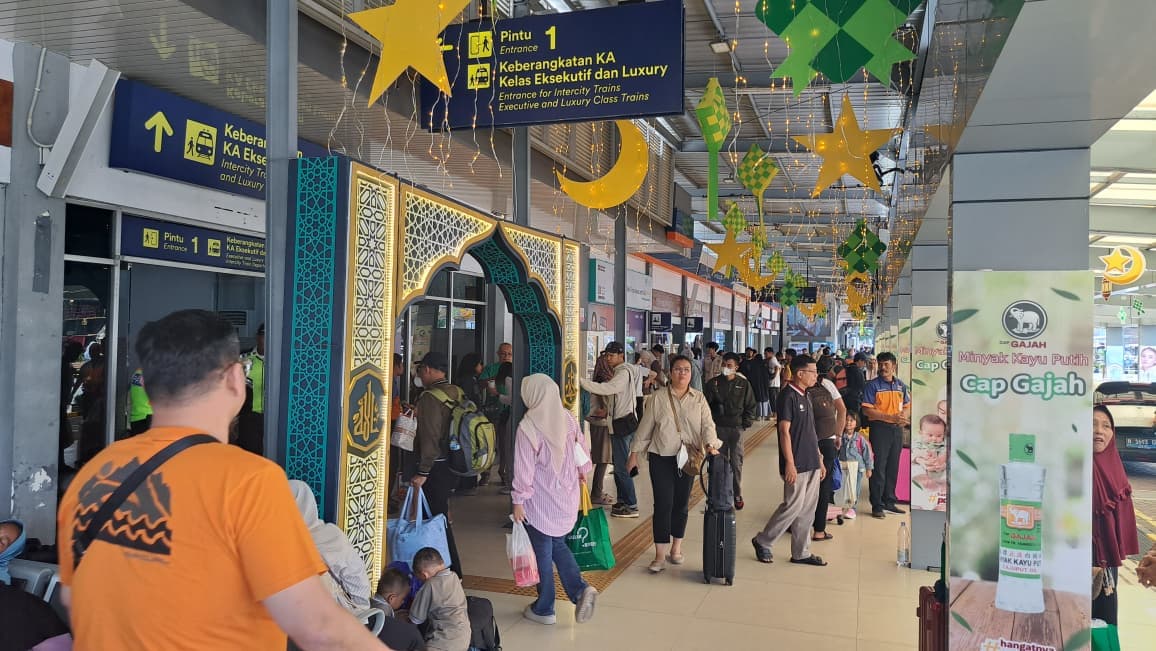
Four Consecutive Days of Records, Train Occupancy Exceeds 140 Percent at the Peak of the Lebaran Return Flow
PT Kereta Api Indonesia (Persero) recorded that the return flow phase of Lebaran 2026 transportation reached its peak, with a significant surge in customer volume. Train travel is increasingly becoming a preferred choice as it provides certainty in travel time amid high levels of public mobility.
For four consecutive days, KAI recorded the highest customer volume during the 2026 Lebaran period, with occupancy levels exceeding 140 percent. On March 22, 242,810 customers (150.7 percent) were recorded, increasing on March 23 to 247,025 customers (154.1 percent), then reaching a peak on March 24 with 250,650 customers (153.4 percent), and remaining high on March 25 at 230,784 customers (141.2 percent).
This achievement surpassed the previous year's record for the highest daily volume, which stood at 223,348 Long-Distance Train customers.
This surge shows that the return flow has remained strong while also becoming more evenly distributed, in line with people's travel patterns as they return to their home cities after Eid al-Fitr.
As of March 26, 2026, at 10:00 a.m. Western Indonesia Time (WIB), ticket sales for Lebaran transportation had reached 4,479,481 or 99.6 percent of the total capacity of 4,498,696 seats. This figure reflects the high level of public confidence in railway services during the Lebaran period.
KAI Vice President of Corporate Communication Anne Purba said that this trend reflects a change in travel behavior that is becoming increasingly planned.
“Train travel has continued to increase since mid-March and has now entered the return flow phase. Trains are becoming a preferred choice because they are comfortable, scheduled, and provide certainty in travel,” said Anne.
Specifically, ticket sales for Long-Distance Trains have reached 3,809,761 or 106.7 percent of the total capacity of 3,571,760 seats. Meanwhile, Local Trains recorded ticket sales of 669,720 or 72.3 percent of the total 926,936 seats, with seats still available on several routes.
Throughout the period from March 11 to 25, 2026, KAI served 3,407,548 customers on the islands of Java and Sumatra, consisting of 2,859,152 Long-Distance Train customers and 548,396 Local Train customers. This figure shows that mobility continues to grow and is spread across various regions.
Daily Occupancy Details of Long-Distance Trains (March 11–25, 2026):
- March 11: 101,617 customers (63.7 percent)
- March 12: 126,208 customers (79.2 percent)
- March 13: 165,675 customers (101.4 percent)
- March 14: 185,873 customers (113.7 percent)
- March 15: 180,836 customers (110.6 percent)
- March 16: 173,753 customers (106.3 percent)
- March 17: 191,413 customers (117.1 percent)
- March 18: 205,842 customers (125.9 percent)
- March 19: 196,324 customers (120.1 percent)
- March 20: 167,659 customers (104.6 percent)
- March 21: 193,583 customers (120.2 percent)
- March 22: 242,810 customers (150.7 percent)
- March 23: 247,025 customers (154.1 percent)
- March 24: 250,650 customers (153.4 percent)
- March 25: 230,784 customers (141.2 percent)
Entering March 26, 2026, the return flow trend was still ongoing. As of the morning, 196,401 Long-Distance Train customers had been scheduled to depart with temporary occupancy reaching 120.2 percent, and this number could still increase as sales continued.
KAI encourages the public to take advantage of alternative travel options by choosing different departure dates or routes. During this period, KAI is also offering the Silaturahmi Promotion, providing a 20 percent discount on Executive Class tickets applicable to purchases and departures from March 25 to April 1, 2026.
Anne explained that occupancy levels above 100 percent are common in long-distance railway operations.
“In a single journey, one seat can be used by more than one customer on different routes. This arrangement allows the number of customers served to exceed the available seating capacity,” explained Anne.
Several trains with high booking levels during the Lebaran period include KA Airlangga, KA Joglosemarkerto, KA Sri Tanjung, KA Bengawan, KA Kahuripan, KA Rajabasa, and KA Jayakarta.
“With capacity still available, people can plan their return journey more flexibly so that their trip remains comfortable and smooth with the railway,” concluded Anne.
VP Corporate Communication KAI