
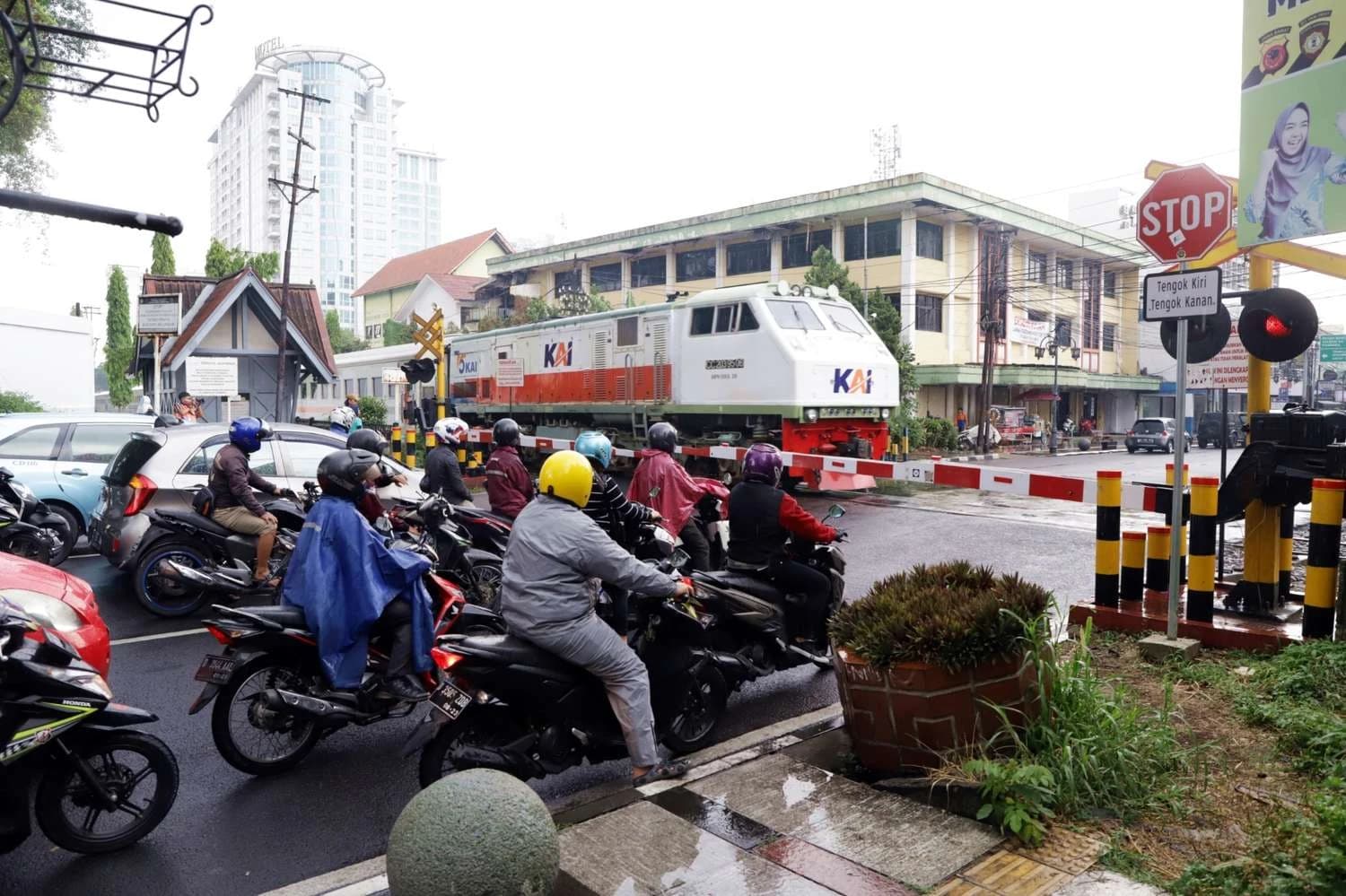
KAI Reinforces Safety at Level Crossings, Urges Road Users to Follow Traffic Rules
PT Kereta Api Indonesia (Persero) continues to urge the public to increase vigilance when passing through level crossings between railway tracks and roads. This appeal is conveyed as part of joint efforts to ensure the safety of both rail journeys and road users.
Vice President of Corporate Communication at KAI, Anne Purba, stated that safety at level crossings requires discipline from all road users. Level crossings represent intersection points between rail tracks and public roads, demanding full attention from every driver.
From January through February 2026, KAI alongside key stakeholders executed various steps to enhance safety at level crossings. During this period, KAI closed 45 crossings, cleared 9 illegal structures surrounding tracks, and conducted 243 public safety awareness activities. Educational outreach was also carried out through 32 school awareness sessions and the installation of 51 safety banners across strategic locations.
These safety programs continue on an ongoing basis. Throughout 2025, KAI conducted 2,016 safety awareness activities, 212 school sessions, 316 crossing closures, 687 banner installations, 655 safety-related Corporate Social Responsibility (TJSL) programs, and 52 clearances of illegal structures near rail tracks.
Anne explained that safety at crossings relies heavily on road users' compliance with traffic signs and regulations. She reminded drivers that they must stop briefly before crossing, even if the crossing gate is open or unavailable.
"Vehicles intending to cross must come to a complete stop before entering a level crossing. After checking both left and right and ensuring that no train is approaching, drivers may proceed across the crossing," said Anne.
Anne added that crossing gates are safety devices designed to secure train journeys. Therefore, road user vigilance remains the primary factor when traversing railway tracks. Across various countries with strong safety cultures, drivers routinely stop briefly to ensure tracks are completely clear before continuing their journey.
In accordance with Law No. 22 of 2009 on Road Traffic and Transportation Article 114, vehicle drivers are obligated to stop when crossing signals sound, barrier gates begin to close, or other signals indicate an approaching train. Under these conditions, trains maintain absolute right-of-way.
Road users are also advised to observe traffic conditions before crossing tracks. In the event of traffic congestion, drivers are expected to stop before the tracks and refrain from queuing on top of the railway. Only after the preceding vehicle has cleared the crossing and sufficient space is available should drivers proceed safely.
To sustainably enhance safety, KAI also encourages stronger collaboration with central and local governments according to their respective authorities. On road segments with high traffic volumes, constructing flyovers or underpasses serves as a long-term solution to eliminate intersections between rail lines and roadways.
This aligns with Ministry of Transportation Regulation No. 94 of 2018 Articles 5 and 6, which mandate that central or local governments evaluate level crossings at least once a year according to road classifications. Evaluation results serve as the foundation for upgrading level crossings into grade-separated crossings (flyovers or underpasses), closing crossings, or improving safety facilities at existing locations.
Anne emphasized that safety at level crossings ultimately rests on the vigilance of every road user. Simple habits such as stopping briefly and looking right and left before crossing represent vital steps in protecting collective safety.
"Stop. Look left and right. Even if the crossing gate is open or absent, always make sure no train is approaching before crossing. A moment of caution can save lives. Level crossing safety is everyone's responsibility." Anne concluded.
VP Corporate Communication KAI