
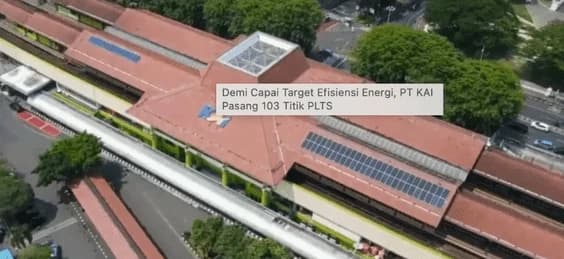
KAI Expands Solar Power Utilisation, Reaching 103 Installations with a Total Capacity of 4,450.65 kW
PT Kereta Api Indonesia (Persero) continues to expand its use of renewable energy by installing Solar Power Plants (PLTS) across various company facilities. As of early 2026, PLTS has been installed at 103 points spread across stations, railway workshops (balai yasa), offices, crew quarters (griya karya), depots, the record center building, and company messes.
From 2022 to 2026, total installed capacity reached 4,450.65 kWp. In 2026, KAI aims for an additional capacity of 500 kWp, which will increase the total number of installation points to 113 locations across all operational regions.
Vice President of Corporate Communication at KAI, Anne Purba, stated that this step forms part of the company's ongoing efforts to manage energy more efficiently and align with the national energy transition direction.
"We are installing PLTS in stages according to the needs of each location. Besides supporting energy efficiency, this initiative contributes to reducing emissions from daily operational activities," said Anne.
With an installed capacity of 4,450.65 kWp, KAI's PLTS system is projected to generate approximately 5.8 to 6.2 GWh of electricity per year, depending on solar radiation potential in each region. This energy production is equivalent to a significant reduction in fossil-based electricity consumption.
Based on the average emission factor of the national grid system of around 0.85 tons of CO₂ per MWh, the utilization of PLTS has the potential to reduce emissions by more than 5,000 tons of CO₂ annually. The additional capacity of 500 kWp in 2026 will further increase emission reduction contributions gradually.
In terms of cost efficiency, solar energy helps reduce electricity loads during daytime operational hours at stations, offices, workshops, and depots. This scheme also enhances energy resilience as part of the power demand can be met directly from on-site renewable energy sources.
The distribution of PLTS includes 62 stations, 10 railway workshops, 12 offices, 10 crew quarters, 6 depots, 1 record center building, and 2 messes. Stations utilizing PLTS include Gambir, Pasar Senen, Jakarta Kota, Manggarai, Yogyakarta, Solo Balapan, Madiun, Surabaya Gubeng, Surabaya Pasar Turi, Malang, Jember, and Tanjungkarang.
Beyond stations, installations have also been completed at railway workshops, locomotive and wagon depots, Regional Division and Sub-Division offices, the Bandung Head Office, the JRC Building, Record Center, and various non-station official buildings. Each installation is tailored to the building characteristics and power requirements of each asset.
Through these measures, KAI demonstrates that railway transformation also touches on how the company manages energy more wisely. The adoption of PLTS across hundreds of locations forms part of KAI's journey toward operations that are increasingly efficient, low-emission, and prepared to face future energy challenges.
"Sustainability for us is the company's long-term direction. We want to ensure that every train journey serving the public also delivers a positive impact on the environment," Anne concluded.
VP Corporate Communication KAI