
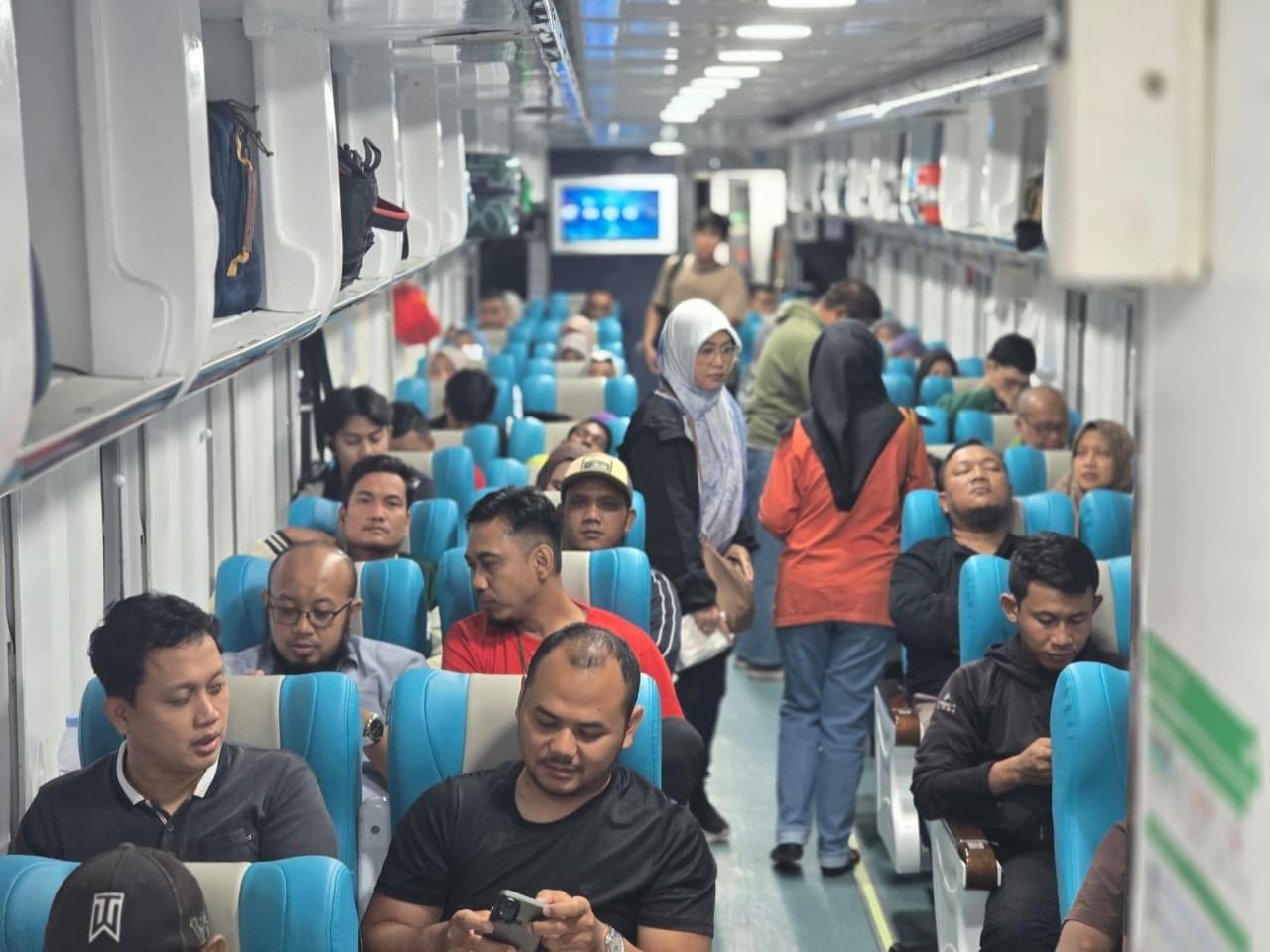
Eid 2026 Ticket Availability Remains Ample, Customers Can Take Advantage of Alternative Dates and Connecting Trains
PT Kereta Api Indonesia (Persero) recorded that ticket sales for the 2026 Eid Transport period, covering departures from March 11 to April 1, 2026, continued to show a positive trend. Several popular routes such as Surabaya, Purwokerto, and Yogyakarta recorded increased bookings. Nevertheless, overall capacity remains sufficient for various travel dates.
As of February 25, 2026, at 07:00 WIB, a total of 1,898,511 tickets had been sold out of 4,290,381 seats provided. This means that approximately 2.39 million seats are still available for people planning their Eid homecoming journeys.
For Long-Distance Trains, 1,869,064 tickets have been sold out of a total of 3,650,981 seats, representing an occupancy rate of 51.19 percent. Meanwhile, KAI Local Trains have sold 29,447 tickets out of a total of 639,400 seats, with an occupancy rate of 4.61 percent. Local Train sales will continue to increase as most tickets can only be booked starting seven days before departure.
Several dates with seats still available for Long-Distance Trains include:
- April 1, 2026: 16,153 tickets sold out of 157,316 seats (10.27%)
- March 31, 2026: 26,643 tickets sold out of 159,196 seats (16.74%)
- March 11, 2026: 28,303 tickets sold out of 159,152 seats (17.78%)
- March 30, 2026: 43,949 tickets sold out of 159,196 seats (27.61%)
- March 12, 2026: 48,704 tickets sold out of 158,950 seats (29.73%)
- March 13, 2026: 67,048 tickets sold out of 158,956 seats (42.18%)
- March 16, 2026: 72,074 tickets sold out of 158,454 seats (45.49%)
- March 15, 2026: 73,853 tickets sold out of 158,770 seats (46.52%)
- March 29, 2026: 76,183 tickets sold out of 158,762 seats (47.99%)
- March 27, 2026: 77,768 tickets sold out of 158,758 seats (48.99%)
Outside these dates, a number of routes on other days also still have available seats and can serve as alternative travel options.
Vice President Corporate Communication KAI Anne Purba urged customers to plan their journeys flexibly.
“Overall, a large amount of capacity is still available. Customers can choose dates with lower occupancy levels or utilize the connecting train scheme to obtain a combination of routes and departure times that suits their needs,” said Anne.
Anne added that Eid travel patterns are generally dominated by flows from Jakarta and western regions toward Central Java and East Java. At the same time, travel in the opposite direction, or the contra flow, still has considerable seat availability.
“Students and workers from the Greater Jakarta area who are currently in Yogyakarta, Semarang, Solo, or Surabaya can take advantage of this period to return to Jakarta and its surrounding areas. The movement from east to west also helps support a more balanced distribution of passenger flows while providing customers with more flexible schedule options,” concluded Anne.
VP Corporate Communication KAI

