
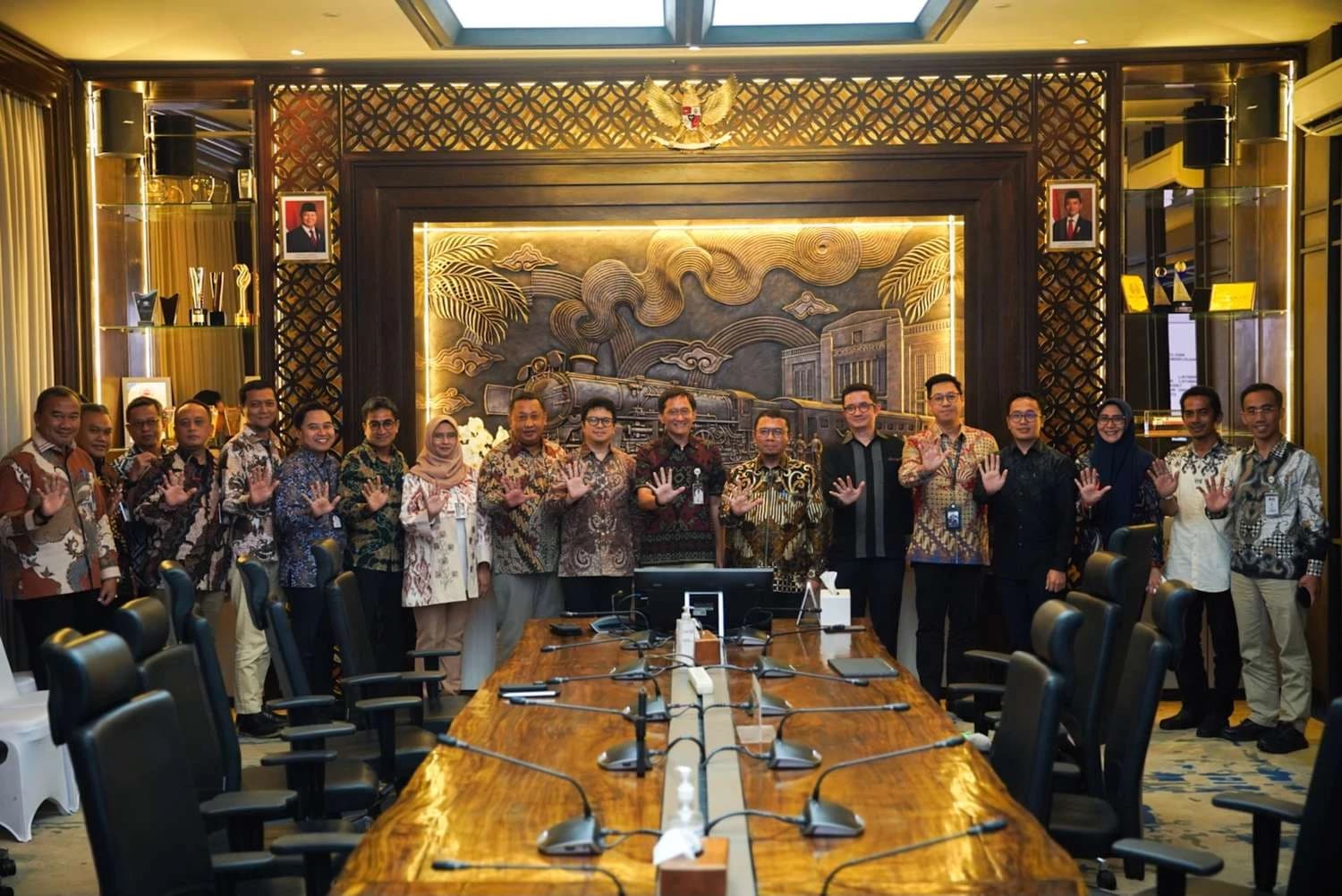
KAI and Perumda Paljaya Explore Wastewater Management Cooperation to Strengthen the ESG Agenda
PT Kereta Api Indonesia (Persero) signed a Memorandum of Understanding with Perusahaan Umum Daerah Pengelolaan Air Limbah Jaya (Perumda Paljaya) regarding the exploration of cooperation in wastewater management services and supporting services at stations, assets, and infrastructure owned and managed by KAI. The signing took place at the Jakarta Railways Center on Tuesday, February 24, 2026.
The Memorandum of Understanding was signed by President Director of PT Kereta Api Indonesia (Persero) Bobby Rasyidin and President Director of Perumda Paljaya Untung Suryadi.
This collaboration is directed at strengthening domestic wastewater management within the operational environment of KAI Group, specifically in Regional Division 1 Jakarta and assets located within Paljaya's piped network service coverage. This initiative serves as an implementation of Minister of Environment and Forestry Regulation Number P.68/2016 on Domestic Wastewater Quality Standards, Regional Regulation of DKI Jakarta Province Number 10 of 2024 on Domestic Wastewater Management, and KAI Board of Directors Regulations concerning ESG Implementation Guidelines.
President Director of KAI Bobby Rasyidin stated that environmental management at KAI is designed systematically and on a measurement basis.
"With passenger volume reaching 47,405,539 on Long-Distance Train services throughout 2025, environmental management has become an integral part of our operations. Total emissions for Long-Distance Trains were recorded at ±127,315,192 kg CO₂e, demonstrating significant efficiency compared to other modes. Wastewater management at stations and supporting facilities must meet quality standards and be integrated into standardized systems to ensure environmental quality is maintained," said Bobby.
On an equivalent journey scenario, emissions from Long-Distance Trains were recorded at approximately three times lower than intercity buses and dozens of times lower than private vehicles. These data reinforce the characteristics of trains as a high-capacity mass transit mode with more controlled emissions.
President Director of Perumda Paljaya Untung Suryadi explained that the wastewater management system in Jakarta is carried out in a centralized and standardized manner. He emphasized that the odor frequently appearing at several reservoirs, such as Setiabudi Reservoir, does not originate from treated wastewater, but rather from water channels entering without prior treatment.
"Treated wastewater that meets quality standards actually helps maintain water quality in receiving water bodies. Reservoirs function as flood control facilities, while aerators are operated to maintain water quality and prevent odors," Untung explained.
Paljaya operates a water reclamation facility in the Sudirman area that treats waste from various buildings in the Sudirman, Kuningan, Gatot Subroto, SCBD, Senopati, and Manggarai regions. In addition, fecal sludge treatment is conducted through Fecal Sludge Treatment Plants (IPLT) in Pulo Gebang and Duri Kosambi.
Based on the Regional Regulation, every building is required to have a wastewater treatment plant, and buildings not yet connected to the network must undergo fecal sludge desludging at least once every three years. The treatment process produces water that is discharged back into water bodies according to standards, sludge utilized for specific needs such as soil enrichment, and gas as part of biological processes.
Untung also mentioned that Paljaya manages wastewater treatment plants for MRT Jakarta as well as Transjakarta sanitation facilities. The ongoing Jakarta Sewerage System (JSS) Zone 1 project has a processing capacity of up to 240,000 cubic meters per day and will integrate waste collection from several major areas across Jakarta.
"We stand ready to partner with KAI in ensuring all waste generated from operational activities is managed according to quality standards and regulatory provisions, thereby supporting better city sanitation targets," Untung stated.
Through this collaboration, both parties will carry out technical mapping and system integration to ensure effective wastewater management across KAI Group's environment and deliver measurable environmental impacts.
This cooperation supports Sustainable Development Goal (SDG) Number 6, Clean Water and Sanitation, while strengthening sustainability governance within the national transportation sector.
VP Corporate Communication KAI