
From Continuously Growing Residential Areas to Industrial Zones, the Kulon Line Drives Economic Activity in Western Java
The development of the western region of Java Island has progressed rapidly and consistently in recent years. The growth of residential areas in Tangerang, Serang, Lebak, and Pandeglang Regencies has gone hand in hand with increasing public mobility toward Jakarta’s activity centers. The commuter pattern that has emerged is becoming increasingly stable and has become part of the daily rhythm of the urban area.
This is reflected in the profile of transit passengers at Tanah Abang Station on the Rangkasbitung Line in 2026. An average of 120,633 users make transit journeys every day. On weekdays, the number reaches 128,295 users, while on holidays it remains high at 106,641 users. These figures indicate that the Kulon Corridor has become one of the important mobility hubs within the Jabodetabek urban system.
The growth trend is also reflected in annual performance. Throughout 2025, the Tanah Abang–Rangkasbitung Line served 77,552,716 users, increasing from 69,999,362 users in 2024 and 62,085,471 users in 2023. This consistent increase demonstrates the growing role of rail transportation in supporting the economic and social activities of communities in the western region.
KAI Vice President of Corporate Communication Anne Purba stated that service development in the western region is being carried out in line with the growth of the area.
“The western region is developing as an integral part of the Jabodetabek urban system. Rail transportation is here to keep mobility smooth, affordable, and sustainable. Every service enhancement is carried out gradually while ensuring infrastructure readiness and user comfort,” said Anne.
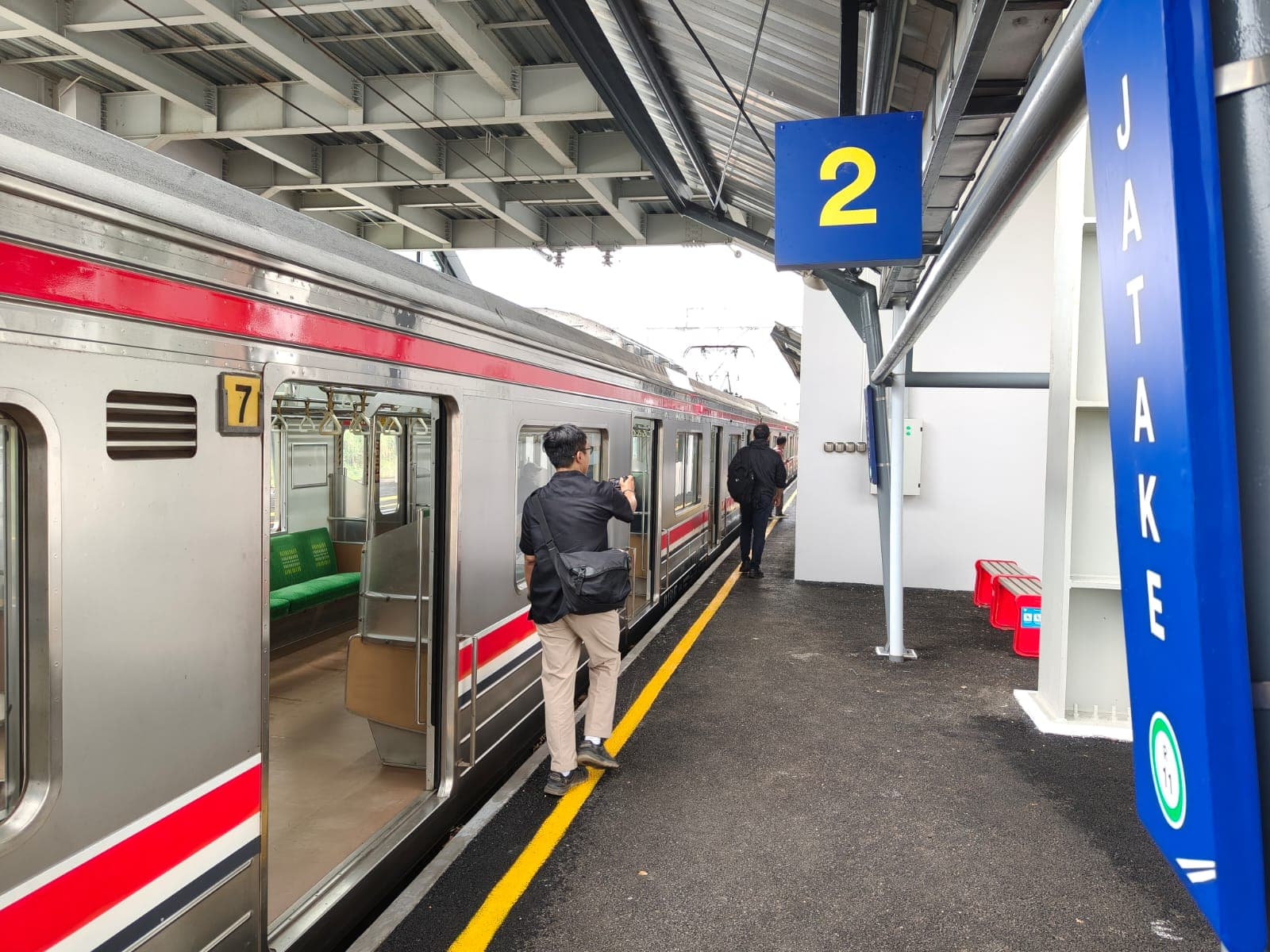
As part of strengthening the area’s structure, KAI introduced Jatake Station in Tangerang Regency. Since commencing operations on January 28 through February 5, 2026, the station recorded 7,936 gate-in users and 8,206 gate-out users. Its presence provides shorter access for communities to rail services while supporting the growth of new activity centers in the surrounding area.
The development of the area is supported by the electrification of approximately 72.8 kilometers of track from Tanah Abang to Rangkasbitung, which has increased capacity and travel reliability since 2017 to 2018. Train frequencies have also continued to be adjusted, increasing from 90 trips per day in 2015 to 122 trips per day in 2025, in line with growing mobility needs.
The western region also plays a strategic role as a regional connector through the Merak Line, which is integrated with the port serving connections to Sumatra. Over the past five years, the number of Commuter Line Merak users has increased from 1,035,383 users in 2021 to 4,463,446 users in 2025, indicating stronger interregional connectivity.
Support for the local economy has also been strengthened through the operation of dedicated trains for farmers and traders on the Merak–Rangkasbitung Line since December 1, 2025. With 14 trips per day and a fare of IDR 3,000, the service had been used by 8,650 customers as of January 31, 2026, helping distribute local produce in a more scheduled and efficient manner.
Going forward, KAI, through KAI Commuter, will continue coordinating with the government to gradually develop urban railway services in line with the growth of residential areas and new economic centers in the western region of Java Island.
“KAI continues to collaborate with the Directorate General of Railways of the Ministry of Transportation in modernizing and developing infrastructure along the Kulon Line. This is being carried out because KRL services on the corridor are increasingly becoming a mainstay for the public. Over the past three years, the number of users has increased from 43,317,716 in 2022 to 77,552,716 in 2025, representing growth of more than 79 percent. This growth shows that service capacity and quality need to continue to be aligned with the development of the area,” concluded Anne.
VP Corporate Communication KAI


