
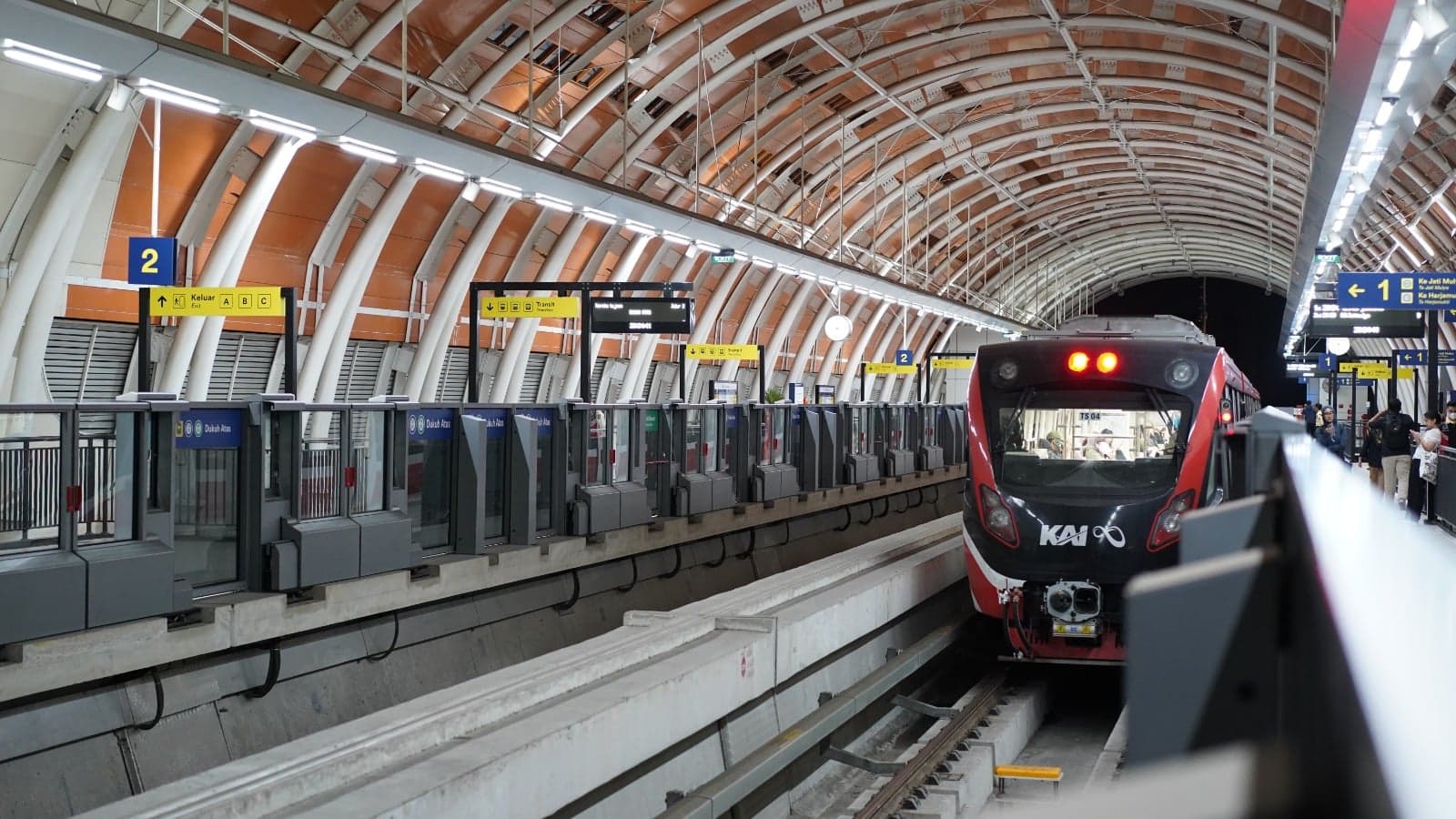
57.1 Million Customers Served, Jabodebek LRT Shows Consistent Growth Since the Start of Operations
In January 2026, Jabodebek LRT served 2,714,594 customers, a significant increase compared to 2,146,859 customers in January 2025 and 1,200,399 customers in January 2024. This trend demonstrates growing public confidence in Jabodebek LRT as a daily mode of transportation, particularly for commuting and economic activities in urban areas.
On an annual basis, the acceleration in growth is also clearly visible. Throughout 2024, Jabodebek LRT served 21,055,870 customers, which then increased to 28,816,787 customers in 2025. This growth has gone hand in hand with the development of residential areas, office centers, and service activities that require reliable, scheduled, and sustainable public transportation connectivity.
The distribution of customer movements at major stations demonstrates Jabodebek LRT’s contribution to strengthening connectivity between areas. Dukuh Atas Station recorded 17,548,139 gate-ins and gate-outs, making it the busiest movement hub. This area serves as an intermodal integration center connecting various public transportation services while also being located at the heart of the office and business district.
Harjamukti Station served 13,281,814 gate-ins and gate-outs, reflecting its role as a main access point for rapidly developing residential areas in the eastern region. Direct connectivity to activity centers encourages a shift in people’s travel patterns from private vehicles to rail-based public transportation.
Meanwhile, Kuningan Station recorded 10,274,649 gate-ins and gate-outs, driven by the area’s characteristics as a center for offices, embassies, and service activities. The high movement at this station underscores Jabodebek LRT’s role in supporting formal economic activities that require certainty in travel times. Cikoko Station served 9,246,972 gate-ins and gate-outs as an intermodal integration hub for urban railway services, while Pancoran Station, with 7,347,741 gate-ins and gate-outs, strengthened connectivity between residential areas and activity centers.
The performance of Jabodebek LRT is in line with population mobility dynamics. Data from the Central Statistics Agency (BPS) in 2025 recorded an increase in daily travel activity among the productive-age population in urban areas, particularly for work and access to economic services. Urban rail transportation is an important element in maintaining connectivity between areas, improving travel efficiency, and supporting reduced dependence on private vehicles.
Vice President of Corporate Communication KAI Anne Purba stated that the growth in Jabodebek LRT customers reflects the tangible benefits of this service in supporting regional development and the national development agenda.
“Jabodebek LRT is designed to connect residential areas, activity centers, and transportation hubs in an integrated manner. Consistent customer growth shows that this service is increasingly becoming part of people’s daily lives, while also supporting the Government’s efforts to develop an urban transportation system that is sustainable, efficient, and oriented toward public service,” said Anne.
Going forward, Jabodebek LRT is projected to play an increasingly important role in supporting urban mobility as new activity centers develop and intermodal integration is strengthened. With a sustained growth trend since the start of operations, Jabodebek LRT is becoming an important part of the transformation of national public transportation toward a more connected, adaptive, and sustainable system.
VP Corporate Communication KAI
