
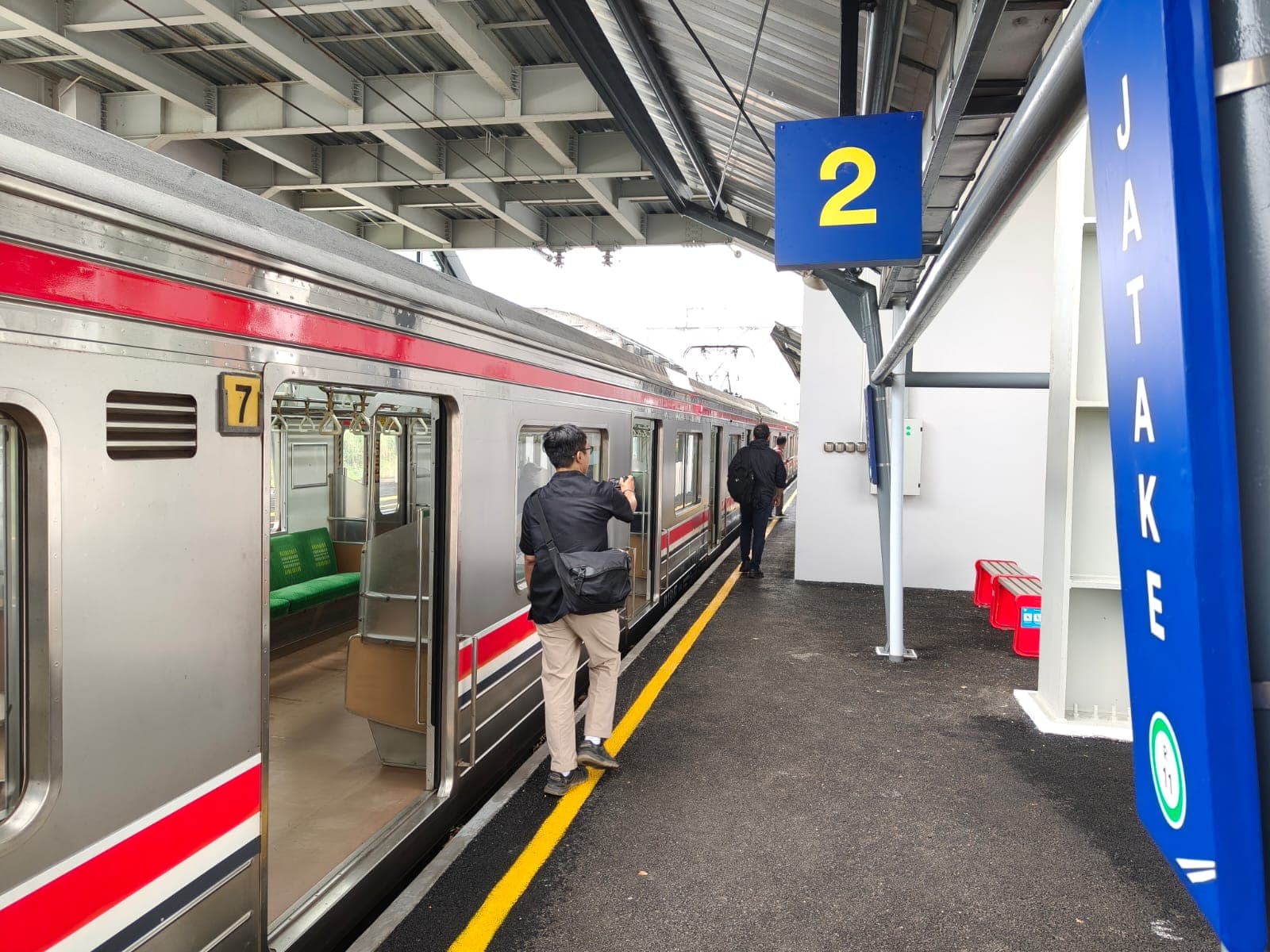
Jatake Station Strengthens Mobility Accommodation in Western Java through Phased Service Development
PT Kereta Api Indonesia (Persero) continues to accommodate the mobility needs of communities in western Java amid increasing economic activity and daily movement toward centers of activity. Various public inputs regarding service needs in the western region are continuously mapped and serve as the basis for the gradual and measurable development of railway services.
These needs are growing in line with regional economic dynamics. Based on 2025 data from the Central Statistics Agency (BPS), the western Java region, including Tangerang, Serang, Lebak, and Pandeglang Regencies, showed an acceleration in economic activity driven by the trade and agricultural sectors, as well as labor mobility toward the Greater Jakarta area. This condition has encouraged increasing demand for reliable, scheduled, and integrated public transportation.
In response to these dynamics, KAI has introduced Jatake Station as a new service hub in Tangerang Regency. Since commencing operations on January 28 to February 5, 2026, Jatake Station recorded 7,936 gate-in users and 8,206 gate-out users. This achievement reflects the growing need for rail transportation access closer to residential areas and new economic growth centers in the western region.
The increasing mobility pattern in the western region is also reflected in the performance of the Tanah Abang–Rangkasbitung Commuter Line service. Throughout 2025, this route served 77,552,716 users, an increase compared with 69,999,362 users in 2024, 62,085,471 users in 2023, and 43,317,716 users in 2022. Over the past decade, this trend demonstrates the increasingly dominant role of urban railways in supporting the daily economic activities of communities in Jakarta’s surrounding areas.
Vice President of Corporate Communication KAI Anne Purba stated that service development in the western region is carried out by taking into account the growth in public needs and infrastructure readiness.
“We have comprehensively mapped public input from communities in the western region. KAI responds to this through gradual service improvements, in line with infrastructure strengthening to ensure orderly, safe, and sustainable operations,” said Anne.
Strengthening railway infrastructure in the western region serves as the main foundation for these service improvements. From 2017 to 2018, KAI together with the Directorate General of Railways of the Ministry of Transportation carried out the gradual electrification of the railway lines, covering Tanah Abang–Serpong for 24.278 kilometers, Serpong–Parung Panjang for 10.271 kilometers, Parung Panjang–Maja for 21.080 kilometers, and Maja–Rangkasbitung for 17.140 kilometers. Overall, electrification of the western railway line reached approximately 72.8 kilometers, strengthening the capacity and reliability of travel services.
In line with the strengthening of this infrastructure, KAI has consistently adjusted operational patterns and travel frequencies. The Tangerang Line Commuter Line service increased from 90 trips per day in 2015 to 96 trips per day in 2016, and continued to grow to 122 trips per day in 2025. This adjustment reflects service adaptation to the long-term growth in mobility among communities in the western region.
The strategic role of the western region is also evident on the Merak Line, which is directly connected to the ferry port serving routes to Sumatra. Over the past five years, the number of Commuter Line Merak users grew from 1,035,383 users in 2021 to 4,463,446 users in 2025, indicating the increasing utilization of railways as a regional mode of transportation.
In response to the characteristics of the local economy, which is strongly supported by the agricultural and trade sectors, KAI through KAI Commuter has operated a dedicated train for farmers and traders on the Merak–Rangkasbitung route since December 1, 2025. The service operates 14 trips per day, stops at all stations along the route, and charges a fare of Rp3,000 per trip, thereby supporting the mobility and distribution of community-produced goods in a more organized manner.
As of January 31, 2026, the farmer and trader train service had been utilized by 8,650 customers, with Cikeusal Station recorded as having the highest number of boarding and alighting passengers. This achievement demonstrates the contribution of railway transportation in maintaining the smooth flow of local economic activities that require time certainty and affordable services.
All service development and infrastructure strengthening efforts are carried out in coordination with the Directorate General of Railways of the Ministry of Transportation, from the planning stage, facility adjustments, and technical testing to operations, to ensure that services operate in accordance with national railway standards.
Going forward, KAI will continue to coordinate with the government in developing urban railway services gradually, in line with infrastructure strengthening and improved connectivity between services.
“This step is aimed at maintaining a balance between the high mobility needs of communities, the smooth distribution of economic activities, and the comfort of all railway service users in western Java,” concluded Anne.
VP Corporate Communication KAI

