
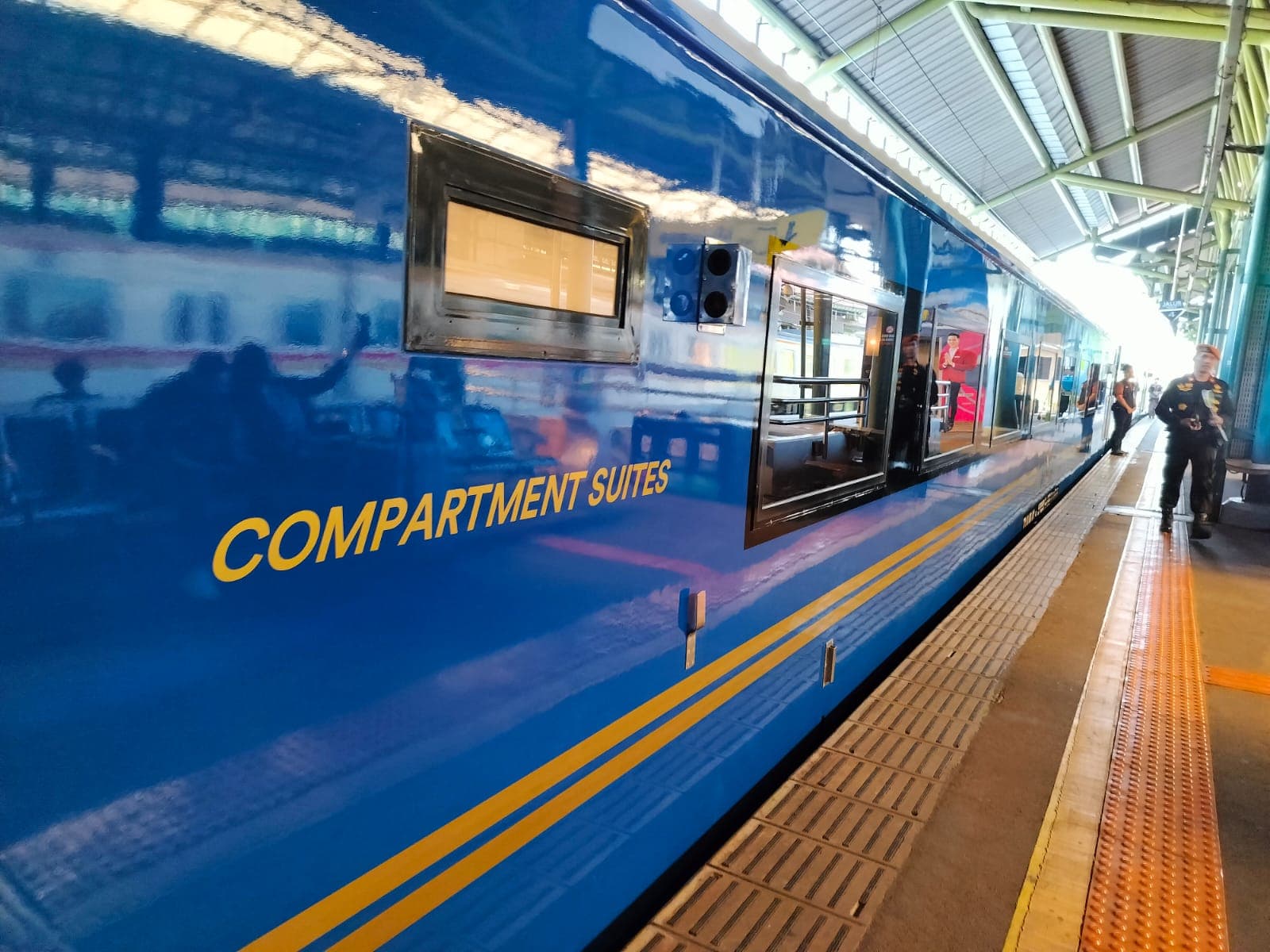
January 2026, Suite Class Compartment Customers Reach 4,273, Growing 74.1 Percent Compared to January 2025
PT Kereta Api Indonesia (Persero) recorded positive performance for its Suite Class Compartment service at the beginning of 2026. Throughout January 2026, the service served 4,273 customers, growing by 74.1 percent compared to the same period in January 2025, which recorded 2,454 customers. Compared with January 2024, which reached 2,255 customers, growth was recorded at 89.5 percent, demonstrating consistently accelerating interest in premium train services.
Vice President of Corporate Communication KAI Anne Purba stated that this trend reflects changes in public preferences for long-distance travel. Customers are increasingly considering personal comfort, privacy, and service quality as important parts of the travel experience, particularly on intercity routes with long travel durations.
The Suite Class Compartment train was first officially launched on October 10, 2023, at Gambir Station. In one trainset, the service features 16 private compartments designed to provide an exclusive travel experience. Each compartment is equipped with an automatic sliding door, a seat reclining up to 180 degrees, massage and seat-heating features, a Train Onboard Infotainment System, as well as comprehensive meal services that support comfort throughout the journey.
Currently, the Suite Class Compartment service operates on KA Bima on the Gambir–Surabaya Gubeng (PP) route, KA Argo Semeru on the Gambir–Surabaya Gubeng (PP) route, and KA Argo Bromo Anggrek on the Gambir–Surabaya Pasar Turi (PP) route. These three routes are strategic corridors with high demand, serving business, family, and tourism travel needs.
From a tourism perspective, the increase in Suite Class Compartment customers is in line with the growth trend in domestic travel. Statistics Indonesia (BPS) data for 2025 shows that domestic tourist mobility continues to increase, particularly along the Jakarta–East Java corridor, which serves as a major link to cultural and culinary tourism destinations as well as MICE (Meeting, Incentive, Convention, and Exhibition) activities. The presence of premium train services strengthens interregional connectivity while supporting a more even distribution of tourism mobility.
Economically, the performance of this service reflects sustained demand from the upper-middle segment as well as increasing added value in the transportation sector. Customer movement contributes to economic activities in destination cities, including hospitality, culinary centers, and travel support services, which play a role in maintaining regional economic dynamics.
Anne added that KAI continues to monitor customer demand patterns as a basis for future service development.
“Suite Class Compartment is part of KAI’s strategy to provide service differentiation and strengthen the position of railways as a preferred mode of transportation for long-distance travel with high comfort standards,” she concluded.
VP Corporate Communication KAI
