
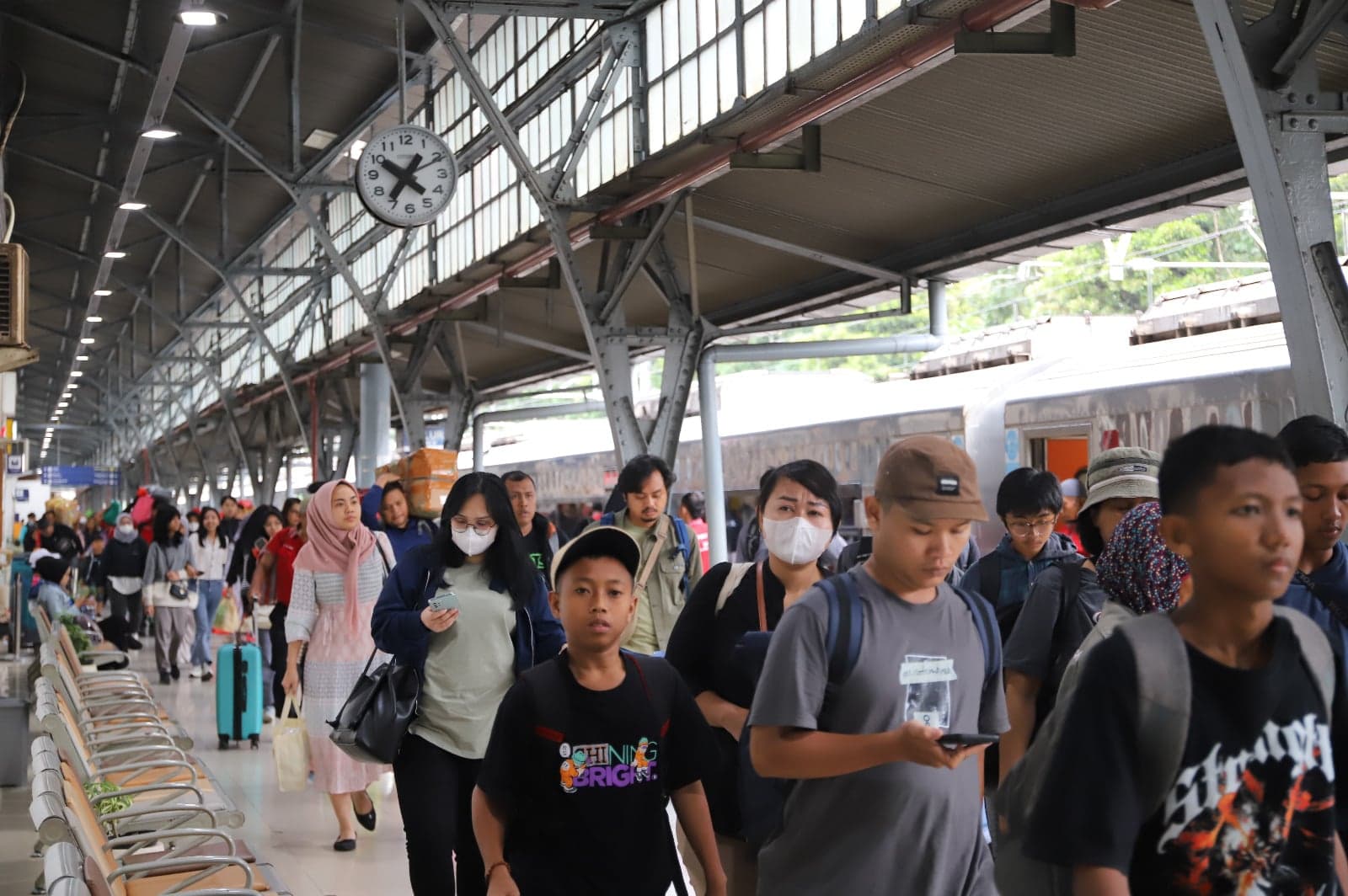
Carrying 47.4 Million Customers Throughout 2025, KAI Long-Distance Trains Keep Carbon Emissions Under Control
PT Kereta Api Indonesia (Persero) recorded total carbon emissions from Long-Distance Train (KA Jarak Jauh/KA JJ) services during the January–December 2025 period at approximately 127,315,192 kg CO₂e. During the same period, Long-Distance Train services served 47,405,539 customers, reaffirming the role of railways as a primary mode of intercity travel with managed emissions characteristics.
Vice President of Corporate Communication KAI Anne Purba stated that this achievement reflects how the growth of public mobility can go hand in hand with carbon emission control. According to her, trains are designed as high-capacity mass transportation with energy efficiency that supports efforts to reduce emissions in aggregate.
As an illustration of intercity travel, assuming an average travel distance of 300 kilometers per Long-Distance Train customer, the total travel activity throughout 2025 was equivalent to approximately 14.22 billion passenger-kilometers (pkm). Based on this calculation, total carbon emissions from Long-Distance Trains were recorded at approximately 127.3 million kg CO₂e, or 127.3 thousand tons CO₂e, over one year of operations.
Anne explained that this amount of emissions demonstrates the efficiency of rail-based transportation, which is capable of carrying large numbers of passengers on a scheduled basis. With high transport capacity, the emissions generated can be distributed among more intercity travelers, thereby keeping cumulative emissions under control.
Under the same scenario, if all Long-Distance Train customers traveled by intercity bus, total carbon emissions are estimated to reach approximately 386.4 million kg CO₂e, or 386.4 thousand tons CO₂e. Meanwhile, if the journeys were made using private vehicles, total carbon emissions are estimated to increase to approximately 2,716.3 million kg CO₂e, equivalent to 2.72 million tons CO₂e.
“This comparison shows that the choice of transportation mode has a significant impact on the accumulation of carbon emissions in the transportation sector. With a large number of customers, the use of trains helps keep emissions more under control compared with other modes,” said Anne.
Furthermore, Anne added that KAI continues to promote improvements in operational efficiency, strengthen passenger occupancy rates, and integrate intermodal services. These measures are aimed at ensuring that the growth of Long-Distance Train services remains aligned with sustainability principles.
“Through consistent and measured management of Long-Distance Train services, KAI is committed to supporting a reliable and efficient national transportation system oriented toward controlling carbon emissions, in line with the growing mobility needs of the Indonesian people,” concluded Anne.
VP Corporate Communication KAI
