
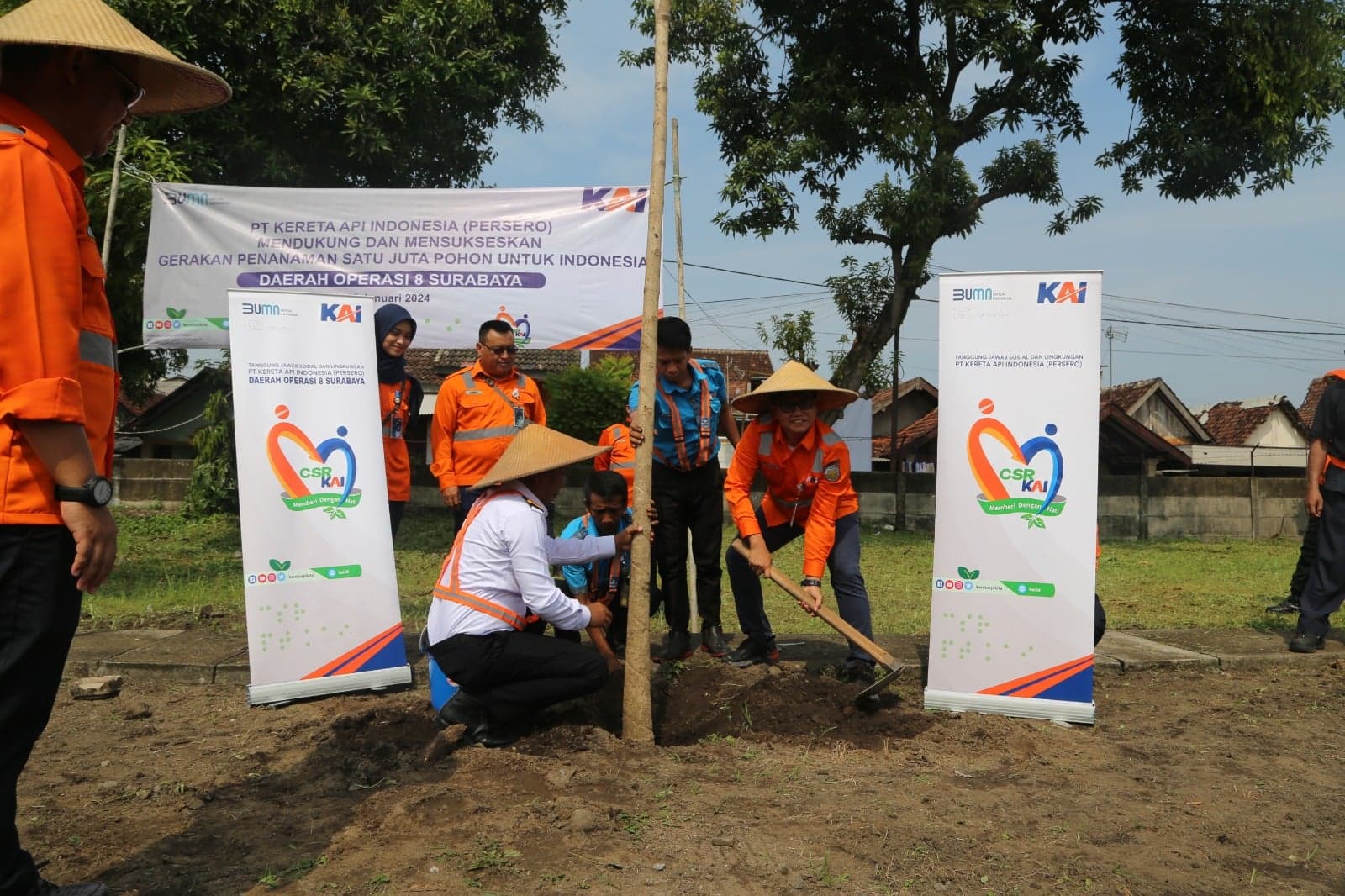
6,989 Trees Planted Throughout 2025, KAI Strengthens Its Role in the National Green Transition
PT Kereta Api Indonesia (Persero) continues to strengthen its active role in supporting the national green transition agenda through sustainable greening programs across various operational areas. Throughout 2025, KAI planted 6,989 trees around stations, along railway lines, in coastal areas, and in residential areas.
This figure increased from 2024, when 6,716 trees were planted. Cumulatively, during the 2021–2025 period, KAI has planted 108,008 trees in various regions across Indonesia. This program is in line with the government’s policy direction under Asta Cita, particularly the pillars of sustainable development and strengthening environmental quality, while also supporting the Net Zero Emission 2060 target.
Vice President of Corporate Communication KAI Anne Purba stated that the greening program is part of the company’s long-term strategy to provide environmentally friendly, sustainable, and future-oriented public transportation services.
“Tree planting not only has an impact on environmental aesthetics, but also directly contributes to increasing water absorption capacity to reduce the potential for standing water and flooding, preventing abrasion in coastal areas, and creating greener and more comfortable public spaces for communities around railway lines and stations,” said Anne.
Throughout 2025, KAI distributed and planted various types of plants, ranging from shade trees and hardwood trees such as banyan, rain tree, mahogany, pule, and ketapang, to fruit trees such as mango, avocado, durian, longan, and jackfruit. In addition, KAI also planted mangroves and sea cypress trees in several coastal areas as part of efforts to maintain coastal ecosystem balance and environmental resilience.
This greening program was carried out through collaboration with local governments, environmental foundations, farmer groups, and communities in various regions, including Central Java, the Special Region of Yogyakarta, North Sumatra, Lampung, and other areas. In mountainous areas, KAI distributed bamboo and sugar palm seedlings to support water resource management, while in residential areas, ornamental plants and productive fruit trees were planted to provide economic benefits to the community.
KAI’s commitment to environmental management is reflected in the S&P Global ESG 2025 assessment, in which KAI recorded an ESG Score of 55 points, an increase of 14 points compared with the previous year, placing the company among the top 20 percent of the global transportation industry.
The improvement in ESG performance was also supported by various other sustainability initiatives, such as the utilization of Solar Power Plants (PLTS) at several stations, strengthening energy and operational efficiency, and the availability of the Carbon Footprint feature on the Access by KAI application, which encourages customer participation in low-emission travel.
“All of these efforts are part of KAI’s ongoing transformation to provide public transportation that is not only safe, reliable, and affordable, but also responsible toward the environment and the future of generations to come, in line with Indonesia’s green development agenda,” concluded Anne.
VP Corporate Communication KAI