
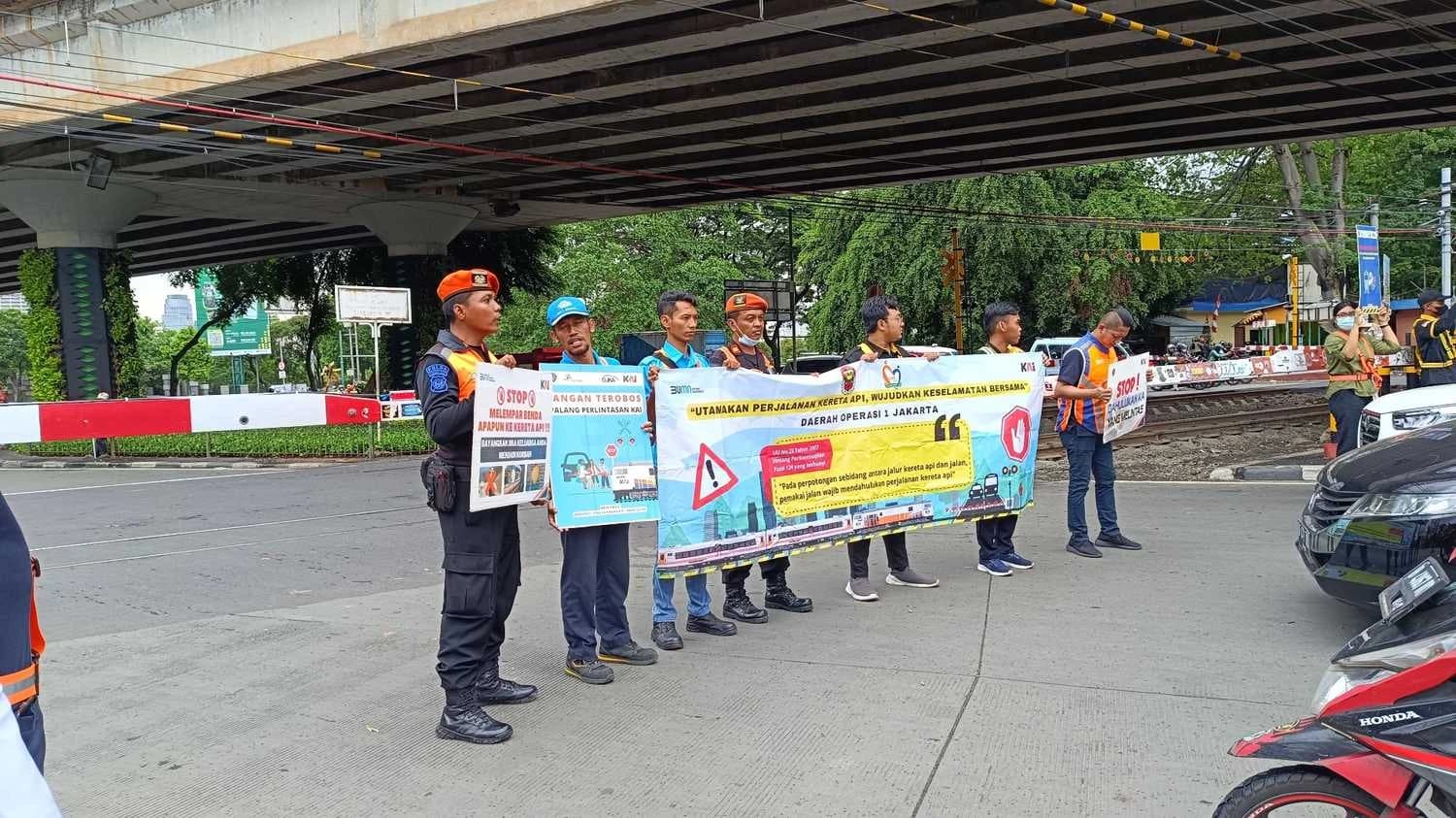
KAI Strengthens Safety at Level Crossings, Calls on the Public to Protect Lives and Promote Shared Safety
PT Kereta Api Indonesia (Persero) emphasizes that every incident at level crossings is a social issue involving discipline, care, and mutual safety. On every train journey, officers perform their duties with full responsibility to protect the safety of thousands of passengers as well as other road users.
Train drivers and assistant train drivers stand on the front lines of railway travel safety. They execute their duties in accordance with established operational procedures and safety regulations. When violations occur at level crossings, the resulting risks can threaten the safety of officers on duty, disrupt train travel, and compromise the safety of road users.
One of the recent incidents occurred on Wednesday (21/1) at 02:47 WIB, when Train 177B (Menoreh) on the Semarang Tawang–Pasarsenen route collided with a truck at level crossing JPL 329 (an official, un-manned crossing) on the Babakan–Waruduwur section at Km 201+400 downstream track. As a result of the incident, the train driver and assistant train driver sustained severe injuries while carrying out their duties, in conditions that threatened their lives.
KAI stresses that railway travel safety heavily depends on the compliance of all road users with rules at level crossings. Every driver is required to exercise caution, obey traffic signs, and prioritize train movement in accordance with applicable regulations. Non-compliance with safety procedures at level crossings has the potential to cause serious risks to both railway staff and the public.
Vice President of Public Relations at KAI, Anne Purba, stated that every incident at level crossings directly impacts human safety.
"Train drivers and assistant train drivers are officers who perform their duties with full responsibility and have families waiting for them at home. Every violation at level crossings risks serious consequences for their safety," said Anne.
Anne emphasized that level crossings are shared spaces that demand awareness and mutual care among road users.
"Stopping briefly, obeying signs, and ensuring safe conditions before crossing are actions that reflect care for human lives," she added.
As a reminder, railway crossings in Indonesia are strictly regulated under national legislation. Road users are obligated to give priority to trains, as stipulated in Law Number 23 of 2007 concerning Railways and Law Number 22 of 2009 concerning Road Traffic and Transport.
Based on safety evaluations up to December 2025, KAI recorded that 276 vulnerable points remain across the entire railway network. To mitigate accident risks, KAI, together with central and local governments, the police, the military, and relevant ministries and institutions, has closed 316 high-risk level crossings as a measure to protect public safety.
In addition to physical security measures, KAI consistently fosters a safety culture through educational approaches. Throughout 2025, KAI conducted 2,016 safety socialization activities around railway lines, 212 school education sessions, installed 687 safety banners, and carried out 655 Social and Environmental Responsibility (TJSL) initiatives around stations and neighboring communities.
"Safety is a social responsibility that must be maintained together. When care declines, risk increases, and human lives are at stake," Anne emphasized.
Closing her statement, Anne once again urged the public to make safety a daily habit.
"Stopping briefly, looking right and left, and ensuring safe conditions before crossing is a simple decision that holds great meaning for the safety of oneself and many others," Anne concluded.
Vice President Public Relations KAI