
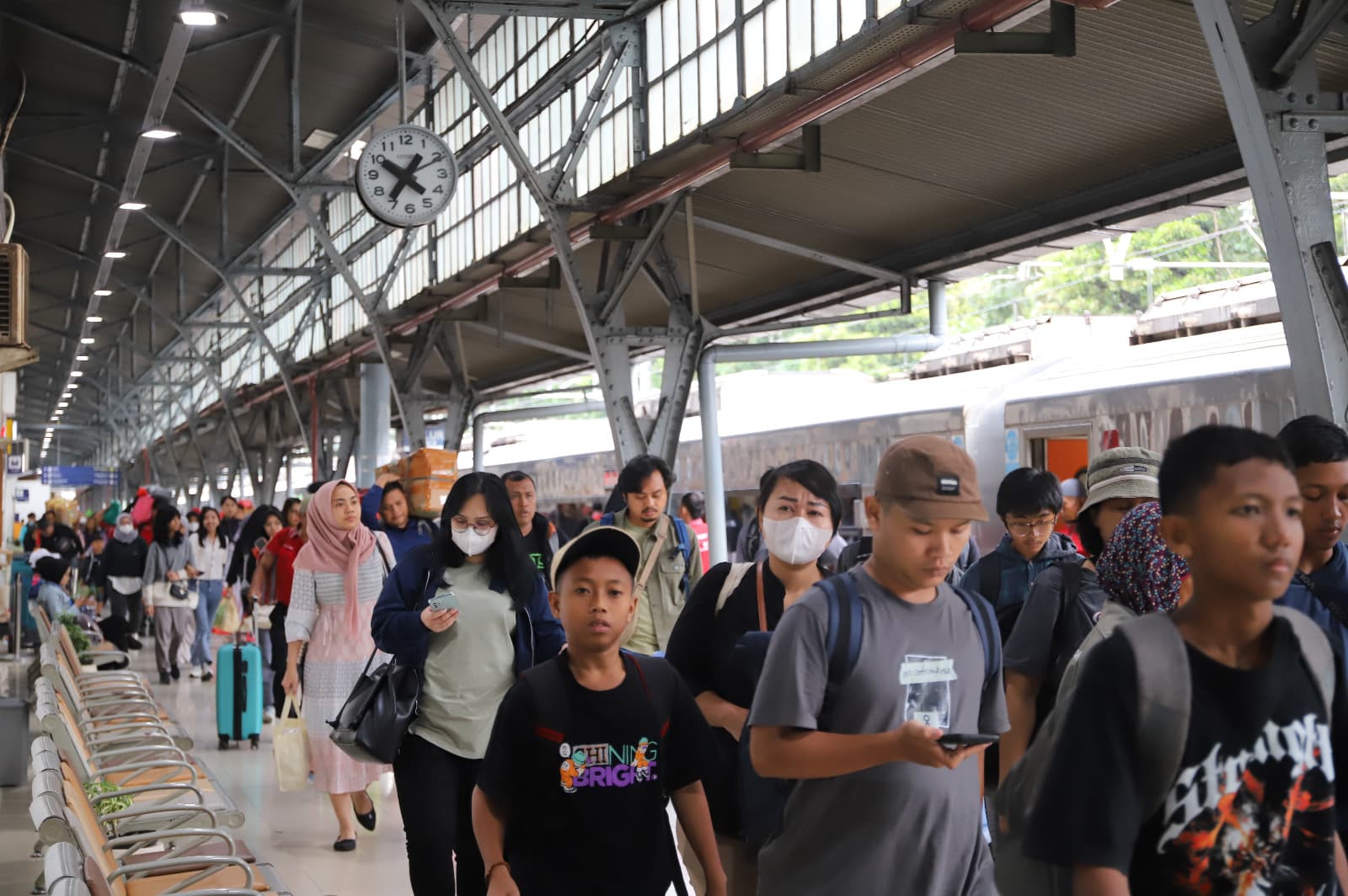
PSO Railway Services Serve 1.1 Million Passengers During the 2025/2026 Nataru Period
The government’s presence in ensuring access to affordable transportation was clearly felt during the 2025 Christmas and 2026 New Year transportation period (Nataru). Through the Public Service Obligation (PSO) scheme, the government and PT Kereta Api Indonesia (Persero) worked together to ensure that public mobility remained safe, comfortable, and inclusive amid high year-end travel activity.
Throughout the period from December 18, 2025 to January 4, 2026, PSO railway services served 1,103,379 passengers, reflecting the strategic role of government subsidy policies in reaching various segments of society. This figure consisted of 676,149 passengers on PSO long-distance railway services and 427,230 passengers on PSO local railway services, both of which increased compared to the 2024/2025 Nataru period.
KAI Vice President of Corporate Communication Anne Purba said that PSO services represent a tangible manifestation of the government’s commitment to providing affordable and equitable public transportation.
“Through the PSO scheme, the government, through KAI, is present to ensure that people can continue to travel safely, comfortably, and affordably, particularly during periods of high mobility such as Nataru,” said Anne.
Overall, during the 2025/2026 Nataru period, KAI served 4,179,095 passengers, an increase of 12.02 percent compared to the 2024/2025 Nataru period, which recorded 3,730,584 passengers. Of this total, long-distance railway services served 3,392,439 passengers, equivalent to 122.9 percent of the capacity of 2,761,048 seats. Meanwhile, local railway services served 786,656 passengers, or 105.6 percent of the capacity of 745,056 seats. The occupancy levels were influenced by dynamic passenger travel patterns, particularly on local railway services, which are characterized by passengers boarding and alighting at numerous stations.
The high level of public mobility during Nataru also contributed to tourism travel, family gatherings, and economic activity in various regions. The availability of affordable railway services through the PSO scheme serves as an important support for the tourism sector, onward transportation, and businesses around stations, ranging from MSMEs to local service providers.
From an operational perspective, railway performance remained well maintained. During the period from December 18, 2025 to January 4, 2026, passenger train On-Time Performance (OTP) recorded departure punctuality of 99.68 percent, while arrival punctuality reached 96.13 percent. This achievement demonstrates KAI’s operational readiness in maintaining service reliability amid a surge in travel volume.
During the Nataru period, KAI also implemented a 30 percent fare discount for commercial economy-class trains, applicable from December 22, 2025 to January 10, 2026, with a total of 1,509,080 seats provided. As of January 5, 2026 at 08:00 WIB, discounted ticket sales had reached 1,524,487 tickets, or 102 percent, indicating strong public interest in affordable railway services.
“This affordable fare policy is in line with the government’s efforts to maintain people’s purchasing power and encourage productive mobility during the holiday period,” explained Anne.
Going forward, KAI will continue to strengthen coordination with the government, particularly the Directorate General of Railways of the Ministry of Transportation, to ensure that PSO railway services continue to operate optimally and that their benefits can be sustained for communities across various regions.
“PSO railway services are not merely transportation services, but also part of the government’s presence in maintaining connectivity, equitable access, and economic activity for the public. KAI is committed to carrying out this responsibility with full accountability,” concluded Anne.
VP Corporate Communication KAI