
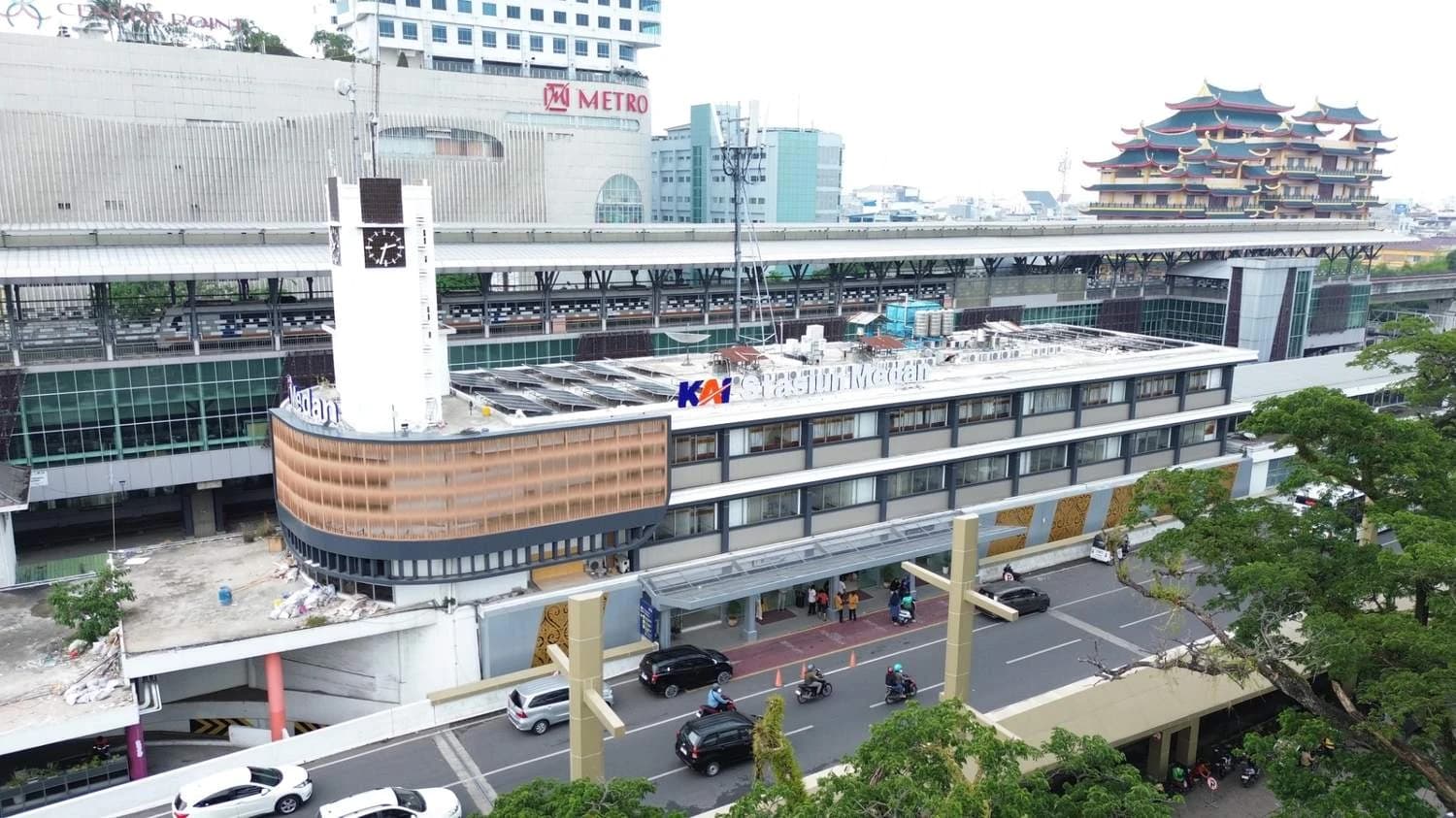
3.82 Million Customers Used Train Services in Sumatra in the First Half of 2026
Mornings at stations across Sumatra present a variety of travel stories. There are workers heading to activity centers, school and university students departing for their studies, traders carrying goods for their businesses, as well as families traveling to visit relatives in different cities.
These journeys take place across the railway network of Regional Divisions in North Sumatra, West Sumatra, Palembang, and Tanjungkarang. From behind the window, passengers can observe urban areas transitioning into rice fields, plantations, rivers, hills, and residential communities.
Throughout the first half of 2026, PT Kereta Api Indonesia (Persero) served 3,818,770 passengers on long-distance and local train services across four Regional Divisions (Divre) in Sumatra. This figure increased by 11.35 percent compared to the same period in 2025, which recorded 3,429,603 passengers.
Vice President of Corporate Communication KAI, Anne Purba, stated that this increase reflects the significant demand for rail-based travel across various regions in Sumatra.
“Railways have become part of people’s daily activities for work, education, trade, business operations, visiting family, and tourism. Each region has its own travel characteristics, all of which must be served with a priority on safety, punctuality, and comfort,” said Anne.
Passenger growth was recorded across all KAI Regional Divisions in Sumatra. Divre I North Sumatra served 1,390,985 passengers, an increase of 4.7 percent compared to 1,328,370 passengers in the first half of 2025.
Divre II West Sumatra recorded 1,142,466 passengers, up 17.6 percent from 971,845 passengers. This percentage represents the highest increase among the four Divre in the first half of 2026.
Meanwhile, Divre III Palembang served 603,967 passengers, an increase of 10.8 percent compared to 545,326 passengers. Divre IV Tanjungkarang recorded 681,352 passengers, up 16.7 percent from 584,062 passengers.
The increase across all regions indicates that the need for rail-based travel exists across diverse geographical characteristics and community activities. In North Sumatra, rail services support intercity travel as well as mobility toward Medan and its surrounding areas.
In West Sumatra, railway services are part of community travel toward Padang city center, educational areas, business locations, Minangkabau International Airport, as well as tourist destinations along coastal and hilly regions.
In the service areas of Divre III Palembang and Divre IV Tanjungkarang, railways support intercity travel in southern Sumatra. Passengers come from various needs, ranging from work, education, trade, family visits, to tourism.
“Data from each Divre shows that railways are closely integrated with people’s daily lives. Some passengers use them daily, some travel between cities, and others choose trains to enjoy journeys with their families,” Anne added.
KAI’s operational areas in Sumatra are managed through Divre I North Sumatra, Divre II West Sumatra, Divre III Palembang, and Divre IV Tanjungkarang. This regional network serves community needs according to the characteristics of each area and operational routes.
On certain routes, trains provide access to government centers, business districts, markets, schools, universities, healthcare facilities, airports, and tourist areas. This connectivity helps people carry out social and economic activities with planned travel schedules.
Passenger experience is also shaped by the scenery along the journey. In West Sumatra, travel may be accompanied by stretches of rice fields, hills, and community life along the railway. In North Sumatra, passengers pass through urban areas, plantations, and settlements connecting Medan with surrounding regions.
On southern Sumatra routes, journeys present landscapes of plantations, rivers, rice fields, and cities that serve as activity centers. Each region offers a distinct visual experience shaped by its landscape and community life.
“Rail travel provides passengers with the opportunity to see Sumatra from a unique perspective. The scenery along the route becomes part of the travel experience, while stations connect passengers with various activities in their destination cities,” said Anne.
The 11.35 percent passenger growth in Sumatra exceeds the overall increase in KAI’s long-distance and local train passengers. Nationally, the number of passengers increased by 8.7 percent, from 27,463,553 passengers in the first half of 2025 to 29,858,243 passengers in the first half of 2026.
According to Anne, this development must be accompanied by capacity management, rolling stock readiness, infrastructure reliability, staff competence, cleanliness, and the delivery of clear travel information to passengers.
“Increasing volume must be balanced with the readiness of all service elements. Safe and comfortable journeys are built through rolling stock inspections, track maintenance, operational management, staff readiness, and passenger service from the station to arrival at the destination,” Anne stated.
Service performance in Sumatra is also related to the direction of national railway development. President of the Republic of Indonesia, Prabowo Subianto, has positioned the railway system as one of the government’s priorities and has directed that railway networks be expanded across various regions. The President also emphasized the importance of proper planning for the Trans Sumatra Railway alongside network plans in Kalimantan and Sulawesi.
KAI views operational service data as a source of insight into travel patterns. Passenger data, regional characteristics, readiness of facilities and infrastructure, safety aspects, and connectivity with other modes are important components in discussions on strengthening connectivity.
Railway network development is an agenda that requires comprehensive study and collaboration between the government, KAI, regional governments, and stakeholders. Each region has different geographical conditions, travel needs, and infrastructure readiness.
“Existing services provide an overview of community needs in each region. This data is important to enrich discussions on connectivity, service capacity, safety, and travel integration in Sumatra,” Anne added.
At the global level, 2026 marks the beginning of the United Nations Decade of Sustainable Transport 2026–2035. The United Nations places transport as a supporter of various development goals, including resilient infrastructure, economic growth, trade, supply chains, energy efficiency, and climate change mitigation. This agenda encourages sustainable, inclusive, and resilient transport systems through collaboration among stakeholders.
For Sumatra, the increase in passengers indicates significant potential for rail-based public transport to support public access to social and economic activities. Services with large capacity and planned schedules can support regional mobility according to the needs of each area.
“The increase in passengers across all Divre in Sumatra serves as encouragement to continue maintaining safe, reliable, comfortable, and user-friendly services. Strengthening the railway sector also requires collective efforts so that its benefits can be increasingly widespread for society and regional economies,” Anne concluded.
VP Corporate Communication KAI