
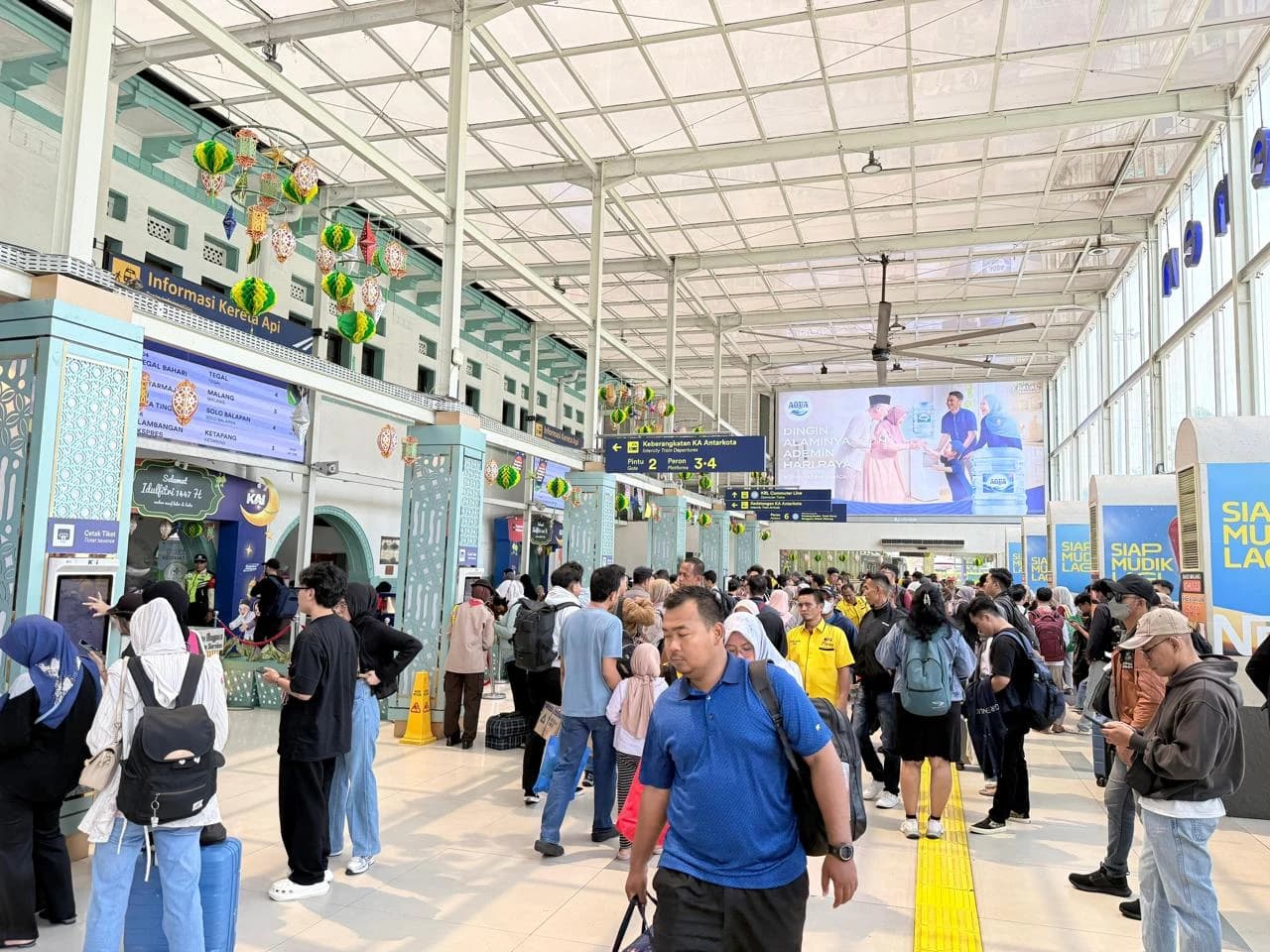
With 3.15 Million Customer Movements by May 2026, Pasar Senen Will Become KAI's Busiest Long-Distance Train Station in Indonesia
PT Kereta Api Indonesia (Persero) recorded Pasar Senen Station as the long-distance train station with the highest number of boarding and alighting passengers on KAI services from January to May 2026. During that period, Pasar Senen Station served 3,155,845 long-distance train passenger movements, consisting of 1,670,428 boarding passengers and 1,485,417 disembarking passengers.
KAI Vice President of Corporate Communications Anne Purba stated that the high number of passengers at Pasar Senen Station demonstrates the station's important role as an intercity travel hub from Jakarta to various regions on the island of Java.
"Pasar Senen is a strategic hub for intercity mobility in Indonesia. Data from January to May 2026 shows that this station plays a significant role, serving a high volume of long-distance travel and connecting commuters and urban public transportation."
On a monthly basis, long-distance train passenger movements at Pasar Senen Station were recorded at 622,763 in January, 492,511 in February, 783,962 in March, 613,383 in April, and 643,226 in May 2026.
This figure places Pasar Senen above several other major stations during the same period, such as Gambir (2,603,087), Yogyakarta (2,574,177), Semarang Tawang (1,736,897), and Surabaya Gubeng (1,547,309).
Anne explained that Pasar Senen's strong character lies in its service to a wide range of travel segments, from families, workers, students, tourists, small business owners, and even those who rely on trains as their primary means of transportation to various cities.
"For many customers, Pasar Senen is a convenient, convenient, and connected starting point for their journeys. KAI continues to ensure that customer flow at this station runs smoothly, from arrival at the station, through the boarding process, through travel information, and through to train departure."
In addition to serving long-distance trains, Pasar Senen Station also serves the Cikarang/Bekasi Commuter Line. The travel patterns through Pasar Senen include Bekasi/Cikarang–Pasar Senen–Kampung Bandan and Kampung Bandan–Pasar Senen–Bekasi/Cikarang.
From January to May 2026, 1,509,193 Commuter Line users at Pasar Senen Station were recorded, consisting of 706,562 gate-in customers and 802,631 gate-out customers. On a monthly basis, the Commuter Line user volume in Pasar Senen reached 311,994 in January, 262,895 in February, 382,015 in March, 272,160 in April, and 280,129 in May 2026.
During the same period, the Cikarang Line served 36,294,605 users, consisting of 7,483,175 in January, 6,871,690 in February, 7,362,799 in March, 7,466,071 in April, and 7,110,870 in May 2026.
"Integration with the Cikarang/Bekasi Commuter Line makes it easier for customers from Bekasi, Cikarang, Jatinegara, Kampung Bandan, and other areas of Jakarta to access long-distance trains via Pasar Senen. This connectivity makes the journey to the station more convenient." "This is efficient, especially for customers who choose public transportation from the start of their journey."
The connectivity of the Pasar Senen Station area is also supported by Transjakarta access at the Senen Bus Stop. Available services include BRT 2 Pulo Gadung–Monas, route 2A Pulo Gadung–Rawa Buaya, route 7F Kampung Rambutan–Juanda via Cempaka Putih, BRT 14 Jakarta International Stadium–Senen, and route 14B Tanjung Priok–Senen via JIS.
With this access, long-distance train customers can continue their journeys to the city center, residential areas, commercial centers, educational areas, tourist destinations, and other community activities more easily.
From a demographic perspective, Pasar Senen Station is located in the Senen District, Central Jakarta. According to BPS data in the Senen District in Figures 2025, the population of Senen District in 2024 reached 119,457 people, consisting of 60,405 males and 59,052 females.
Senen District consists of six urban villages: Kenari, Paseban, Kramat, Kwitang, Senen, and Bungur. Kramat Village has the largest population, with 33,821 people, followed by Paseban (27,694), Bungur (20,954), Kwitang (18,029), Kenari (11,200), and Senen (7,759).
The Senen area also boasts strong economic activity and accommodations. Statistics Indonesia (BPS) recorded that Senen District had 25 hotels and 14 guesthouses in 2024. All urban villages in Senen District also have land transportation infrastructure with fixed-route public transportation.
"Pasar Senen's strength lies in its intersection of intercity, commuter, commercial, accommodation, and urban transportation functions. Therefore, KAI continues to strengthen service flow, travel information, cleanliness, security, and coordination with stakeholders in the Senen area."
KAI urges customers departing from Pasar Senen Station to arrive early, double-check their travel schedules via Access by KAI, prepare their identification, pay attention to staff announcements, and look after their belongings while in the station area.
"KAI is committed to providing a safe, comfortable, and orderly journey for all customers. With such a large volume of passengers, customer discipline and service readiness are key to ensuring a smooth journey from Pasar Senen,"
VP of Corporate Communications