
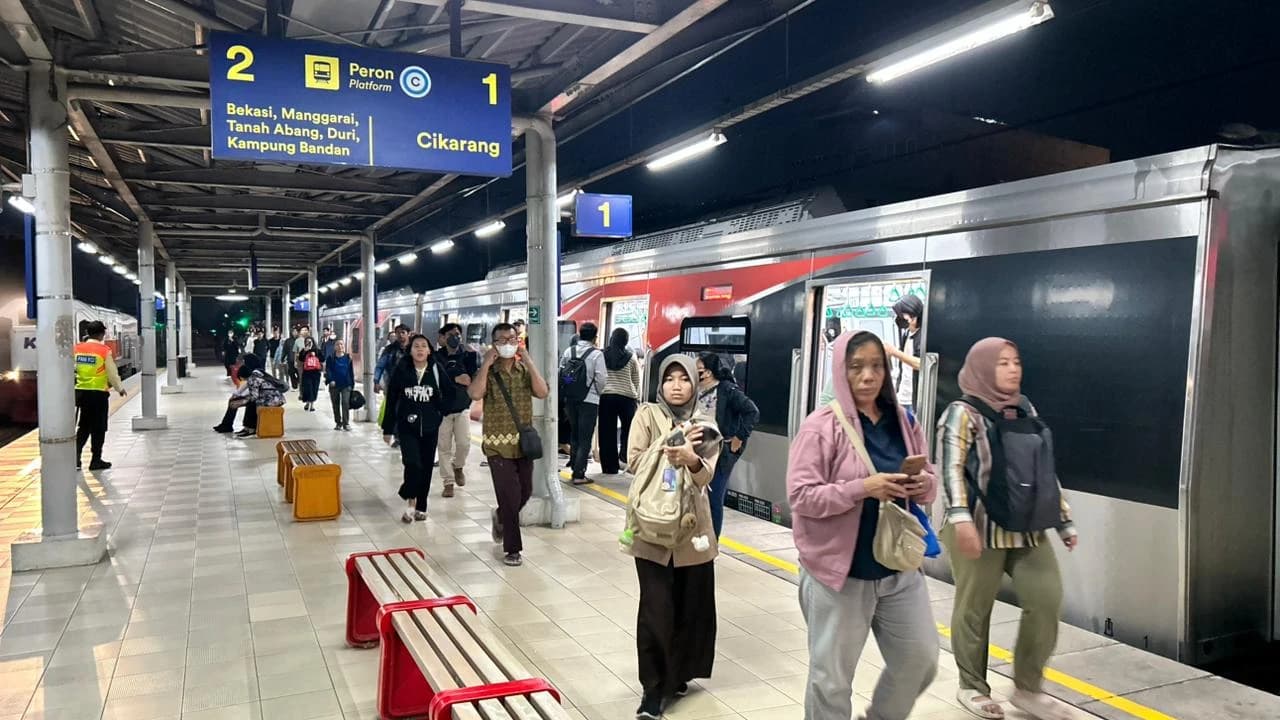
210.47 Million Commuter Line Jabodetabek Passengers Strengthen Productivity and Low-Carbon Mobility
PT Kereta Api Indonesia (Persero) served 210,468,029 Commuter Line Jabodetabek passengers throughout January–July 2026. This figure increased by 6.39 percent compared with the same period in 2025, when 197,833,176 passengers were served.
Over the past four years, Commuter Line Jabodetabek usage during the January–July period has shown consistent growth. The number of passengers reached 161,004,449 in 2023, increased to 186,056,667 in 2024, reached 197,833,176 in 2025, and rose to 210,468,029 in 2026.
Compared with January–July 2023, the number of passengers during the same period this year increased by 49,463,580, or 30.72 percent. This development demonstrates the growing role of mass transportation in supporting economic and social activities in Indonesia's largest metropolitan area.
Vice President Corporate Communication KAI Anne Purba said that Commuter Line Jabodetabek helps people carry out their daily activities more efficiently. Each journey connects residential areas with employment, education, commercial, healthcare, and public service centers.
“A total of 210.47 million passengers used Commuter Line Jabodetabek during the first seven months of 2026. Behind this figure are people's journeys to work, study, run businesses, meet family needs, and access public services. The reliability of mass transportation plays a direct role in maintaining productivity across Jabodetabek,” said Anne.
The large passenger volume also demonstrates the benefits of rail-based transportation capacity in managing urban mobility. A single train formation can serve many passengers in one journey, making the use of space, energy, and urban infrastructure more efficient compared with individual trips using private vehicles.
Commuter Line provides travel certainty for workers and students, expands access to economic opportunities, and connects communities in surrounding areas with activity centers in Jakarta and its surroundings. This connectivity helps maintain the smooth flow of people's activities while reducing traffic congestion.
“Reliable public transportation provides greater opportunities for people to access employment, education, and business activities. Residents can live in surrounding areas while remaining connected to various activity centers, allowing economic benefits to be distributed more widely across Jabodetabek,” said Anne.
The benefits of using Commuter Line can also be seen from an environmental perspective. Based on an illustration in the KAI 2025 Sustainability Report, a 30-kilometer Bekasi–Jakarta journey by train generates approximately 2.4 kilograms of CO₂ emissions per day.
Over the same distance, a journey by private car generates approximately 12 kilograms of CO₂ per day. The emissions difference reaches 9.6 kilograms of CO₂, meaning that using a train in this illustration can reduce the daily carbon footprint by approximately 80 percent.
The same report states that passenger trains produce approximately 41 grams of CO₂ per passenger per kilometer, while private vehicles produce approximately 192 grams of CO₂ per passenger per kilometer. This characteristic makes rail-based transportation an important instrument for reducing emissions from the transportation sector and supporting low-carbon urban development.
“Daily transportation choices will shape long-term environmental impacts. When millions of people use Commuter Line, the benefits can be seen through lower travel emissions, reduced energy consumption, and less pressure from vehicles on roads,” said Anne.
KAI continues to strengthen service capacity and quality by improving the reliability of railway facilities, enhancing station facilities, adjusting train operations based on passenger needs, strengthening electrical and signaling systems, and integrating services with other modes of public transportation.
In 2026, the Commuter Line Jabodetabek network serves 85 stations, up from 71 stations in 2015. This network expansion strengthens access for communities in surrounding areas to activity centers while supporting the development of residential areas and new economic centers.
The growth in mobility is also reflected in Commuter Line Cikarang, which serves the Bekasi area and the eastern corridor of Jabodetabek. Passenger volume on this corridor increased from 55.66 million trips in 2022 to 84.53 million trips in 2025. Over three years, the number increased by approximately 28.87 million trips, or 51.86 percent.
In 2025, Commuter Line Cikarang contributed 24.53 percent of the total Jabodetabek KRL passenger volume. This achievement made it the second-largest corridor by passenger volume after Commuter Line Bogor. Its growth demonstrates the significant demand for travel from Bekasi, Cikarang, and the eastern areas to activity centers in Jakarta.
This increase further underscores the need to develop capacity along the eastern corridor, including improving the reliability of railway facilities, electrical systems, signaling, and station facilities, optimizing train operations during peak hours, and completing infrastructure development to support the separation of Commuter Line services from other railway services.
“The growth of Commuter Line Cikarang shows that public transportation has become a key need for communities in eastern Jabodetabek. Strengthening services along this corridor will help maintain productivity, expand economic access, reduce the burden on roads, and provide environmental benefits for a rapidly developing area,” said Anne.
According to Anne, the increase in passenger numbers provides a basis for KAI to continue developing capacity gradually while prioritizing safety, reliability, punctuality, comfort, and crowd management.
“Strengthening Commuter Line Jabodetabek is an investment in community productivity, urban efficiency, and environmental quality. KAI will continue to support the Government's policies to expand the use of mass transportation and accelerate low-carbon development toward Indonesia's Net Zero Emission target by 2060,” concluded Anne.
VP Corporate Communication KAI